The bonus of the book “Stay or Leave?”
The Crossroads Workbook.
You read the chapter, you liked the tool, and in three days it will be gone. That’s why the Workbook exists: every tool from the book, ready to fill in here, while you still have it fresh. What you write saves on your device and stays yours. And at the bottom the full loop is waiting: ten moves, from the doubt to the signature.
You’ll find it in the book, on the Crossroads Workbook page, at the back: it’s printed big. Spaces and dots don’t count.
Don’t have the book yet?
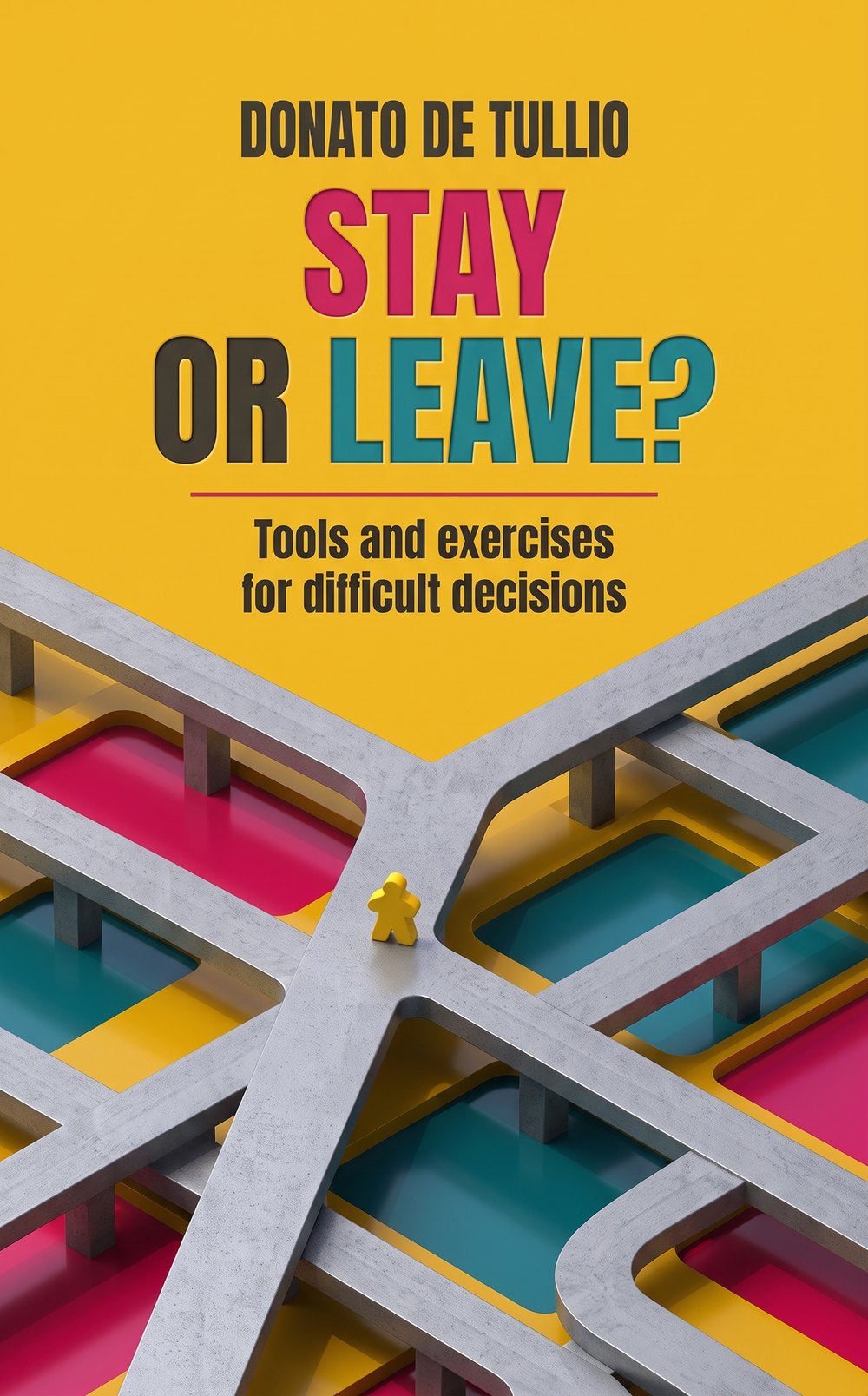
The workbook is the digital companion of “Stay or Leave?”: tools and exercises for difficult decisions. The English edition is on Amazon now, in Kindle and paperback, and so is the Italian one. Every copy opens the Crossroads Workbook, where all the tools can be filled in like this one.
Welcome to the workbook
You made it. Now the work starts.
In here you find two things. The crossroads path, the map of the whole book in ten moves, to run on your real crossroads. And the toolbox, chapter by chapter, with the tools ready to fill in when you need them.
One recommendation, the same one the book makes: don’t use them all. At a crossroads you don’t need twenty techniques, you need two or three. Pick the ones that speak to your case today and leave the others alone. Using them all at once is the surest way to recreate the paralysis of the forty-seven kinds of bread.
The 5D Method, in five lines
Data. What is true, net of the stories you tell yourself.
Direction. Which field it makes sense to move in (not yet the precise goal).
Decision. Which road you choose, and what not choosing costs you.
Destination. The precise point you want to reach, fixed with a date.
Desire (the hidden D). What you really want, underneath what adds up.
Every tool in this workbook serves one of these five Ds: it’s written on every move. The full method is in the book, chapters nine to thirteen: one chapter per D.
What you write here doesn’t reach me and doesn’t reach anyone: it lives only in the browser of this device. That’s why at the bottom of the page you find the backup: if you change phone or computer, you take the workbook with you. And if you clear your browser data, the workbook empties: download it every now and then.
The special exercise
The crossroads path, in ten moves.
It’s the full loop from chapter fifteen, on your own crossroads: the ten moves cross the five Ds of the method, one after the other, all the way to the signature. If you already filled in the exercises in the chapters, here you just copy them over. Write, close, come back whenever you want: the workbook keeps your place.
Filter.
First of all, the 72-hour test: the doubt that fades after a few days was a bad day, the doubt that stays is a signal. And you show up at a crossroads rested.
If one of the two boxes stays empty: rest first, or let the doubt go and come back in three days. The workbook will wait.
Orient yourself.
Ten minutes of writing about your most important value, without even naming the decision: you’re just reminding yourself who decides. Then the two questions from chapter eight.
Look at the facts.
One page, four columns. Memory tells you a story: before you decide on it, check the facts.
Optional, but it’s the number that weighs the most: real savings divided by one month of expenses.
Under three months, stop: this crossroads does not get signed, it gets postponed with a date. Fuel first, then the road. Run the real numbers: savings divided by one month of expenses.
The loop does not end here. At move ten you can sign the condition: a fact and a date.
Widen.
You don’t need to know where you’ll end up: you need to know which field to play in. And the real options are almost always more than two.
If you can’t name at least three things it excludes, it’s too vague: rewrite it.
Now close the two obvious doors: if I could do neither A nor B, what would I do? At least three roads.
Weigh the door.
Look at the road you’re leaning toward and ask yourself: if six months from now I find out I was wrong, can I go back? At what price? Almost every “last chance” is a two-way door in disguise.
Decide.
You marked a two-way door: here you finished before you started. The 70% rule, a date below, and on to move seven.
The pre-mortem: jump one year ahead and declare it dead. Not “it could go wrong”: it went wrong, it’s a full-blown failure. Write the autopsy, without mercy and without defending yourself. The more ruthless you are now, the safer you are later.
A real date, close, written down. Without a date, the analysis starts over tomorrow, and you know it. And make sure you’re rested that day.
Set the destination.
One sentence: field plus precise point plus deadline. If the date is missing it’s not a destination, it’s a wish.
Then three if-thens, as concrete as possible. At least one dedicated to the biggest risk from your pre-mortem: it showed you where you’ll fall, the if-then puts the mattress exactly there.
And the basics check: the three practical things without which your destination doesn’t stand up (the months of notice, the money set aside, the paperwork, who picks up the kids on Tuesday). Checked one by one.
Dig.
The destination is perfect on paper and still feels blurry in your chest? You’re not impossible to please: the hidden D is missing. Unmask the fear, flip the coin, and then go back to move six with the answer. If instead it already feels yours, skip this move and go to nine.
Then unmask the biggest fear, in three columns:
The thirty-second trick: assign the two roads to heads and tails and flip. The coin doesn’t decide anything: while it’s in the air, listen to what you hope comes up.
Check.
Big decisions can’t be delegated, but they aren’t made alone. Before you sign, two checks.
My council of the wise: 3 to 5 people, chosen for values and role, not for affection. Next to each, the reason I choose them.
Protect and record.
Your crossroads has two exits, and they need different kinds of protection.
Two or three concrete conditions that, if they show up, reopen the decision. Staying with the warning lights on is a choice that renews itself; staying without them is just hoping things change on their own.
And if the signature doesn’t come? You haven’t failed the loop. “Not yet” is a decision too, on one condition: it needs a fact and a date.
The condition is worth as much as a signature. You reread it on that date, not before.
You came in with one line. You leave with a page.
This is your path, all in one place. Download it: it’s your document, to reread on the check date.
There is no right choice. There is your choice, made with a method and sustained over time.
And if the signature doesn’t come? You haven’t failed the loop. “Not yet” is a decision too, on one condition: it needs a fact and a date. You write it at move ten, in place of the plain signature.
Want to reread your page with someone who knows crossroads well? Thirty minutes, a coffee, no strings attached.
The toolbox, chapter by chapter
The tools from the book, ready to fill in.
Fifteen tools, in the same order as the chapters. In every card: the tool, the 5-minute move, the line to take home and the rule of the chapter. The tools from Part C live inside the path above: their cards take you to the right move. Everything you write saves by itself.
Part A · The little voice
Ch. 1The 72-hour test+
When a doubt bites you, do nothing. Write one line: what you feel, what day it is. Wait three nights, living your normal life. If it’s gone, it was tiredness. If it’s still there, it’s a signal.
The 72-hour test. When a doubt bites you, write one line and wait three nights. If it’s still alive, it’s a signal; if it’s gone, it was tiredness. And don’t throw that line away: you’ll need it right away, in the next chapter.
To take homeThe doubt is not a flaw to silence. It’s the signal that two voices inside you disagree, and the bigger the choice, the louder the noise.
The doubt that fades after a few days was a bad day. The doubt that stays is a signal.
Ch. 2The count and the three lists+
Count your decisions for three days, then split them into three lists. Take everything you can off the pile: every yes to a decision that doesn’t matter is a no to one that does.
Tonight pick ONE decision that repeats every day (breakfast, clothes, menu) and turn it into a fixed rule for a week. When you want the full version: count your decisions for three days and split them into the three lists.
To take homeOn an empty tank you decide badly, and from the inside you don’t notice: you feel weak, you’re just drained. You tell tiredness apart from real doubt with three nights of sleep.
Every yes to a decision that doesn’t matter is a no to one that does.
Ch. 3The smallest possible first step+
Take the thing you keep postponing because “you don’t feel ready” and shrink it until confidence is no longer required. The right size: it makes you a little uncomfortable and you can do it by tomorrow.
Write the smallest first step for your crossroads (it must make you a little uncomfortable and fit within tomorrow) and put it in your calendar now, with a time on it.
To take homeThe boy at the intercom never started believing in himself: he put proof in the archive, one piece at a time, until confidence arrived on its own. Waiting for it before acting means waiting for the archive of things you haven’t done yet.
Confidence comes later. First, you set off.
Ch. 4The evidence file+
One fixed place where you record every result as a fact: date and fact, no comments, no adjectives, no “but that was luck”. When the impostor’s voice says you’re not good enough, don’t argue: open the file and read. And fill it in right away, on the day the thing happens.
The first entry in the file, now: the date and one win from this week, no comments. From today on, you fill it in the same day.
To take homeIn twenty years the voice has never been right: it has only changed subject at every step up. The problem isn’t hearing it, it’s letting it keep the books.
Don’t argue with the voice: open the file.
Ch. 5The tank check-up+
Once a month, five scores from 1 to 10. Above 35 points the tank holds; between 25 and 35, lighten the load; below 25, stop and recover before deciding anything big.
Total: 25/50 ·
The check-up, now: five scores from 1 to 10 and one sum, right on this page. Below 25, the crossroads waits: first you recover, then you decide.
To take homeBurnout arrives like water rising, one centimeter a day, and from the inside you don’t notice: the measuring instrument is the first part to switch off.
Past the breaking point you don’t decide. You recover.
Ch. 6The 10/10/10 rule+
How will I feel about this in 10 minutes, in 10 months, in 10 years? At 10 minutes the ego speaks, at 10 years your values speak. If a choice seduces you only in the first ten minutes, it’s the ego: and the ego never asks how you’ll feel, it asks how you’ll look.
On the road that tempts you most. Then, a couple of days later, redo it on the other road.
The 10/10/10 on your crossroads, in writing: how will I feel in ten minutes, ten months, ten years? If all the appeal sits in the first ten minutes, it’s the ego voting.
To take homeIn the decision room there are three voices: the heart, the mind, and an intruder in disguise. You recognize the ego because it always asks how you’ll look, never how you’ll feel.
The ego never asks how you’ll feel. It asks how you’ll look.
Part B · The compass
Ch. 7The values compass, in three steps+
Step one: the values you act on. Start from the facts, not from the list of nice values. Your last five important decisions: what was each one protecting?
Step two: the values you want at the wheel. Before looking at any list, question your emotions: they know where the values are.
And the fact check that never lies: your calendar and your bank statement for the last three months. Where do your free time and your free money end up? Those are values in action, whether you chose them or not.
Then pull out your four. Not ten: four. And for each one an operational line: what does a person who lives this value actually do? “Family” is not enough: “I have dinner with my kids at least five evenings a week” is a value with legs.
Step three: the filter, from today. At every crossroads, including yours, the question becomes simple: which option lets me live more of my four values? And for the scores: how much could each of your four values breathe on each road, from one to ten? It isn’t math, it’s an X-ray.
Need a vocabulary? The list of values is at the back of the book.
Take ONE recent decision and write down what it was protecting. Then the question that stings: did I choose that value, or did it come pre-installed?
To take homeYour values are what your decisions protect, not what you say you care about. And at every age we believe we’re the final version of ourselves: that’s why nobody updates the GPS.
Values need updating. Like the GPS.
Ch. 8The eighty-year-old test+
Imagine you’re 80 and look back. Not which road paid more: which one will make you say “too bad, I wish I had tried”? You’re not choosing between two roads, but between two versions of you.
The two lines, in writing: if I choose A I become someone who… if I choose B I become someone who… Then the question: which of the two do I like? The two lines are in move two of the path.
To take homeUnderneath the options there are identities. And your future self, to the brain, is almost a stranger: that’s why we dump today’s comfortable choices on him.
You’re not choosing between two roads, but between two versions of you.
Part C · The 5D Method
Ch. 9Data · the facts page, the journal and the outside view+
What is true, net of the stories you tell yourself. You fill in the facts page in move three of the path. And the decision journal, the one Kahneman told people to keep, is in chapter nine of the book, and you write the journal page at move ten of the path, to reread on the check date.
The three questions to keep in your pocket, even before the workbook: am I remembering or am I imagining? Did this feeling arrive in under three seconds? And how did it go, in fact, for two or three people who already took this road?
The first page of the journal, now, on your crossroads: what I’m deciding, why really, what I expect, how I feel. Reread it in six months: it’s the only honest mirror you have.
Instead of asking how it will go for you, go and ask how it went for them. Three people who already walked the road of your crossroads, with different outcomes: one it went well for, one it went badly for, one in between. Three questions: what does a normal day look like? What would you have wanted to know first? What did it cost you that nobody had told you?
To take homeMemory is not an archive, it’s a film director: it cuts the scratches and turns up the colors, on the past you miss as much as on the future you dream of. The facts have to be hunted down on purpose, by writing them.
Memory tells you a story. Before you decide on it, check the facts.
Ch. 10Direction · the field and the hidden options+
The direction in one sentence that excludes something, and then the question that cracks open the fake crossroads: if I could do neither A nor B, what would I do? You fill them in in move four of the path.
The Heath brothers’ question on your crossroads: if I could do neither A nor B, what would I do? Write at least one road C, now.
To take home“Stay or leave” is almost always a fake crossroads: seven decision-makers out of ten look at a single option, and fail one and a half times more often. You don’t need the precise goal: you need the field, and you recognize a field by what it excludes.
You don’t need to know where you’ll end up. You need to know which field to play in.
Ch. 11Decision · the door, the pre-mortem and the 70%+
Weigh the door: if it’s a two-way door, decide at 70% with a date. If it’s a one-way door, pre-mortem: declare it dead one year from now and write the autopsy. They are moves five and six of the path.
Weigh the door of your crossroads: if six months from now I find out I was wrong, can I go back? At what price? If it’s a two-way door, 70% and a date are enough. If it’s one-way, pre-mortem.
To take homeAt some point analyzing paralyzes, and not deciding is already a decision made by fear. But almost all doors are two-way doors dressed up as a last chance: and twenty thousand genuinely undecided people, six months after changing, were happier.
Not deciding is already a decision. Make sure your decisions belong to you.
Ch. 12Destination · the formula and the three if-thens+
Field plus precise point plus deadline, and three if-thens with the mattress under the biggest risk. It’s move seven of the path.
Fill in the formula on your crossroads: inside the field of…, I do…, by… Plus one if-then on the biggest risk from your pre-mortem.
To take homeA choice, on its own, is still an intention, and intentions die in February. The destination is the precise point with a date on it.
A dream without a date is just a wish. Put a date on it.
Ch. 13Desire · the fear map and the coin+
For when the destination is perfect on paper and still doesn’t convince you: unmask the fear, remove the audience, and flip the coin that doesn’t decide. It’s move eight of the path, coin included.
The coin that doesn’t decide: heads and tails on the two roads of your crossroads, flip it, and listen to what you hope for while it’s in the air. That is the answer of desire.
To take homeWhen everything checks out on paper and you stay unlit, you’re not impossible to please: the hidden D is missing. And the fear that covers it cheats: we overestimate the pain of the worst scenarios, in intensity and in duration.
Data tells you what adds up. Only desire tells you what you want.
Part D · The life you build
Ch. 14The council of the wise and the best-friend question+
What would I advise my best friend in my place? And the 3 to 5 wise ones, chosen for values and role: they’re there to help you see better, not to vote in your place. You find them in move nine of the path.
The best-friend question, in writing: what would I advise my best friend if he were exactly in my place, at my crossroads? Then the names of your three wise ones, with the reason next to each.
To take homeThere are two kinds of loneliness: the one made of kilometers and the sneakier one, made of contacts without bonds. And alone you decide badly: we’re wise about other people’s problems and blind about our own.
Big decisions can’t be delegated, but they aren’t made alone.
Ch. 15The full loop and the exit signals+
The full loop, in ten moves, is the path above: the map of the whole book. And if you choose to stay, the exit signals with the check date are in move ten: staying with the warning lights on is building.
The loop in ten moves on your crossroads: you already wrote the first four in the chapters, copy them over. And if you stay, the exit signals with the check date.
To take homeEvery crossroads changes its face but not its nature: the same loop runs through them all. The perfect bread doesn’t exist: whoever demands it starves in front of the shelf, whoever takes the good one eats and learns.
There is no right choice. There is your choice, made with a method and sustained over time.
The workbook is yours
Download it, take it with you.
Everything you wrote lives only on this device. From here you can download it as a document to reread and print, or make a backup to move it to another device.
From the book, and the book took them from where they come from: the pre-mortem from Gary Klein, the if-thens from Peter Gollwitzer’s studies, the decision journal from Daniel Kahneman’s recommendation, the coin from Steven Levitt’s experiment, the 10/10/10 from Suzy Welch, and the work on values owes much to Luca Mazzucchelli. The order, the loop and the method are Donato’s, built at his own crossroads, one mistake at a time. The honest lines stay: these are not clinical tools. If what’s blocking you is not decision fatigue but a deeper pain, the right move is a mental health professional.