The nerves before a talk never disappear completely, and that is fine, because adrenaline means you care. What helps is having a routine instead of relying on willpower. Three tools that work: rewrite the first ninety seconds until you could say them half asleep, get your body ahead of your mind with slow exhales, and reframe the signal as fuel.
I still get nervous before every talk. After hundreds of them: boards, conferences, rooms full of scientists. Heart going, hands not entirely mine.
I used to think it was a defect to eliminate. It took me years to learn that the people who look calm on stage have adrenaline too. They also have a routine.
Why your body does this
Your brain reads the room as a high-stakes moment, and it is right: something you care about is on the line. So it sends fuel: adrenaline, faster heart, sharper senses. The signal is not «run». The signal is «this matters».
Trying to suppress it is like being angry at your car for revving before an overtake. The move is to put the fuel to work.
Tool 1: own the first ninety seconds
Nerves peak at the start, then the body settles. So take the part where you are weakest and make it the part you know best: script the first ninety seconds, word for word, and rehearse them until you could deliver them half asleep.
Not the whole talk: just the opening. Once you are through it, you are in conversation mode, and conversation is something you already know how to do.
Tool 2: the body goes first
You cannot think your way out of a physical state, but you can breathe your way out of one. The simplest version: exhale longer than you inhale. Four seconds in, six to eight seconds out, five times, right before you go on.
The long exhale tells your nervous system the emergency is over. It is physiology: the body calms first, the mind follows.
Tool 3: rename the signal
Don't try to relax. Change the label and say «I am ready» in place of «I am nervous». Same heartbeat, different story.
The physical state of excitement and the physical state of fear are nearly identical. Your body has already decided to show up with energy: you only choose the label. I say a version of this to myself in the corridor before every talk, in whichever of my three languages comes first.
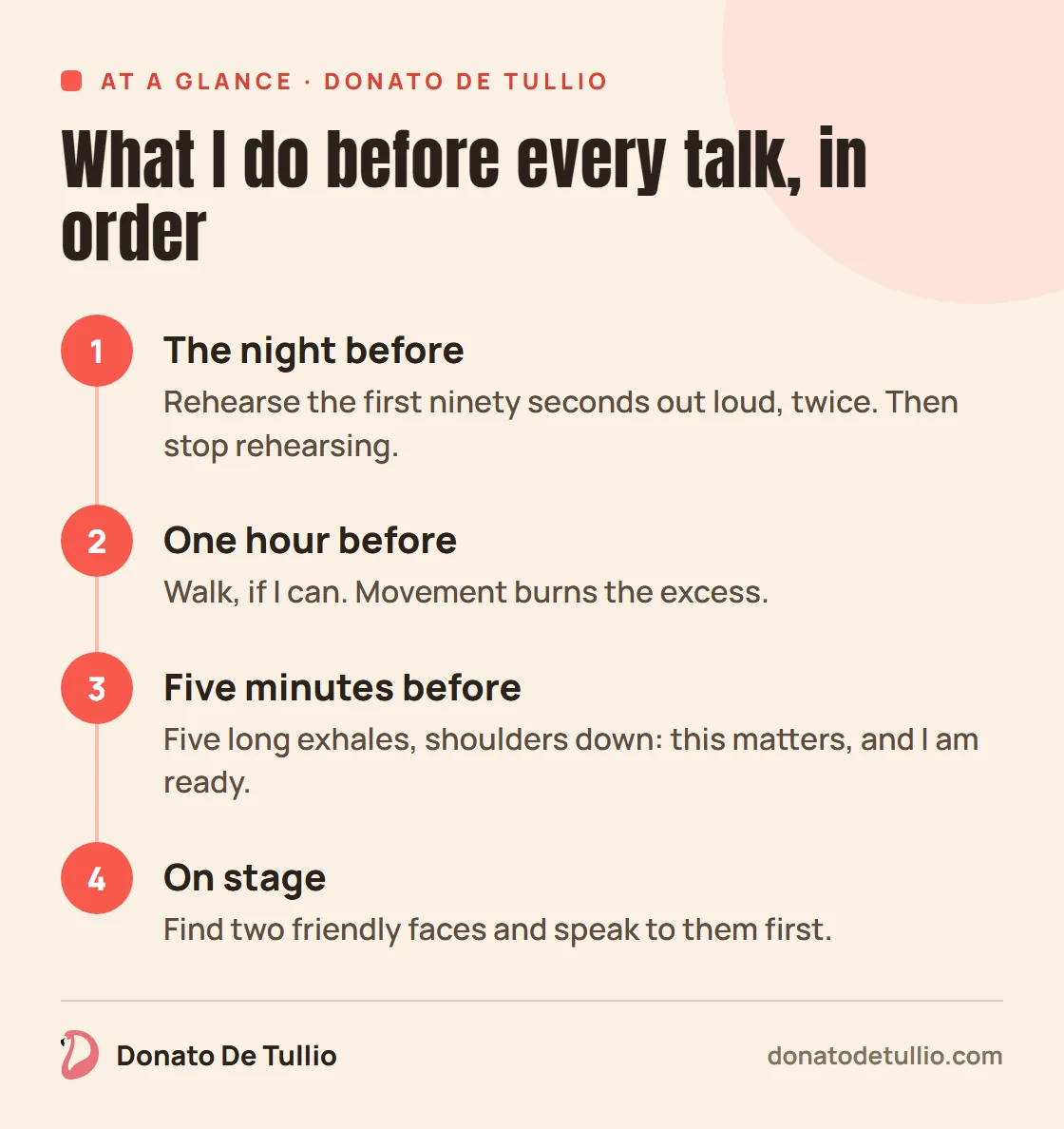
What I do before every talk, in order
- The night before: rehearse the first ninety seconds out loud, twice. Then stop rehearsing.
- One hour before: walk, if I can. Movement burns the excess.
- Five minutes before: five long exhales, shoulders down, and the sentence: this matters, and I am ready.
- On stage: find two friendly faces and speak to them first.
Nerves are not the enemy of a good talk. An unrehearsed opening is. Script the first ninety seconds and let the adrenaline do its job.