To delegate to AI, give it work that repeats, that you can judge and that you can check: drafts, video editing, transcripts, sorting files. Treat it like someone who started yesterday. You explain the job, hand over the material and look at what comes back. The responsibility stays with you, so decide in advance what you'll check.
I record my videos on my phone, often when I'm out, sometimes with the dog. Then I stop thinking about them. The file lands in a folder, and on the laptop at home a program built with AI transcribes it, cuts the pauses, fixes the sound, adds subtitles and turns it into a vertical video. My video editor is an AI.
In the first real video I gave it, the opening two seconds showed something that shouldn't have been seen. To the machine those were two seconds like any others. Not to me. Since that day I always check the opening.
That scene is the whole of delegating to AI. The job leaves your hands and the responsibility doesn't. This article is about what to hand over and how to check what comes back. If your problem is that everything still lands on your desk, start with doing everything yourself.
How to use AI to delegate: where do you start?
With a question I asked in one of my videos. «What's that thing I do over and over that I could ask AI to do for me?» The word that matters is over and over. If you do something once, explaining it costs more than doing it. If you do it every week, you only pay for the explanation once.
What if you don't know how? In the same video I said to skip the big courses and ask the AI itself. It helped me a lot. It tells you which program you need, where to click, what to paste. At first I just chatted with it and asked it for information, like everyone does. It took me a while to work out how to make it do real work, and I'm telling you because in the first week it will feel like a waste of time. Often it is.
Which jobs should you give to AI, and which not?
Before I hand over a job I ask two questions. Does it repeat? And when it comes back, can I tell whether it's any good? If both answers are yes, it's usually one of these.
- Drafts. The first version of an email you always send the same way, a quote, a page that needs tidying. You change the part that matters.
- Editing and files. Cutting pauses, adding subtitles, changing formats, renaming a hundred documents.
- Transcripts. The voice notes you leave yourself in the car, meetings, calls.
- Repetitive work with data. Copying from one sheet to another, filling in the same form every time.
What stays off the list is the reason people choose you. I put it this way to someone I was working with. «I use it a lot to be super productive, but not to think.» I've gone through what to keep for yourself in AI for business owners.
You can't see the line between the two from the outside. There's a well-known experiment by Dell'Acqua and colleagues with 758 Boston Consulting Group consultants. On tasks within the AI's reach, those using it worked about a quarter faster and got better results. On one task picked because it lay outside its reach, those using it did worse than those working alone. It was run on consultants, with a 2023 tool, and the machines have changed. I only use it to remind myself that somebody has to check.
Why is delegating to AI like delegating to a new hire?
A new hire is fast, keen and knows nothing about you. They don't know what must stay out of your videos. My machine writes «CioGPT» in the subtitles instead of ChatGPT. A machine getting the name of a machine wrong, which is pretty funny. It still gets fixed, because my name is on it.
With a video nearly four minutes long I did what I'd do with a new colleague. I watched all of it and found repeated words, a thread that went weak in the middle, and lower quality than the original. I sent it back. Each correction became a written rule. The subtitles carry the words I actually said. Videos where I give instructions out loud take a different route, because the automatic edit doesn't understand them.
There's one condition, and I repeat it to anyone who asks whether the machine can do everything. «Doing it yourself unblocks you and helps you. Because once you know how to do it, you can hand it to the AI.» If you've never done a job, you can't read it when it comes back. With a person you can tell from their face that something's off. A machine always answers with confidence.
How do you check what comes back?
Checking costs time, and it's better to admit that. That's why I decide what to check before I see the result. These are usually the things I look at.
- The opening and the ending. Everyone notices them, and to the machine they count like everything else.
- Names, figures and dates, compared with the original one by one.
- The thread. Go through the work from start to finish as if you knew nothing. Where you get lost, you pick it up again.
- What only you know. What shouldn't be shown, and what you don't say to that client.
And before you paste anything, take out client names and email addresses, and read the privacy terms of the tool you use. I tell the people I work with the same thing.
When does delegating to AI turn into pretending?
I'll confess this one, because I was a little ashamed of it. For a long time I asked AI questions compulsively. I'd read the start of the answer, ignore the rest and ask another question. It felt good, it felt like work. I produced an immense quantity of documents and solved nothing.
I call it the productivity trap. You feel busy and you haven't taken anything off your week. My test is simple. At the end of the week, is there a job you no longer have to do? If all you have is more documents, you've found yourself a second job.
The sheet to fill in today
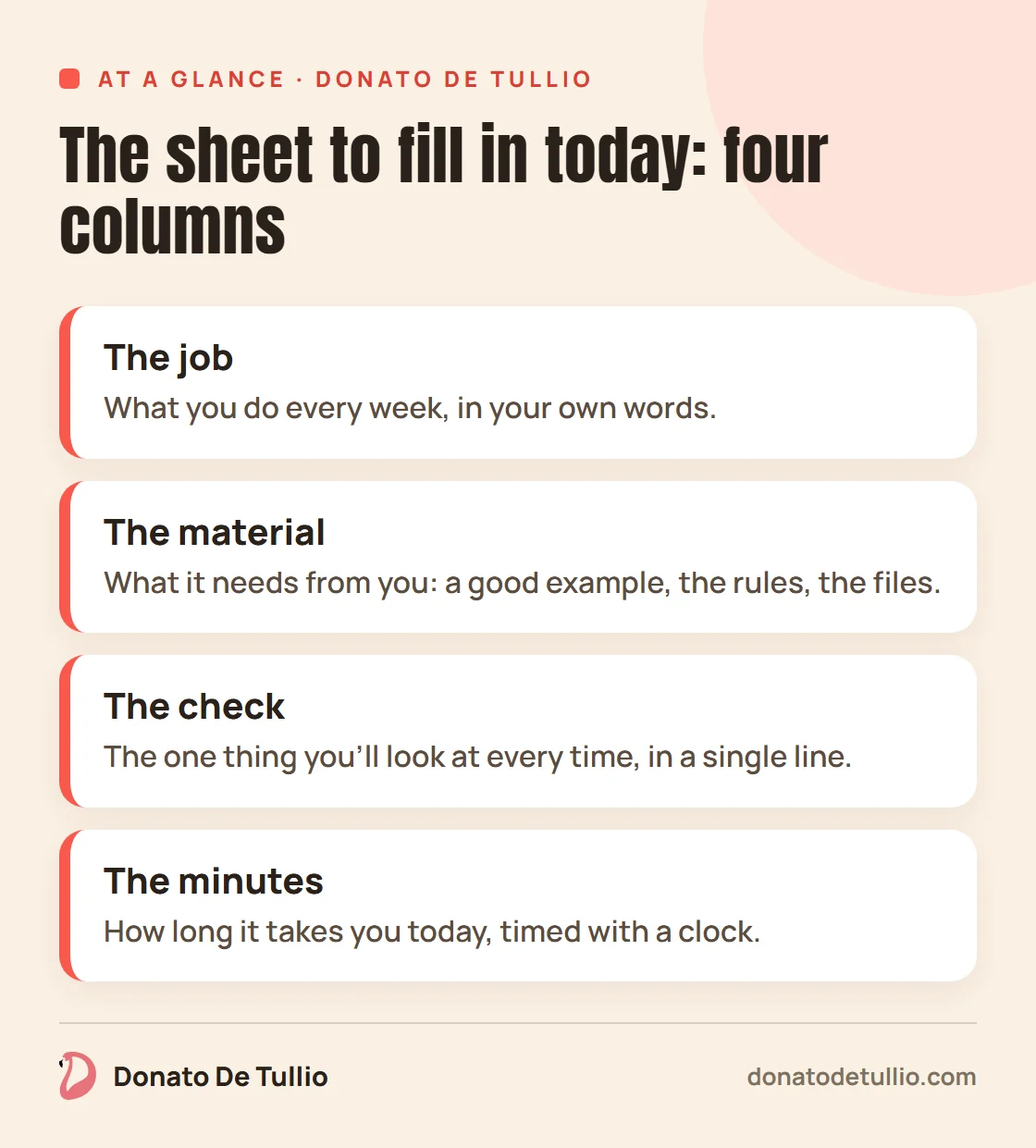
Take a sheet of paper and draw four columns. Five rows are enough.
- The job. What you do every week, in your own words.
- The material. What it needs from you: a good example, the rules, the files.
- The check. The one thing you'll look at every time, in a single line.
- The minutes. How long it takes you today, timed with a clock.
Pick the dullest row, where a mistake costs little. Have the AI do it the next three times and write down the minutes, including the check. Hardly anyone counts the check, and that's how everyone ends up saying they saved hours. If the minutes don't drop, take the job back and try the next row.
I won't give you a number of hours to expect. It depends on the job, and the number that matters is yours.
What's left for you once you've delegated?
When AI takes a job off you, you come face to face with what you were putting off because you were busy. The same goes for reading numbers, as I explain in using AI to read data and structure your work.
If you'd like someone from outside to look with you at what you keep and what you let go, that's the work I do in Decision Lab.
Frequently asked questions
What work can I delegate to AI first?
Work that repeats every week and that you can judge when it comes back: email and quote drafts, transcripts, video editing, sorting files. Start with the dullest job, where a mistake costs little.
How do I check AI's work without redoing it?
Decide in advance what to look at. Usually the opening and ending, names and figures compared with the original, and one read from start to finish as if you knew nothing. Count the time this takes too.
Can I delegate a job to AI if I don't know how to do it?
You can ask it to explain how the job is done, and that helps a lot. Handing it over without ever having tried is riskier, because you can't tell whether what comes back is any good. Do it yourself a few times first.
Was this useful? Get the next articles by email: leave your address here.

He did his PhD in chemistry with Merck, then spent more than ten years in European multinationals, working his way up from the warehouse floor to running logistics. Today he helps professionals and companies who make a living from their expertise get chosen by the right clients.
About meWhere to start: the positioning guide.