For business owners, AI works as technical support: it takes drafts, summaries, sums and repetitive work off your hands. Creative and strategic thinking stays with the person. Who to say no to, what price to charge, what you say about yourself and where your business is going are your decisions, because you pay for the consequences.
In a session a few months ago, someone asked me a question I hear a lot. They had a talk to prepare and were thinking of feeding their ideas to AI and having it written for them. They already had a doubt, though. Doing it that way, they told me, I won't learn anything.
I said that AI works on the average of what's out there, because that's how statistics work. Then I said the line I repeat most often. «So if you want mediocre work and you want to be a mediocre person, this is a good way to do it. If you want that extra touch, you have to do it yourself.»
Put like that, it sounds as if I'm against it. I use it every day. I have a job at a company and I build my own business in the evenings. My position is a bit uncomfortable, and I'm keeping it. AI somehow steals some of your humanity, and it also matters enormously, because you have to be productive in your own way.
AI for business owners: what do you give it?
You give it the technical work, the kind you can check. I sort it into three piles.
- Delegation. Video editing, drafts, repetitive jobs. I've explained how in how to use AI to delegate.
- Summaries. Calls, documents, the long regulations you would never read.
- Data. Your accounts, your client list, comparisons. There's a separate piece on this, using AI to read data and structure your work.
For all of this, average is fine. If you build your website with AI, it won't be the site of someone who's been making them for ten years. It'll be a seven out of ten. If you couldn't have done better alone and you saved hours, that's fine. You can't be excellent everywhere.
The words you put on that site are another matter. That's where the difference lies. «The tool is fine, then it's always you who adds the extra touch.»

Which decisions should you not give to AI?
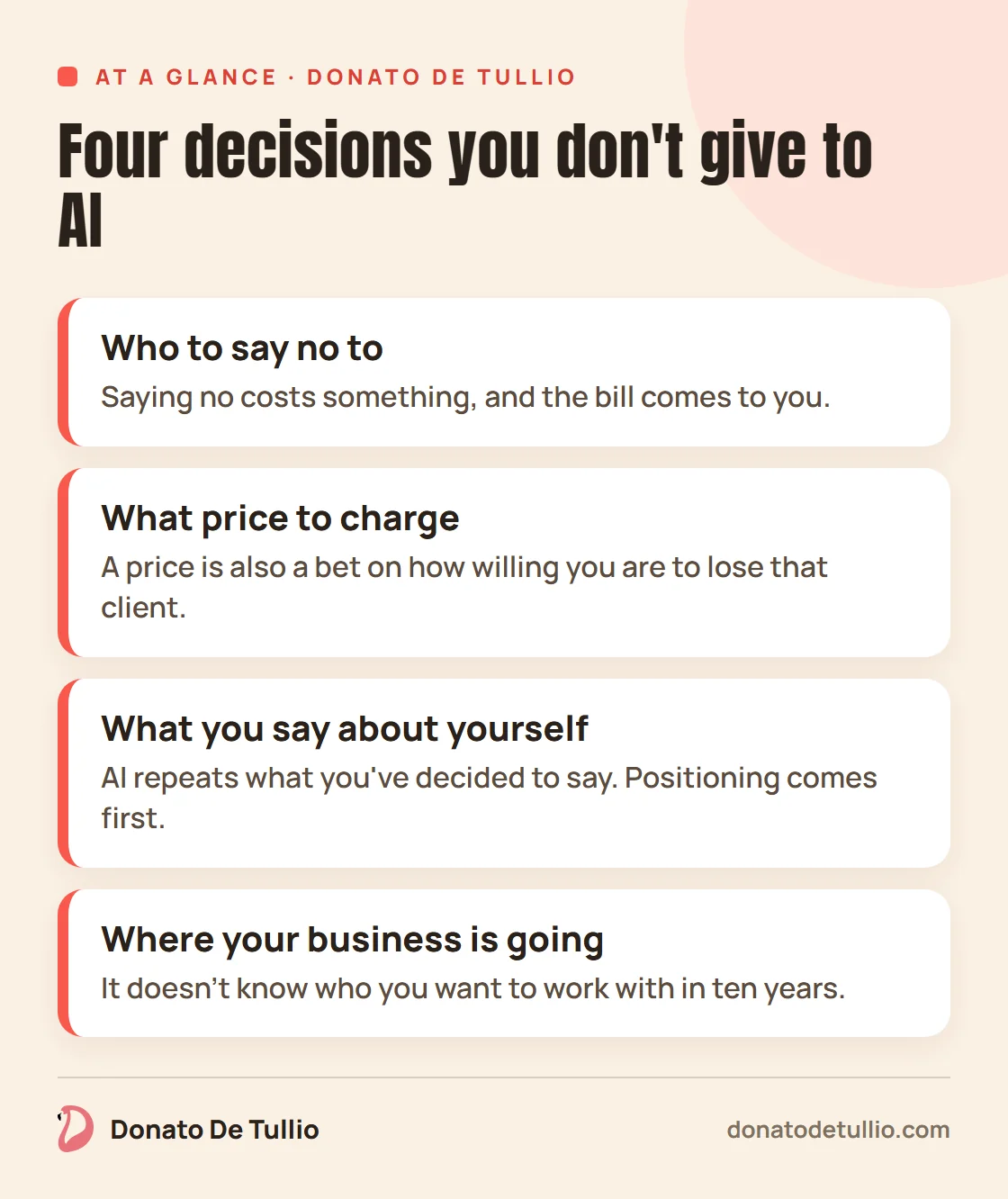
There are four. Asking for help preparing them is fine, but the answers come from you.
Who to say no to. AI can line up your clients from recent years and tell you who paid late. It doesn't know who keeps you awake on Sunday night, or whether you still need that client while you build the rest. Saying no costs something, and the bill comes to you.
What price to charge. It can add up your costs and show you what others put on their websites. A price is also a bet on how willing you are to lose that client. Ask the machine and you'll get the average of what it has read.
What you say about yourself. I ran a test. I asked ChatGPT to compare me with other consultants, and it took its information about me from my own website. I described it like this to someone I was working with. «It compares me with the others on the basis of what I said.» AI repeats what you've decided to say. If you haven't decided, it hands you back a line anyone could say, beautifully written. Positioning comes first.
Where your business is going. It can draft three scenarios in a minute. It doesn't know who you want to work with in ten years, or what you're willing to give up. If you've noticed you're the best worker in your own company and nobody is doing the strategy any more, read work on your business, not in it.
Why can't AI do the thinking for you?
Try this, it takes two minutes. Ask it for the best possible opening for a talk of yours. Then tell it you don't think much of it. It'll say you're right. Tell it you've changed your mind and it's actually good, and it'll say you're right again. In that session I called it what it is. It didn't give you a result, it gave you a pat on the head.
The problem is well known. A Stanford team (Cheng and colleagues, in Science) tested eleven models and found they side with the person writing 49 percent more often than other people do. What interests me is what comes next. Even with the right instructions, the machine pays nothing. If you get the price wrong, it won't be the one looking at the account at the end of the month. Whoever decides has to have something to lose. Otherwise they're only commenting.
There's a second reason, and it concerns you. «Doing it yourself unblocks you and helps you.» The thinking you do to write two lines about yourself is already part of the decision. Skip it and you end up with a sentence and none of the thought behind it. When a client asks you why, you don't know what to say.
The hours AI gives back: who decides where they go?
In my day job AI saves me time, and then I have to do more. I said so in a video, without mincing my words. «Magic, magic, magic: they get asked to work more.» It isn't only my impression. In a 2024 Upwork survey of 2,500 people, 96 percent of executives expected more productivity from AI, and 77 percent of employees using it said their workload had grown. Upwork sells freelance work and has its own interest, so take it as a signal.
If you have your own business you start with an advantage, because you assign those hours yourself. If you don't, they fill up with other requests and you're back where you were, with more on your plate. I'm not one of those people telling you to work less. You have to work a huge amount, but that doesn't mean not being free, because you work and invest hours in the things you want. That's the point, the things you want. You need to have chosen them before AI frees up your afternoon.
The sheet that shows what you're really asking AI
Open your chat history and copy your last ten questions onto a sheet of paper. Next to each one, write a letter.
- W, for work. You can check whether the answer is right: a sum, a summary, a draft.
- D, for decision. Nobody can tell you today whether it's right, and the consequences are yours: «should I raise my prices?», «do I drop that client?», «how should I present myself?».
Rewrite every D as a request for data. «Should I raise my prices?» becomes «line up the costs of my last jobs and the public prices of five competitors». Read what comes back, and next to it write your decision by hand, with a date. There's only one rule. AI brings you the data, the decision is yours.
If you have a lot of Ds, it's no sin. I spent a long time firing compulsive questions at a machine, and I was ashamed of it. It's easy to ask these things in the evening, when you have nobody to talk to about them, and the machine always answers. I understand that. What you need, though, is someone who knows you and can tell you no.
That role is the work I do in Decision Lab.
Meanwhile, tonight, open your history and count the Ds.
Frequently asked questions
What is AI useful for if you own a business?
Technical support: drafts, video editing, summaries of calls and documents, sums, comparisons. It removes the work you can check. Choices about clients, prices, your message and your direction stay with you.
Can I ask AI what price to charge?
You can ask it for your cost calculations and competitors' public prices. The figure is yours to decide, because it depends on how willing you are to lose a client and what you want to become. It would answer with an average.
Does AI make you mediocre?
If you use it to think for you, yes, because it works on the average of what already exists. On technical work, average is often enough and saves you time. The extra touch has to come from you.
Was this useful? Get the next articles by email: leave your address here.

He did his PhD in chemistry with Merck, then spent more than ten years in European multinationals, working his way up from the warehouse floor to running logistics. Today he helps professionals and companies who make a living from their expertise get chosen by the right clients.
About meWhere to start: the positioning guide.