AI reads in minutes what you'd never have time to read: calls, documents, accounts, client lists. It puts your material in order and prepares comparisons. It also gets names, figures and attributions wrong, so every number you plan to use has to be checked against the original. AI brings you the data, the decision is yours.
On 21 October I wrote one sentence to the machine that helps me keep my work in order. «From today, download only the transcript and not the summary, in the other copies too: summaries bring errors when you work.» I had just seen what the automatic notes were doing. The name of a protocol mangled. Two people swapped. A figure credited to the wrong person. The date of an appointment written two different ways.
Each error was small on its own. The trouble is I was building analyses on top of those notes, and an analysis built on a wrong summary reaches you clean, tidy, with neat little headings. It doesn't make you suspicious.
I still use AI every day for reading, and without it I couldn't keep up with two jobs. I've just learned what to expect.
How do you use AI to read data without being fooled?
When you say «read the data», you're asking for three different jobs, and each goes wrong in its own way.
The first is summarizing. When people ask me how to use it on a long document, I tell them to start here. Say «from all these 150 pages, give me a summary and pull out the five key points». For finding your way around, it's fantastic. A summary is already a choice about what matters, though, and the machine is making it. It can also get facts wrong. In the 2025 study coordinated by the European Broadcasting Union with the BBC, 45 percent of about 2,700 AI assistant answers about the news had at least one significant problem. That's about news and not your documents, so it isn't your percentage. It's enough for me to keep one rule. For every point you need, ask which page or minute it came from, and go and look.
The second is counting. You can have it count how often a word comes up in client emails or reviews. You get a nice number. Then you look closer, and often it's just a way of speaking. The machine counts the words, and what they mean is up to you.
The third is attribution, and that's the one that does the most damage. Once I got back a count of my clients that was more than double the real one. The machine had counted everyone with a certain box filled in on the sheet. It was a tidy, convincing analysis. I said it was wrong because I know my clients, and no program could have told me that. Another time it credited to me some big figures I had used out loud as examples of what other people do. In a transcript, an example and a fact look exactly the same.

What should you check before trusting a number?
Four questions, and they take less time than a meeting. I ask them mainly about the numbers you have to decide something on.
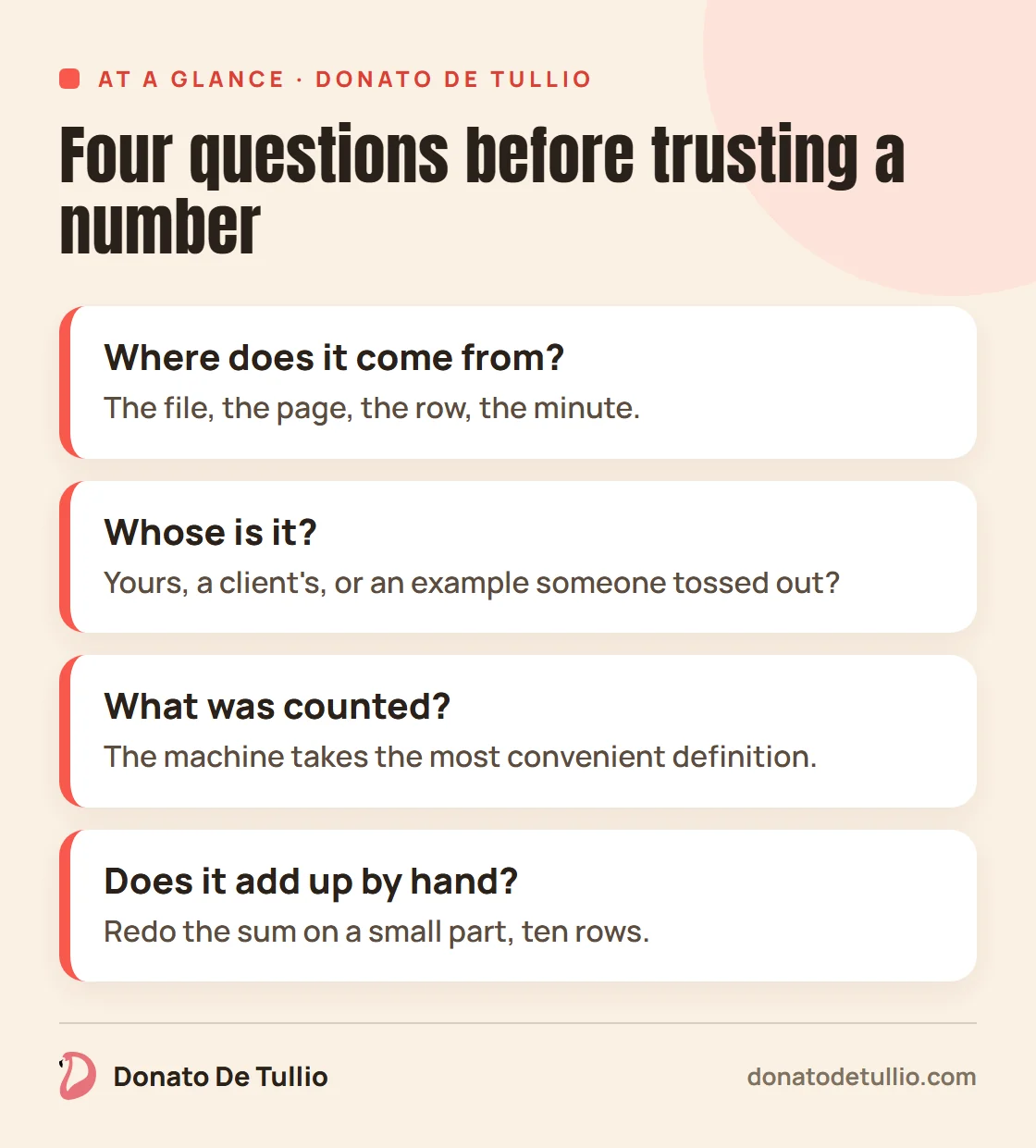
- Where does it come from? The file, the page, the row, the minute. If it can't tell you, that number doesn't exist.
- Whose is it? Yours, a client's, or an example someone tossed out?
- What was counted? Write down what «client», «paying», «active» mean. The machine takes the most convenient definition.
- Does it add up by hand? Redo the sum on a small part, ten rows. If ten rows don't add up, the rest doesn't count.
And before you upload anything, clean it. When I explained this to someone who wanted to cross-reference the transcripts of their calls, I told them to take the email addresses out so they'd be safe. Client names and details don't go into a tool whose privacy terms you haven't read.
How do you structure your work with AI?
This is where AI serves me best. You give it a messy pile and you get back an orderly one. You can dictate ten minutes of what's in your head about a project and ask for the list of steps, with what depends on what. You can give it a year of invoices and ask for your clients in order of how much you worked with each. If you want to step back from the daily grind and look at the whole, work on your business, not in it is a good place to begin. Then have the machine prepare the table of numbers you want to watch.
It can also make connections you'd never make alone. I suggested this request to someone who had gathered some material. Out of everything my clients say and what I think, «where do you find agreement, what am I not seeing, what am I missing». I also told them the limit. Without enough data AI doesn't do much, it only organizes the ideas you already have. From a small pile you won't get anything better than what you put in.
AI brings you the data, the decision is yours: what does that mean in practice?
A made-up example, to make it concrete. The owner of a small firm has AI read her clients from the past year. It tells her the small clients eat up most of her hours and bring in little. That's data, and if she's checked it, it's good data. Does she drop them? That's where the sheet stops. Maybe two of those small clients sent her the three best ones. Maybe she's decided that in five years that's exactly what she wants to do. That column isn't in the file.
In my method the first D is Data, followed by Direction and Decision. AI gives you enormous help with the first and stops at the other two, even though it will answer anyway. It also tends to agree with you. I've written about which decisions never to pass on in AI for business owners.
There's the opposite risk too, and I fell into it. You read, you ask, you get another summary, then another comparison. It feels like work. That's how I produced an immense quantity of documents, as I describe in how to use AI to delegate. Reading better only helps if you decide something afterwards.
The sheet to fill in today
Pick a real question that has been going round your head for a while. Which clients to keep, whether a service still pays, where your hours go. Then make a sheet with five lines.
- The question. Just one, written the way you'd say it to a friend.
- The material. Which file you give it, and what you took out first.
- What it found. Three things at most, each with the place it came from.
- Where I checked it. At least one figure, redone by hand against the original.
- What I decide, and by when. Write this line in pen.
The last line is the one that counts. If it stays empty you've done some nice reading, and you've got one more document. If it's a decision you've been putting off for months even with the data in front of you, the problem wasn't in the data. It can happen to anyone, and that's the point where you need someone from outside. It's the work I do in Decision Lab.
Frequently asked questions
Can I trust AI summaries of my calls?
To find your way around, yes. For facts, no: names, figures and dates can be wrong or land on the wrong person. Keep the transcript and check there anything you'll use to decide.
How do I check a number AI gives me?
Ask which file and row it comes from, check whose it is, write down what was counted and redo the sum by hand on about ten rows. If ten rows don't add up, don't use the total.
Can AI decide for me by looking at the data?
It can show you what the numbers say and prepare comparisons. It doesn't know what isn't in the file: what you want and what you'd give up. AI brings you the data, the decision is yours.
Was this useful? Get the next articles by email: leave your address here.

He did his PhD in chemistry with Merck, then spent more than ten years in European multinationals, working his way up from the warehouse floor to running logistics. Today he helps professionals and companies who make a living from their expertise get chosen by the right clients.
About meWhere to start: the positioning guide.