To work on your business, not in it, means giving the choices only you can make a fixed place every week, instead of spending every day just keeping the work moving. It doesn't automatically mean fewer hours. Your total may stay the same, and what changes is who decides where those hours go.
On Monday morning you write the week's list, twenty-two things. By Friday evening you've crossed off nineteen, and you feel pretty good about it. At the bottom of the page one is left, «figure out where I want to take the business». It's been there since March. You've copied it from one list to the next, in handwriting that gets more tired each time.
On Monday you copy it again.
What does working in your business look like?
It starts well. In the beginning you do everything because there's nobody else, and it works. You're the best, you fix problems in ten minutes, so the problems come to you. Years go by, and one day you notice you're the best employee in your own company.
The only one missing is the boss, the person who decides where things go. That seat is empty, and it's yours. This holds if you work alone too. There it's just harder to see, because nobody comes asking who's in charge.

How can you tell you're stuck in it?
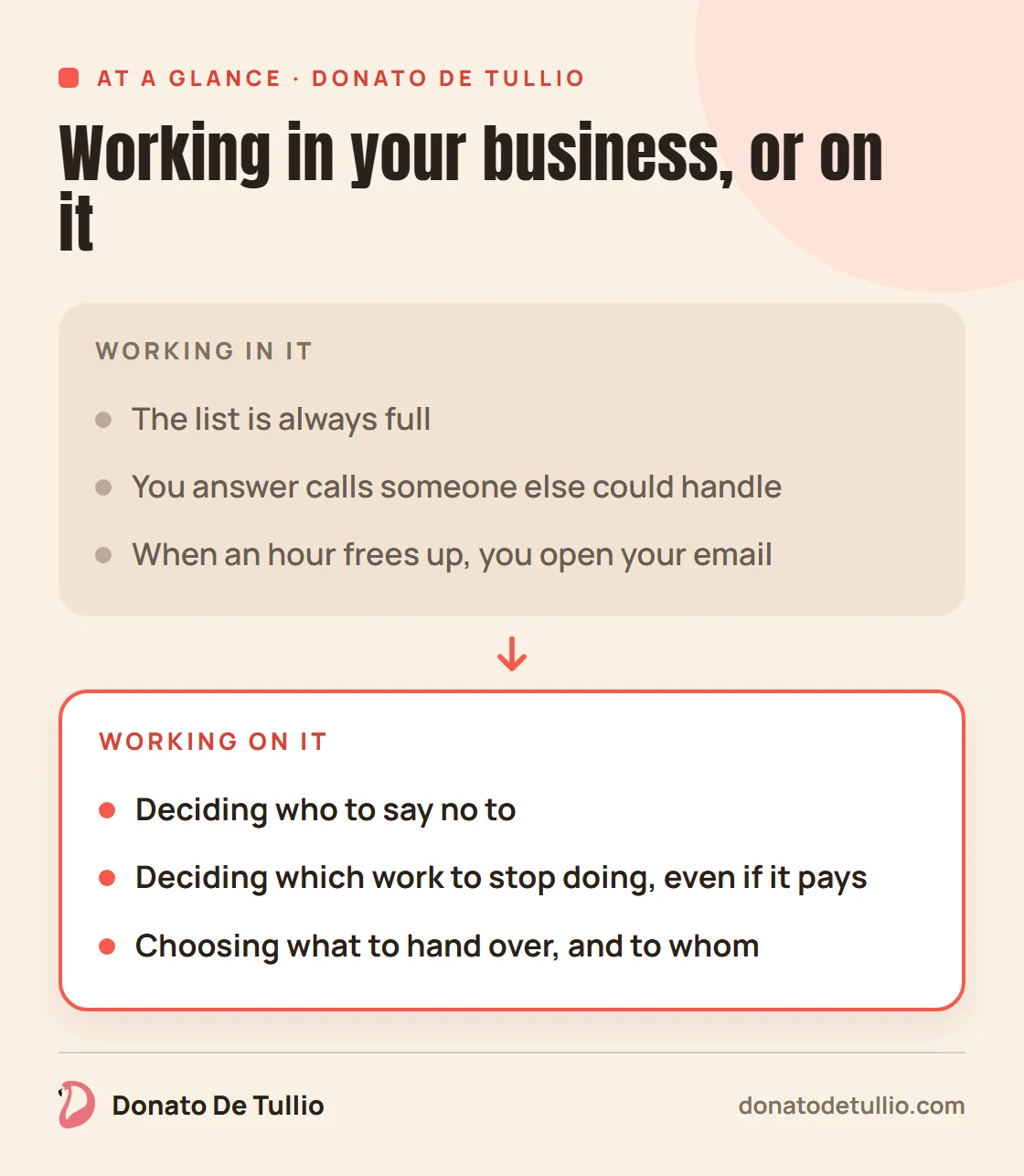
- The list is always full, and the important line is always the same one.
- People call you about things someone else could handle, and you answer.
- At the end of the year you can say how much you did, and you can't say what you decided.
- When an hour frees up, you open your email.
If that's you, it doesn't mean you work badly. It usually means you work well, on everything except the direction.
What is the busyness trap?
I define it like this: keeping yourself busy and not doing. I fell into it myself, as I tell in the article on doing everything yourself.
Laziness has nothing to do with it, the people who fall in usually work very hard. A mechanism is working against you. In a 2018 study on the mere urgency effect, published in the Journal of Consumer Research, Zhu, Yang and Hsee found that people pick the task with the close deadline even when the other one, with no rush, would pay off more.
Your big choices have no deadline. Nobody calls to ask where you want to be in five years. The client does call, and so, week after week, the client wins.
Where does «work on your business, not in it» come from?
The idea comes from Michael Gerber and his book The E-Myth, widely read and based on experience, not on scientific research. He says good professionals end up building themselves a job, and at some point have to move from working in the business to working on it.
In practice, working on it means things like these:
- deciding who to say no to;
- deciding which work to stop doing, even if it pays;
- reviewing your prices and what's inside them;
- choosing what to hand over, and to whom;
- deciding what work you yourself want to be doing in three years.
You can spot them by one detail. If you skip them this week, nobody notices. If you skip them for three years, you do.
Does working on your business mean working less?
No. Moving from operator to strategist doesn't make hours vanish. At first it adds some, because decisions get made while the work carries on.
And if you love your craft, keep it. You can spend most of the week doing what you do best, as long as it's a place you chose and not a place you ended up in. From the outside the two days look alike. From the inside they don't.
How do you move from operator to strategist?
- Give your choices a fixed appointment. Two hours a week, always at the same time, with the respect you'd show your biggest client. If it gets skipped, you make it up the same week.
- Bring one question only. A real one, that can be answered yes or no. If the question is a big one, use the five steps of the 5D Method, which I apply to a real choice in positioning is a decision.
- Remove before you add. Every new choice asks for time, and that time comes from something you stop doing. Start with why you do everything yourself.
- Tell someone. A decision made alone, at night, has evaporated by Monday.
The first few times it'll feel like wasted time, and you'll want to open your email. That's normal. Operational work answers you right away, and strategic work answers you months later.
Count your decisions
Open your calendar for the last two weeks. Next to each block write a letter. A if it moved the work along. D if it decided something that changes your work, meaning a no, a price, a client you chose, something you stopped.
Count the Ds. If there are none, don't beat yourself up, it's a number and now you have it.
Then take the line you've been copying for months. Rewrite it as a question with a yes or no answer, and put it in your calendar this week, with a day and a time. That's your first D.
What if the question is bigger than a list?
Sometimes, during those two hours, you find out that better organization isn't what you lack. You lack an answer about who you want to be in your work. Then you're already in professional repositioning, and it helps to call it by its name. If it's the business that can't move without you, look at the owner dependent business test.
If you want someone to hold you to that appointment and ask the awkward questions, that's what we do in Decision Lab, with me.
Frequently asked questions
What does «work on your business, not in it» mean?
It means keeping a fixed place for the decisions only the owner can make, such as where the business goes, what to stop and what role to have. The phrase comes from Michael Gerber's book The E-Myth.
How many hours a week should I spend working on my business?
Two fixed hours are enough to start, always at the same time. Regularity counts more than length, because big choices have no deadline and they slide if they have no place in your calendar.
Does it mean working less?
No. At first it can mean working more, because decisions get made while the work carries on. It means putting your hours where you've chosen to put them.
Can I work on my business if I'm a solo freelancer?
Yes, and you need it even more, because nobody reminds you to do it. You're both the worker and the boss, so the boss needs office hours.
Was this useful? Get the next articles by email: leave your address here.

He did his PhD in chemistry with Merck, then spent more than ten years in European multinationals, working his way up from the warehouse floor to running logistics. Today he helps professionals and companies who make a living from their expertise get chosen by the right clients.
About meWhere to start: the positioning guide.