If you already have clients, first find out which number has stalled: how many jobs you do, what each job is worth, which jobs you do. If few people ask, you need more inquiries. If little is left over, look at the accounts. Positioning matters when inquiries come in, people compare you with everyone, and they don't pick you.
End of the month, you open your invoice sheet. Roughly the same number as last year. And yet this year you worked more, with two new clients, every other evening at the laptop and a weekend lost to a proposal that went nowhere.
Your first thought is to find more clients. Maybe that's right. Maybe you're about to press the wrong pedal.
Google will give you lists of twenty tips, all reasonable, and none of them says where to start. This article is for people who already have clients, and it's meant to show you what your problem is, even when it isn't the one I work on.
Which number has really stalled?
Revenue is a multiplication, number of jobs times the average value of a job. Then the mix matters, because one job can be worth three of another. Management accountants call this variance analysis, and it's plain arithmetic. If revenue changes, the price changed, or the number of jobs, or the mix.
So «this year is bad» won't do as a diagnosis. A change proposed without numbers is an opinion, and until you know which number moved, every fix is a shot in the dark.

How do I find out in five minutes?
You need the list of invoices from the last two years. A sheet of paper and a pen will do.
- For each year, write down how many jobs you invoiced and the total.
- Divide the total by the jobs, and you have the average value.
- Take the last year, sort the jobs from largest to smallest, and see after how many you reach half of the total.
- Next to the top three, write the hours they took, even a rough guess.
A made-up example, just to show how it works. Thirty jobs at 2,000 euros make 60,000 euros. The next year you do forty jobs at 1,500 euros, and it's still 60,000. Revenue looks flat, but you've got ten more jobs on your back and each one is worth less. More clients would make this worse.
The third step is a version of the Pareto principle. The famous 80/20 is a rule of thumb, and you have to check it on your own data. The useful question is which few jobs are holding you up.
When are you short of inquiries?
If few people ask for a quote and those few often say yes, positioning can wait. Your problem is simpler. Too few people know you, or the ones who do don't think of you when it counts.
John Dawes, for the Ehrenberg-Bass Institute, estimated in 2021 that in any quarter only a small share of possible business buyers are actually in the market. The others will buy later, if they remember you. Take it as an order of magnitude. It says that staying visible is part of the job.
The cheapest move is to ask. Schmitt, Skiera and Van den Bulte followed about 10,000 customers of a bank and saw that those who came through a referral were worth more and stayed longer. A bank isn't your practice, so take it as a direction. From there, ask a happy client one precise question: «who do you know with the problem you had six months ago?»
If you're afraid of the follow-up messages, read afraid of bothering people. If the phone doesn't ring, a nicer sentence won't make it ring.
When is the problem in the accounts?
Sometimes revenue grows and nothing changes in the bank. Then one more client only means more work. Look at three things, ideally with your accountant.
- Margin. Contribution margin is what's left of a job after the costs of that job. Without this number you don't know which job feeds you and which one eats you.
- Discounts. If you keep 40 percent of a job, a 10 percent discount asks for about a third more work just to stand still.
- Hours. I come from logistics, so the question comes automatically: where does everything stop? Goldratt's theory of constraints, a method born in manufacturing, says that improving anything other than the bottleneck doesn't raise the result. If everything stops at your hours, more clients only make the queue longer. That's where doing everything yourself starts to cost.
Look too at who doesn't come back. Reichheld and Sasser, in Harvard Business Review in 1990, showed that losing fewer clients weighs heavily on profit, in three cases with very different results. Three cases don't make a law. Leave out the line about a new customer costing five times more, though: nobody can find an original study that proves it.
When is the problem the price?
One case looks like good news. Someone told me, very pleased, that nine out of ten people bought after the call. I stopped her there. If you really close 90 percent, I said, it might be worth raising prices, closing 70 percent and earning more.
The word is «might», and you test it on a few quotes, with a date. If people nearly always say yes, the first suspicion is that you're asking too little.
When does positioning come into it?
When inquiries come in and the accounts hold up, but from the outside nobody can tell why they should pick you. These are the signs.
- The first question is always how much it costs.
- On every call you explain from scratch what you do.
- You get requests that have little to do with you, and you take them.
- People who recommend you say «he's good» and can't say at what.
- The jobs that pay best are few, and you don't know how to get more.
Technical people often end up here, because the client can't judge the quality of the work and chooses with what they understand. I explain it in the professional repositioning guide. If price is the only topic, go to clients compare you on price.
Positioning alone doesn't raise revenue, and nobody can guarantee that it will. It helps when the rest isn't working because people can't tell who you are and who you work for.
Where do I start?
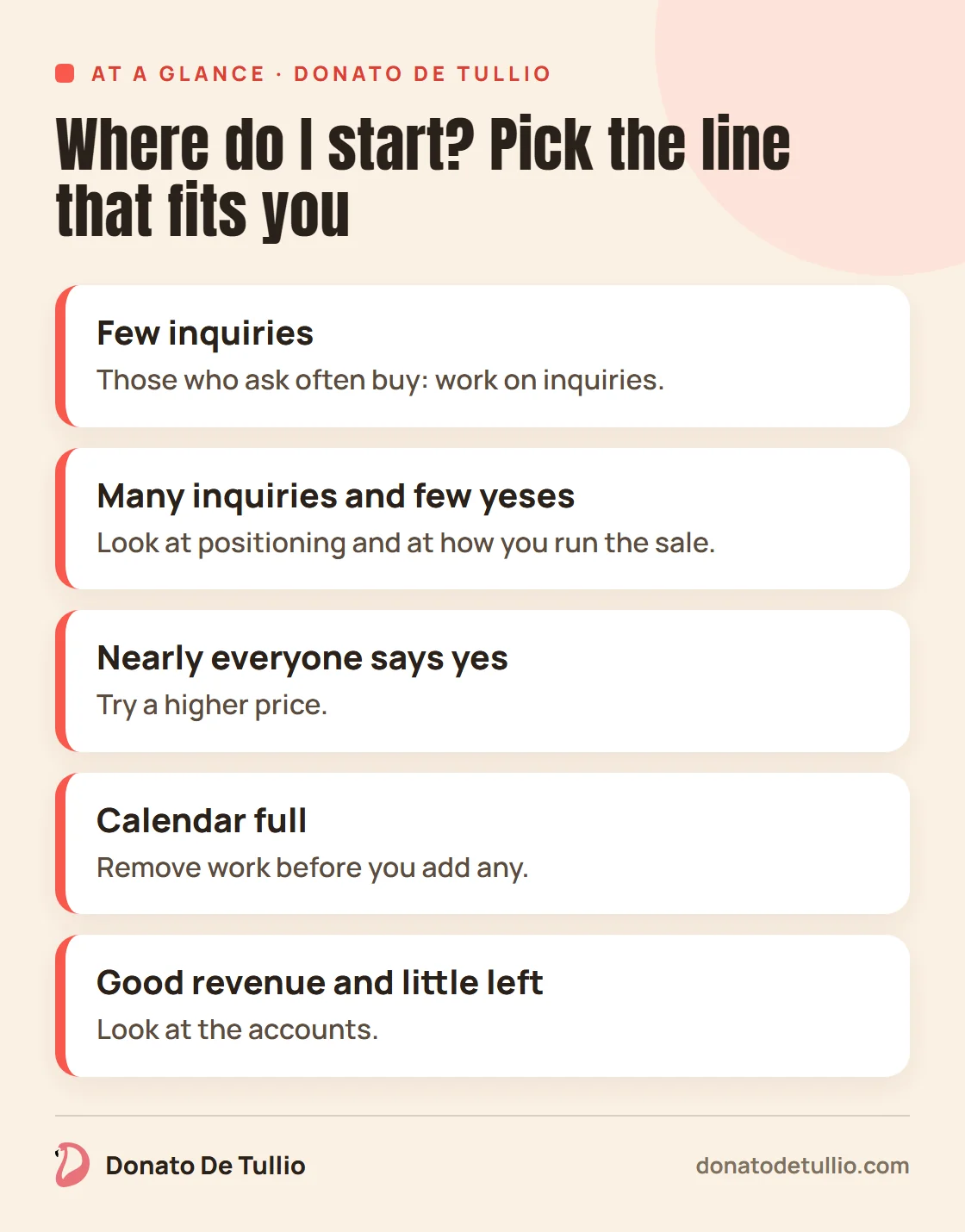
Go back to your sheet and pick the line that fits you best.
- Few inquiries, and those who ask often buy: work on inquiries.
- Many inquiries and few yeses: look at positioning and at how you run the sale.
- Nearly everyone says yes: try a higher price.
- Calendar full: remove work before you add any.
- Good revenue and little left: look at the accounts.
Pick one for a month and check the number at the end. If it's the second line and you want to work on it with someone who pushes back, that's what we do in Position Lab, on your real numbers. The first step is a thirty-minute coffee. Let's have a coffee (30 min).
Frequently asked questions
How do you grow revenue without finding new clients?
You can work on the value of each job, on the kind of jobs you accept, and on how many clients stay or come back. Look at your invoices first, because each of these paths fits a different problem.
Do more clients mean more revenue?
Only if you have free hours and those jobs leave a margin. With a full calendar or poorly paid work, more clients bring more effort and change little in the result.
Does positioning increase revenue?
Not on its own, and anyone who guarantees it is lying. It can help when inquiries come in but people compare you with everyone, because they can't tell who you are and who you work for. If nobody is looking for you, you need inquiries first.
Which numbers should I look at first?
How many jobs you invoiced, the average value of a job, and how many jobs make up half of the total. With two years of invoices it takes five minutes, and adding the hours shows you what's left for each hour.
Was this useful? Get the next articles by email: leave your address here.

He did his PhD in chemistry with Merck, then spent more than ten years in European multinationals, working his way up from the warehouse floor to running logistics. Today he helps professionals and companies who make a living from their expertise get chosen by the right clients.
About meWhere to start: the positioning guide.