To sell your services you need an offer that fits in two lines, a call where you ask before you propose, a price said clearly and a follow-up with a date. None of these moves guarantees a yes. If on every call you have to explain again who you are and people compare you with everyone, the cause may sit before the sale, in your positioning.
Monday, a call with a possible client. They describe their problem in two minutes. Then you talk for twenty, about method, tools and that hard project from last year. They say «very interesting, send me something». You send a four-page quote. After that, silence.
Technical people sell the way they work. They prove they know things, completely and precisely. That's great for the work. In a sale it's dead weight.
If your block is proposing yourself to people you know, start with afraid to sell. This is the practical part, what you do before, during and after the call.
What do you sell, in two lines?
«Consulting» says nothing, because the reader doesn't know what happens, how long it takes or what they hold at the end. An offer stands on two legs, how you deliver it and what result it brings.
A made-up example. «A review of your plant in three days, and at the end you have the list of interventions in order of urgency.» It's clear how you work and what the client keeps. You haven't promised anything you don't control.
Two rules help. The first is to talk about before and after and leave the hours out, because people who buy hours end up counting them. The second is one problem at a time. You don't need to solve ten problems, you need to solve one, and you can come back to the rest later. If today you have a menu, read one offer done better.

Why talk less on the first call?
Neil Rackham, in «SPIN Selling» from 1988, reports research by the company Huthwaite on about 35,000 sales calls. It's private research and the raw data aren't public, so take it with that warning. In complex sales, the best sellers didn't talk more. They asked questions in a certain order, and aggressive closing backfired on high-value sales.
For a technical person that's good news, because you already know how to do this. You'd never prescribe an intervention without a diagnosis. Yet as soon as money comes up, many people skip the diagnosis and open the catalog. Mack Hanan called the alternative consultative selling back in 1970: first you understand the problem, and the proposal grows from there.
Which questions should I ask on the call?
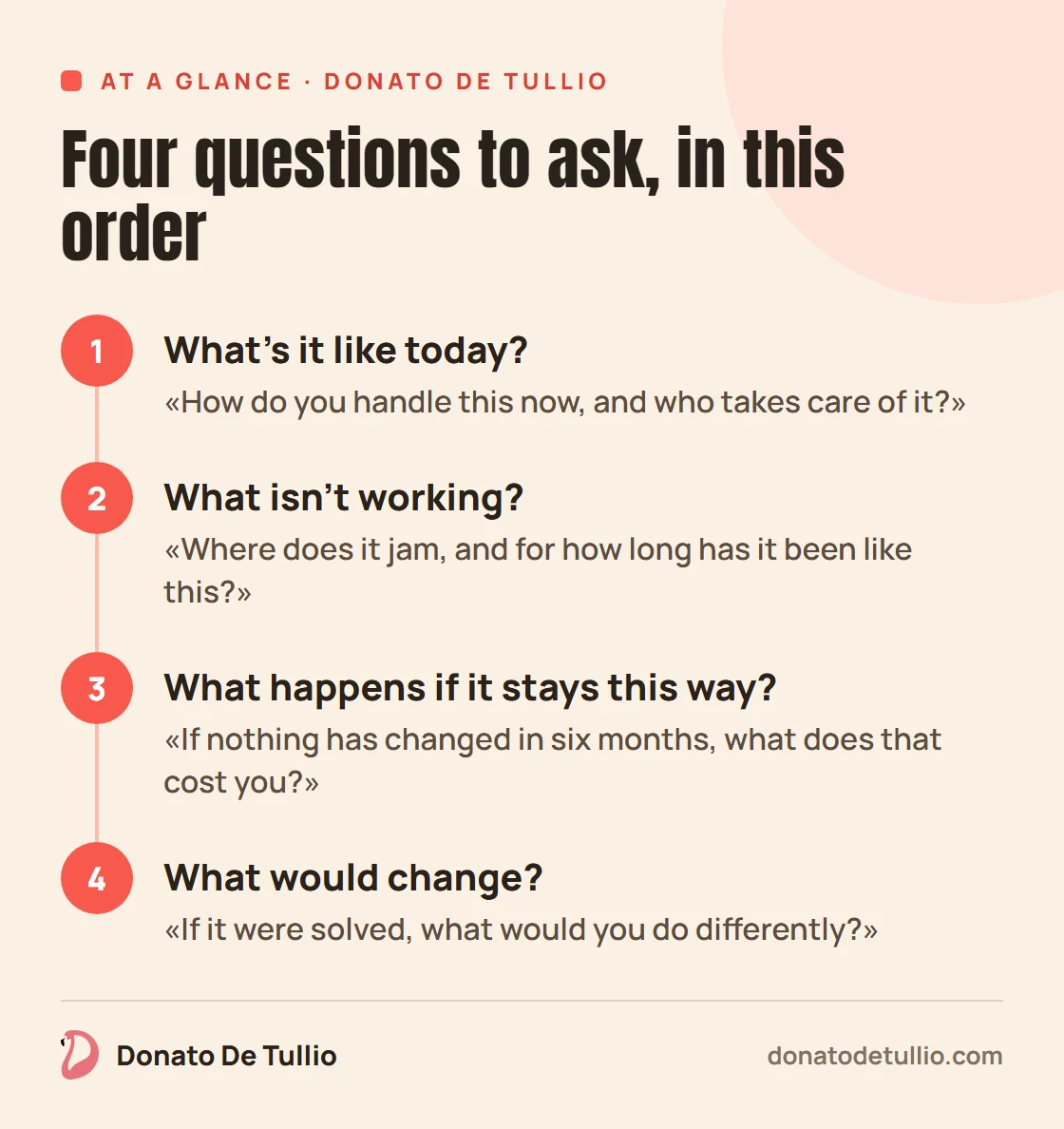
Before your next call, take a sheet of paper and rewrite these four questions in the words of your trade. It takes five minutes. Keep them in front of you and ask them in this order.
- What's it like today? «How do you handle this now, and who takes care of it?»
- What isn't working? «Where does it jam, and for how long has it been like this?»
- What happens if it stays this way? «If nothing has changed in six months, what does that cost you, in money, time or clients?»
- What would change? «If it were solved, what would you do differently?»
The third one makes the difference, and almost nobody asks it. The client is the one who says what the problem costs, with their own number. From then on, your figure no longer comes out of nowhere.
Write the answers in their words. You'll need them for the proposal, and the third one also tells you whether it's worth going on.
How and when do I say the price?
Say it yourself, on the call, with one number or a few options. Galinsky and Mussweiler published research on negotiations in 2001: on average, whoever makes the first offer gets a better result, because the first figure becomes the point everyone reasons around. If you wait for the client to say what they want to spend, you work inside their number.
After the number, stop. No justifications and no «but we can look at it». That's easier if you decided the price beforehand.
The written quote comes later and repeats what they told you. First their problem in their words, then what you do, then what they get, then the figure. One page is nearly always enough.
How do I close without pressure?
By asking for something precise and leaving the other person free to say no. Guéguen and Pascual studied in 2000 what happens when you add to a request that the person is free to refuse, and Carpenter's 2013 meta-analysis confirms a positive but modest effect. So it isn't a powerful trick. It's also the most honest way to close. «If this works for you, we start on the 12th. If it's not the moment, that's fine too.»
I do the same with my own program. I ask for an explicit commitment and I say straight away that I don't take people who don't want to keep it. Anyone who doesn't feel ready now can come back later, and nobody loses anything.
It works the other way too. If you realize the job isn't for you, say so early, in one clean sentence. «Look, that's not a service we offer, thank you, it was a pleasure.» You can use the hour you get back for someone who has the problem you solve.
What do I do after the call?
Decide the follow-up before you hang up. «I'll send the proposal tomorrow and call you Thursday at ten.» With a date you don't have to chase anyone, because you agreed on it together. If the second message feels heavy, read afraid of bothering people.
Answer quickly when someone writes to you, too. Oldroyd, McElheran and Elkington, in Harvard Business Review in 2011, saw that the chances of moving forward with an inquiry drop sharply as the hours go by. These are American data and it isn't a law, but answering fast costs little.
Then keep a sheet with three columns for the noes, date, where it came from, reason. One no hurts, thirty noes tell you what to change. If everyone says «I'll think about it», you often created that objection yourself, because the question about the cost of the problem never came.
What if all this isn't enough?
Sometimes the call goes well and the sale still doesn't start. They ask what you do, you begin the list, and they line you up with two others because they see no difference. Here the questions won't be enough. I put it this way: the problem isn't selling, it's selling before you've decided who you are.
Start with the professional repositioning guide, which explains why people choose with what they understand. If you want to decide and test it with real people, that's what we do in Position Lab. The first step is an espresso together. Let's have a coffee (30 min).
On your next call, speak second.
Frequently asked questions
How do you sell a service when there's no product to show?
You make the work visible with an offer that says how you work and what the client holds at the end. You can add a written proposal in their words, so they see their problem and not your catalog.
Should I say the price on the phone or in the quote?
On the call, once you understand the problem. You see the reaction right away and can talk about it, while a quote sent blind often ends in silence. The document confirms what you've already said.
What do I do when the client says «I'll think about it»?
Ask what they still need to understand or who else has to decide, then set a date to talk again. If many people say it, go back to the question about what the problem costs if it stays: that's often what was missing.
Do I need a sales course?
First try the four questions on three real calls and keep the sheet of noes. If after thirty cases no clear reason appears, a course may help. If people say they don't understand what you do, the problem is positioning.
Was this useful? Get the next articles by email: leave your address here.

He did his PhD in chemistry with Merck, then spent more than ten years in European multinationals, working his way up from the warehouse floor to running logistics. Today he helps professionals and companies who make a living from their expertise get chosen by the right clients.
About meWhere to start: the positioning guide.