Referrals are a good sign and worth keeping. They become a risk when they're the only way work reaches you, because you don't decide the timing or who gets sent to you. You don't need to replace them. You need to make them less random, by giving people a precise sentence to repeat, and to open a second door beside them, just one, that depends on you.
One evening you look at where your last few clients came from. A former client sent this one, a colleague that one, the other came through someone you met at a dinner. All through people you know. It's a nice feeling, and so it should be, because it means you do good work.
Then comes the question that spoils the evening. What if it stops tomorrow?
There's no sign that it's about to happen. You just wouldn't know what to do, because you've never had to do it. Work has always come by itself, and you've never found out whether you can make it come.
Are referrals a problem?
No, and it's better to say so straight away. Anyone telling you to stop relying on referrals is selling you something else. A referral means someone trusted you enough to put their own name on the line with a friend. You keep that, and you say thank you.
The risk begins when it's your only road. A table with one leg can stand for years. Just don't put everything on it.

What are the limits when referrals are all you have?
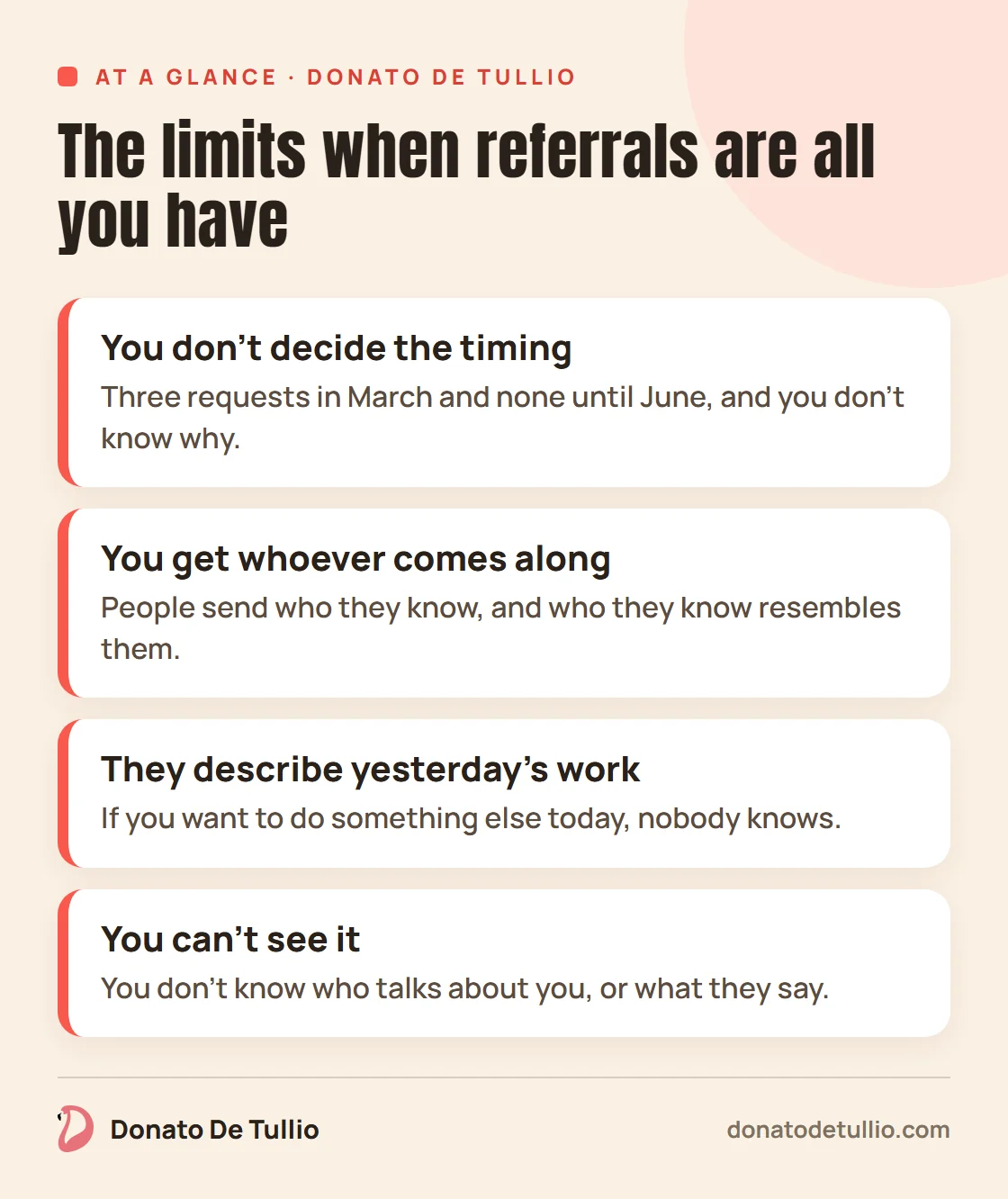
- You don't decide the timing. Three requests in March and none until June, and you don't know why.
- You get whoever comes along. People send who they know, and who they know resembles them. So you stay where you were.
- They describe yesterday's work. People describe what you did for them. If you want to do something else today, nobody knows.
- You can't see it. You don't know who talks about you, or what they say.
There's some evidence on that last point. In The Face-to-Face Book from 2012, Keller and Fay report that the great majority of conversations about brands happen in person. That data comes from a market research firm with interests in the field, so treat it with care. The point still holds, most of what's said about you you'll never hear.
Why can't people who live on referrals explain themselves?
Because they've never needed to. When a friend sends someone, the client arrives already convinced, and the friend has done your job for you. You can go on for years without writing one clear sentence about what you do.
The bill comes when you try to talk to a stranger. That's when you find out you can only explain your work to people who do your job. And the things that seem obvious to you, the ones a stranger would need to hear, you leave out because you're afraid your peers will find them trivial. Before you look for new clients, it helps to know what to say to someone who doesn't know you. I've covered that in positioning.
How do you make referrals less random?
Give people something precise to repeat. If a happy client says «he's excellent», their friend doesn't know if you're the right fit. If they say «he's the one to call when this happens to you», the friend knows at once.
In a 2011 study in the Journal of Marketing Research, Berger and Schwartz found that interesting things get talked about right away, but lasting word of mouth comes from things people run into often that remind them. So tie your name to a moment, meaning what happens when someone ought to think of you. A made-up example. An employment adviser might say «when you hire your first person, call me». «When I hire my first person» is a moment everyone recognizes, and «employment advice» isn't.
And with someone who already has access to your possible clients, another professional for instance, you can go a step further. Say it openly, «let's send each other people in these cases». You state the mechanism instead of hoping it happens.
Which second door should you open?
The one closest to you, and only one. Two are usually the simplest.
The first is former clients. Make the list and write again to the ones you worked well with. If ten out of ten say no, that's still a number, and from those relationships you may come away with a testimonial or a name. If the fear of seeming pushy stops you, read afraid of bothering people. If selling itself is what's hard, try how to sell your services.
The second is being found by people who don't know you yet, by writing something useful on a regular basis. This takes patience. In 2021 John Dawes of the Ehrenberg-Bass Institute summed it up with the 95-5 rule: in business buying, in any given quarter, only a small share of those who could buy are actually buying. The figures vary by sector, what counts is the order of magnitude. Someone reading you today may call you many months from now, so don't judge by the first month.
Who sent you your last ten clients?
Write down your last ten clients, one per line. Next to each, write who sent them. Then do two counts.
The first count is how many lines lead to the same name. If half of your clients come from two or three people, you know who you depend on, and you also know who to thank this week.
The second is how many lines describe the work you want to be doing in the coming years. If there are few, referrals are working very well for the wrong work. Pick one of the people who send you clients and ask them «when you talk about me, what do you say?». It's one message and it takes a minute. Their answer is your real positioning, and it usually comes as a surprise.
What does this have to do with repositioning?
A lot, because referrals always bring you more of what you've already done. If you want to change your role, or your kind of client, you first have to decide where you want to go. Otherwise you open a second door into the same room. I've written about what comes first in the guide to professional repositioning.
If you want to do this with someone who sees from outside what you can't see from inside, that's the work of Position Lab, with me.
Frequently asked questions
Should I stop relying on referrals?
No. Referrals are a good sign and worth keeping. The risk only begins when they're the only way work reaches you, because you don't decide the timing or who gets sent to you.
How do I ask for referrals without feeling awkward?
Give people a precise sentence instead of a vague request. For instance, name the situation in which it's worth calling you. People who respect you are often glad to have the right words.
How many client channels do I need beyond referrals?
At the start, just one. Choose the closest to you, usually former clients, and keep at it for a few months before adding another.
How long before a second channel shows results?
It depends on your sector and how often people buy your service, and nobody can guarantee it. Someone reading you today may call you many months from now, so give it at least a quarter before you look at the data.
Was this useful? Get the next articles by email: leave your address here.

He did his PhD in chemistry with Merck, then spent more than ten years in European multinationals, working his way up from the warehouse floor to running logistics. Today he helps professionals and companies who make a living from their expertise get chosen by the right clients.
About meWhere to start: the positioning guide.