Being good isn't enough because clients can't judge your technical quality, so they pick the person they understand and remember. Positioning fixes that: you decide who you are and who you work for, and you get it across in one sentence.
You studied for years. You do your job better than almost anyone you know. And the client you wanted just went with someone else, someone who knows less than you but explains it better, or who was already in the client's head.
It happens all the time to people from technical fields, and I know it first-hand. I did a PhD in chemistry and, while I was finishing it, I ended up pushing carts in a warehouse. From there I rebuilt myself piece by piece, until I was running eight logistics centers. At every step the competence was there. What was missing, every time, was a clear choice about who I was and who I worked for.
That choice is called positioning.
What is positioning, in plain words?
Positioning is the place you hold in the head of the person who has to choose you. It's the sentence a client uses when they talk about you to someone else: «call him, he's the one who fixes that problem». If that sentence doesn't exist, or changes every time, you aren't positioned.
The logo, the website and the LinkedIn posts come later. They carry a sentence you have already decided.

Why is it harder for technical people?
Three reasons, and I keep running into them.
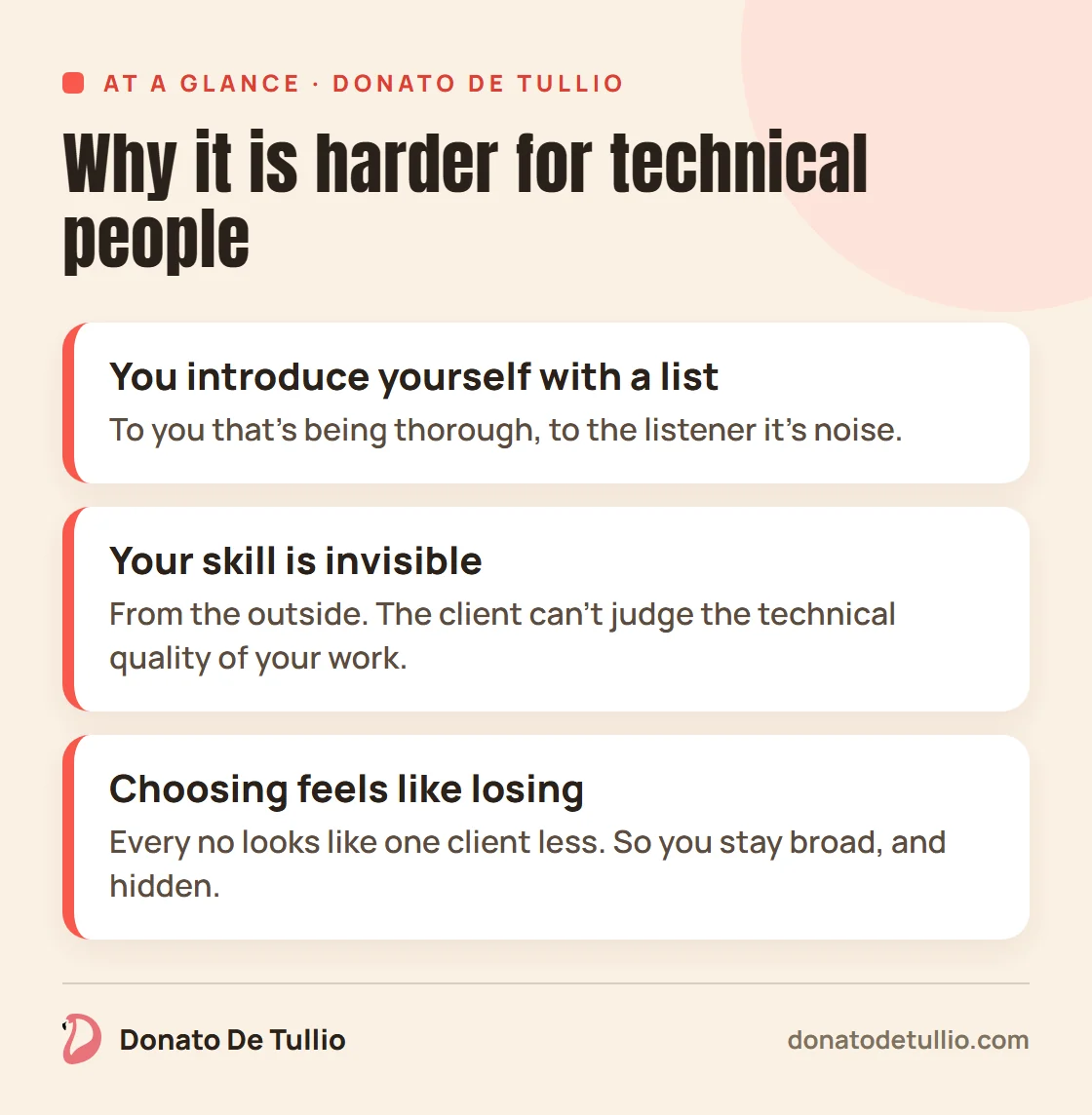
- You introduce yourself with a list. When people ask what you do, you answer with everything you can do. To you that's being thorough, to the listener it's noise. The client is buying a solved problem, and the list leaves them to do the translating. Usually they don't.
- Your skill is invisible from the outside. The client can't judge the technical quality of your work. So they judge what they can understand: the price, how much they like you, whose name they heard first.
- Choosing feels like losing. Narrowing down is scary, because every no looks like one client less. And underneath there's often a little voice telling you you're not yet good enough to specialize. So you stay broad, and staying broad keeps you hidden.
What are the signs you aren't positioned?
- When people ask what you do, you start listing.
- You get compared on price, and the cheapest often wins.
- Work comes almost only through word of mouth, and you can't say why.
- You do a bit of everything for everyone, and every year you work more.
- People who recommend you say «he's good», but can't say at what.
If three of the five sound like you, what you're missing comes before marketing. It's a choice.
Positioning is a decision
You decide your positioning, nobody hands it to you. It's one of the hardest decisions a professional makes, because it asks you to give something up. So I work on it with the same method I use for hard decisions, the 5D Method from my book Stay or Leave?, in five steps.
- Data. What is true, net of the stories you tell yourself. What the people who choose you are really buying, and who they compare you with. Who they think of, which may not be who you think of. Often the real alternative is «I'll do it myself» or «I'll leave it as it is».
- Direction. Which field it makes sense to move in, even without a precise goal yet. Who you want to work for in the coming years, and which work lights you up. You won't stick to a positioning that bores you.
- Decision. Which road you choose, and what not choosing costs you. This is where you give something up: a type of client, a service, a part of the work that pays but keeps you muddled.
- Destination. The precise point you want to reach, fixed with a date. The sentence, the offer and the price, tested on the market with real people by that day.
- Desire. What you really want, underneath what adds up. It keeps you standing in the first months, when giving things up is scary and the result still can't be seen.
If you want a first exercise, start with the 3 Ps of positioning: Person, Problem, Period.
What does positioning have to do with sales and revenue?
When revenue stalls, the first instinct is to push harder: more outreach, more posts, a discount. Sometimes that's enough. Often it isn't, because the people listening still don't see why they should choose you.
- Selling. When a client sees straight away which problem you solve, you don't have to convince them you're good. You talk about their problem. Here's how to sell your services.
- Getting clients. When the people who know you can say which problem you solve, they can send you the right clients.
- Standing out. If you do what everyone else does, only price is left. Here's what to do when clients only compare price.
- Getting the business unstuck. If you do everything for everyone, every request is urgent and the business depends on you. Once you choose, you know what to drop and what to hand over.
Positioning alone won't bring clients or raise revenue, and anyone who guarantees that is lying. It helps when the rest isn't working because people can't tell who you are and who you work for.
What changes when you're positioned?
- People look for you for a precise reason, instead of holding you up against two other quotes.
- Price stops being the main topic of conversation.
- Word of mouth gets precise, because the people who recommend you know who to send.
- You can hand things over. When you know who you are, you also know what you should stop doing. If today you're doing everything yourself, this is where it starts to loosen.
How long does it take?
You can make the decision in a few weeks. For the market to notice takes months: the same sentence and the same problem, repeated everywhere. Positioning rewards the people who stay, and punishes those who change their mind every six months. I say this to myself too, having tried quite a few.
Mistakes to avoid
- Widening too early. First become the reference in your space, then widen if you still want to. More on this in one offer, done better.
- Confusing positioning with image. A new logo doesn't choose for you.
- Waiting until you feel ready. Confidence comes later, from the evidence you pile up. I write about it in the invisible work.
Where do you start?
Take a sheet of paper and finish this sentence: «I help [who] to [solve what], so that [what changes for them].» If you get three different versions, you've found your starting point.
Then go to the piece that's holding you back most: how to choose a niche when you can do everything, what to do when clients only compare price, what to answer to «so what do you do?», how to use the 5D Method on your market.
If you want to do it with someone who pushes back, that's what we do in Position Lab: working together to build your positioning, testing it with real people. The first step is a thirty-minute coffee. Let's have a coffee (30 min).
Frequently asked questions
What is positioning for a professional?
It's the place you hold in the head of the person who has to choose you, meaning the sentence a client uses when they talk about you to someone else. If that sentence doesn't exist or keeps changing, you aren't positioned, however good you are.
Why isn't being good enough to get chosen?
Because clients usually can't judge the technical quality of your work. They judge what they understand: price, how much they like you, whose name they heard first. Skill keeps the client, positioning gets you chosen.
How long does positioning take?
The decision takes a few weeks. For the market to notice takes months of repetition, with the same sentence and the same problem everywhere. Change your mind every six months and you start over each time.
Is positioning the same as a logo or a website?
No. Logo, website and posts come later and carry a sentence you've already decided.
Was this useful? Get the next articles by email: leave your address here.

He did his PhD in chemistry with Merck, then spent more than ten years in European multinationals, working his way up from the warehouse floor to running logistics. Today he helps professionals and companies who make a living from their expertise get chosen by the right clients.
About me