Answer with one sentence that says who you work for, which problem you solve and what changes for that person. Keep the list of what you can do for whoever asks later.
You're at a dinner with friends. The man next to you pours the wine and asks: «So what do you do?» Off you go. The sector, then the projects, then that other thing you do even if nobody would guess, then «well, it depends, a bit of everything really». After forty seconds he nods and reaches for the bread.
I know this well, because it happened to me too, and helping others with their positioning is my job. Sharp as a tack.
Why doesn't the list work?
Because the listener has to do the translating. They have to work out what you can do, then who it's for, then whether it's for them or someone they know. Nobody does that at dinner, and no client does it on the phone either.
Ries and Trout wrote it back in 1981: in a crowded mind you get in by taking a precise spot. Whoever tries to be everything to everyone takes none. If someone can't say in one sentence what you are after talking to you, for them you don't exist yet.
The list protects us. As long as I'm listing, nobody can turn me down on one thing. A precise sentence exposes you, and people who are truly good feel like show-offs saying it.
My answer is what I always say: either you live your life, or you help people with a problem solve that problem. Saying clearly which problem you solve is a service to the listener, who sees right away if you're useful to them. Promoting yourself doesn't mean you can't do the work. If you can do the work, you owe people a clear explanation.

How do you write the sentence?
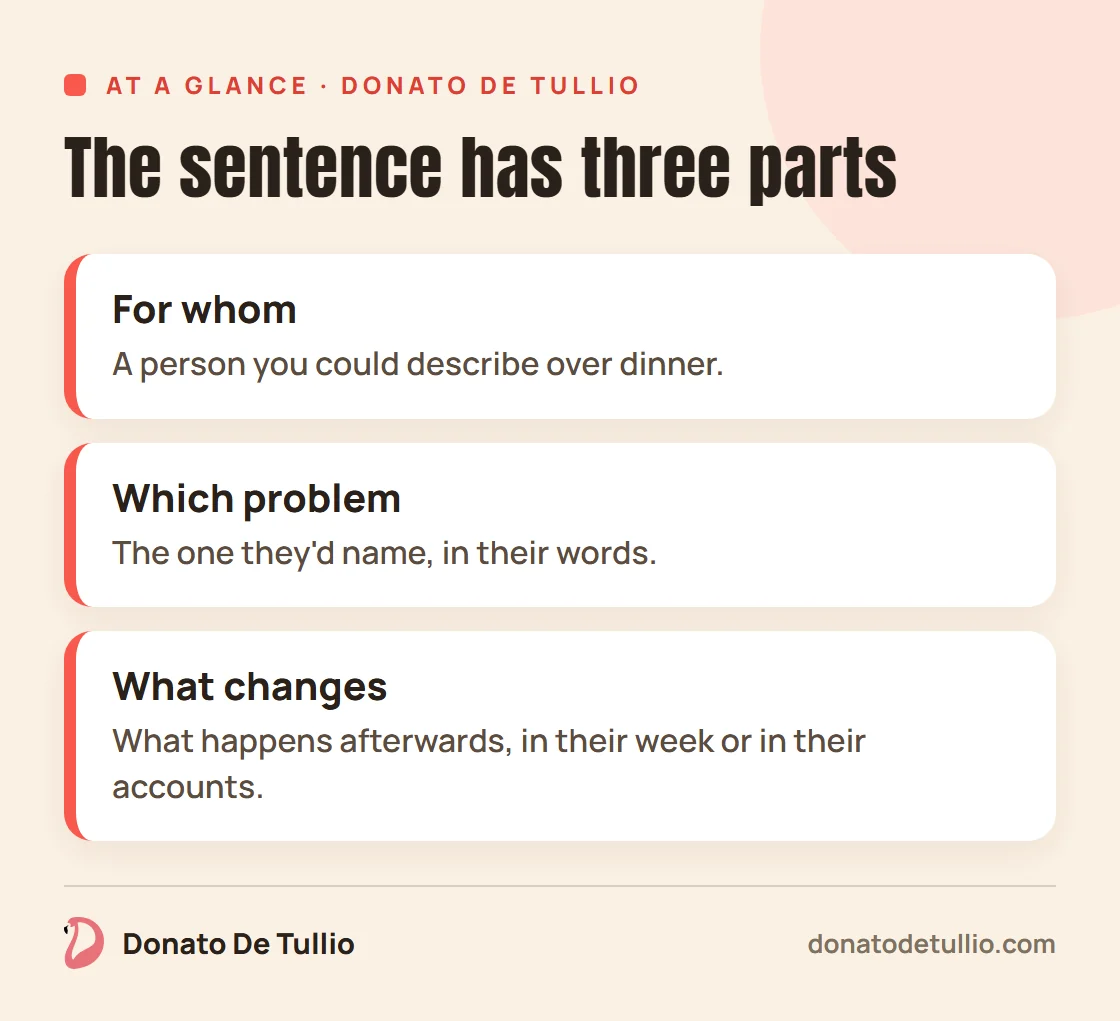
It has three parts. I help [who] to [solve what], so that [what changes for them].
This sentence is where the work starts. It is a hypothesis that gives you initial clarity: then you test it with real clients, and change it if you need to.
- For whom. A person you could describe over dinner. «Companies» and «professionals» don't count.
- Which problem. The one they'd name, in their words. If a word comes out that they'd never use, it's yours.
- What changes. What happens afterwards, in their week or in their accounts. Your method has no place here yet.
To make it stronger, add the moment: «when...». That's the Period in the 3 Ps of positioning, and it says why now.
What does a sentence look like, before and after?
These are made-up examples, to show you the mechanism. Watch what disappears and what stays.
- Before: «I do consulting, training, data analysis and automation, depending on what's needed.» After: «I help small business owners who lose two days at the end of every month chasing their numbers to have them ready in an hour, so they decide sooner.»
- Before: «I manage complex technical projects, from feasibility to delivery.» After: «I help people who've just won funding take their first product from the lab to the customer, without running out of cash on the way.»
- Before: «I work on strategy, organization and people development.» After: «I help new bosses lead their former colleagues in the first six months, so they stop redoing the team's work at night.»
In all three cases the person can still do everything from the first version. They just stopped asking the listener to translate it.
How do I know the sentence works?
Try it out loud, on five people, in the next seven days. Leave the paper and the meeting room aside, and watch what the listener does.
- It works if they ask you a question, or say «you should talk to my brother-in-law».
- It doesn't work if they nod, say «interesting» and change the subject.
- It's too long if you can't say it in one breath.
- It needs rewriting if, a week later, the person who heard it can't repeat it to someone else.
Write down what they said each time. After five tries you have data, and you correct the sentence on that.
And everything else I can do?
It stays where it is, and it comes out with the second question. When they ask «oh, and how do you do that?», you can tell them the rest, and this time they listen, because they understand what it's for.
The last thing is the most boring. Once decided, the sentence goes everywhere, unchanged: website, LinkedIn profile, signature, dinner table.
The sentence is the visible part of positioning. If it won't come, the problem usually sits earlier, in choosing who to work for. In Position Lab we start there and test the sentence with real people. The first step is an espresso together. Let's have a coffee (30 min).
Frequently asked questions
What should I say when people ask «so what do you do?»
One sentence with three parts: who you work for, which problem you solve, what changes for that person. The rest comes if they ask a second question, and that's usually where the real conversation starts.
How long should a positioning statement be?
As long as you can say in one breath, usually twenty or thirty words. If you have to read it, it's too long. If your neighbor gets it the first time, you're fine.
Should I use the same sentence with everyone?
Yes, at least for a few months, because the market only notices what it hears repeated. You can change the examples depending on who's in front of you. The who and the problem stay the same.
What if the sentence feels too limiting?
That's normal, because it asks you to give up saying everything. It limits what you say first, and leaves what you can do untouched. Try it on five people and see if the answers improve.
Was this useful? Get the next articles by email: leave your address here.

He did his PhD in chemistry with Merck, then spent more than ten years in European multinationals, working his way up from the warehouse floor to running logistics. Today he helps professionals and companies who make a living from their expertise get chosen by the right clients.
About meWhere to start: the positioning guide.