A value proposition tells a specific person which problem you solve for them, what they'll hold at the end and why they should pick you. You write it in four pieces: for whom, which problem, which result, which proof. If a competitor can copy it onto their site without lying, rewrite it.
It's ten at night and you're redoing your home page. You write: «Innovative, tailor-made solutions, with professionalism and attention to the client.» You read it back. It isn't false. Then you notice it would work just as well for your plumber, your accountant and your worst competitor.
That's the problem with nearly every value proposition written by someone good at technical work. It's true, and it tells the reader nothing.
What is a value proposition?
It's the promise you make to someone who is weighing up working with you. It answers a question the client asks in a few seconds: what's in it for me, and why from this person?
A slogan helps people remember you, a value proposition helps them understand you. It can even be a little inelegant, as long as the reader recognizes themselves.
You'll find it at the top of a home page, at the head of an offer, in the first lines of a quote.

How is it different from positioning?
These are three close things that often get mixed up.
- Positioning is the decision, who you are and who you work for. I cover it in the professional repositioning guide.
- The positioning statement is what you say out loud when someone at dinner asks what you do.
- The value proposition is what you write for someone already thinking of buying. It goes into more detail and adds the proof.
The order matters. If you haven't decided who you work for, you'll end up with a value proposition for everyone, which means for no one.
Why do technical people find it so hard?
Because they know too much. It's called the curse of knowledge: once you know something, you can't imagine thinking without knowing it.
You fall into it when you write «vibration analysis» or «refactoring».
And you talk about what you do, because that's what you can measure. I keep asking the same question: what's the difference between before and after working with you? If you can answer it, you're halfway there.
How do you write a value proposition?
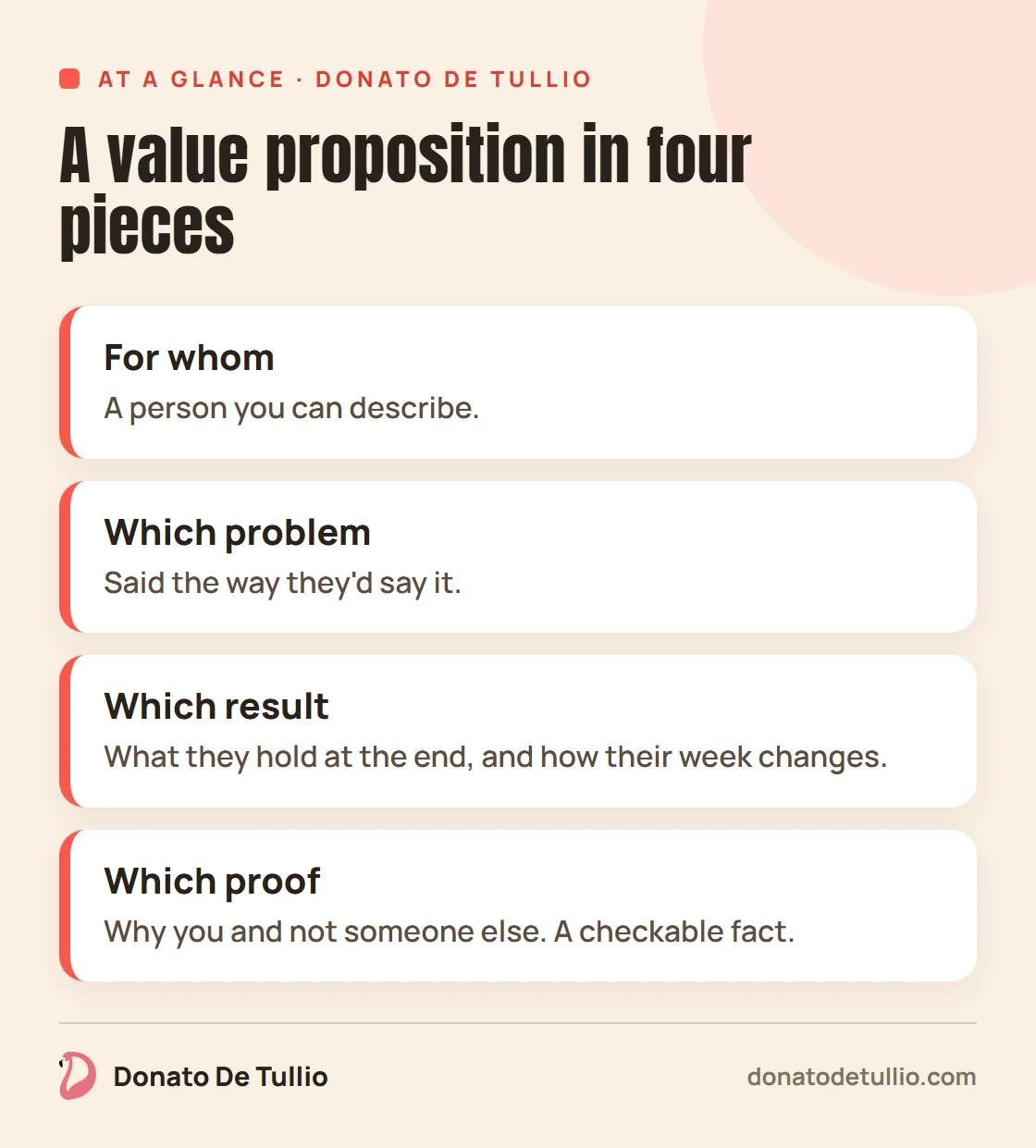
With four pieces. Write them separately and sort out the order at the end.
- For whom. A person you can describe. «SMEs» is too wide. «Someone running a warehouse with an energy bill they can't read» is a person who recognizes themselves right away.
- Which problem. Said the way they'd say it. If you write a word they'd never use, it's yours.
- Which result. What they hold at the end, and how their week changes. Write what you deliver and what you control, and leave out how much revenue the client will make, because that doesn't depend on you alone.
- Which proof. Why you and not someone else. A checkable fact, a combination of experiences, a way of working others don't want to adopt.
Put together, it goes like this: for [whom] who [problem], I do [what] and at the end [result]. I can do it because [proof].
What are some value proposition examples?
I made up these examples to show you the mechanism. They aren't clients and they aren't real people. Watch what disappears between before and after.
A chemical regulations consultant
Before: «Full-service regulatory consulting for the chemical industry.»
After: «For small exporters who get a request for documents from a foreign client and can't make sense of it, I prepare the file and say what's missing before the client has to ask twice. I spent ten years in a quality control lab, so I know what inspectors look at.»
A software developer
Before: «Custom software development with modern technologies.»
After: «If your management system was written years ago by someone who has since left, I make it safe in six weeks. At the end there's documentation, and someone in the company can work on it. The code stays yours, and every Friday you see what changed.»
A data analyst
Before: «Data analysis and business intelligence for your company.»
After: «For owners of manufacturing firms who don't know at month's end which order made money, I build a single sheet that tells them in ten minutes. I come from management control in a factory, and I use the sheet myself.»
An energy engineer
Before: «Energy efficiency solutions.»
After: «If you run a warehouse and pay bills you can't read, I measure for two weeks where the energy goes and hand over three interventions ranked by payback. I also tell you which ones aren't worth it, including the ones I could sell you.»
In all four cases the person can still do everything else. They've only chosen where the reader comes in. And nobody promises a figure for the client's revenue.
How do I check it works?
Take your value proposition and put it through three tests. A sheet of paper and a phone will do.
- The competitor test. Could your closest competitor put it on their site without lying? If so, the proof is missing.
- The «so what?» test. Read each sentence and ask «so what?». If you can't answer with something that changes for the client, cut it.
- The spoken test. Read it over the phone to someone outside your field and ask them to say it back in their own words. If something else comes out, the problem is in the text.
Then you need the market. Try it on five people who have that problem and see whether they ask a question or change the subject. To choose who to try it on, use the 3 Ps of positioning, Person, Problem, Period.
What if I can't get it right?
Usually the block isn't in the writing. It comes out generic because you haven't decided who you work for, and choosing feels like losing clients. No formula fixes that, and I won't promise that a better sentence will bring you more clients either. It helps the people who have the problem to understand you. The rest also depends on how many people meet you and how you sell.
If you don't know who to write it for, start with how to choose a niche. If you want to make that decision with someone who pushes back, and test the sentence on real people, that's what we do in Position Lab. The first step is an espresso together. Let's have a coffee (30 min).
Frequently asked questions
How long should a value proposition be?
Two or three sentences are enough, as long as all four pieces are there. At the top of a page it can stay one line, with the proof right below. If you need more than five lines, you're often still trying to talk to everyone.
Is a value proposition the same as a slogan?
No. A slogan helps people remember you and can be vague. A value proposition helps them understand you, so it says who it's for, what it solves and why they should pick you.
Can I promise a financial result?
Only if you control it and can prove it, which is rare in services. It's better to promise what you deliver and what changes in the client's work, and to say clearly what doesn't depend on you.
Do I need a different value proposition for each service?
You need one main proposition, tied to the person and the problem you chose. If you have several offers, each has its own result. If you need three different people and three different problems, the knot is in choosing who to serve.
Was this useful? Get the next articles by email: leave your address here.

He did his PhD in chemistry with Merck, then spent more than ten years in European multinationals, working his way up from the warehouse floor to running logistics. Today he helps professionals and companies who make a living from their expertise get chosen by the right clients.
About meWhere to start: the positioning guide.