The curse of knowledge is what happens when you know something very well and can no longer imagine how it looks to someone who doesn't. For people who sell their expertise it's a concrete problem. You talk to your peers instead of the people who buy, and the thing that could get you chosen feels too obvious to say. You can't see it from inside, which is why you need an outside view.
A dinner. The person next to you asks what you do, and you answer the way you always answer. They nod politely, and ten seconds later they're talking about holidays. You think your work doesn't interest them. Maybe. Or maybe they understood nothing, and they're too kind to say so.
If it happens now and then, never mind. If it happens with people who could buy, it's a problem. It has a precise name.
What is the curse of knowledge?
Once you know something, you can no longer imagine how people reason without knowing it. The name comes from a study by Colin Camerer, George Loewenstein and Martin Weber, published in 1989 in the Journal of Political Economy. They showed that people with extra information can't set it aside when they have to imagine how someone without it reasons, even when it would be in their interest.
Said at the dinner table, it means this. What is obvious to you doesn't exist for the client. And you don't notice, because it seems obvious.

What does the finger-tapping experiment show?
In 1990 Elizabeth Newton, for her doctoral thesis at Stanford, put people in pairs. One tapped out the rhythm of a well-known song with their fingers, the other listened and had to guess the title. The tappers expected about half of the listeners to recognise it. About 2.5 percent did.
The tapper hears the song in their head, with the voice and the instruments. The listener hears knocks on a table. The same thing happens when you describe your work. You hear ten years of cases, mistakes and solutions. The other person hears “integrated consulting”.
Why does it hit good people in particular?
Because the more you know, the more you take for granted. Early in your career you remember what you didn't understand, and you can explain it. Fifteen years later that memory has gone. What's left is the language of your peers, which is precise, and which nobody outside your circle understands.
So people who are technically very good end up living in a bubble. Inside it, they understand each other perfectly. Little gets out, and they usually conclude that the market can't recognise quality.
How can you spot it when you're selling your work?
When I ask questions of people who are very good at what they do, the same things tend to come out. See how many are yours too.
- You introduce yourself with a sentence anyone in your field could say.
- Your real work is much bigger than what you tell people.
- The things that feel obvious to you stay unsaid, for fear of what colleagues might think.
- You write with them in mind, instead of the people who buy.
- Work only comes through word of mouth, because whoever sends someone has already seen what you can do and needs no explanation.
- You watch the clients you want go to people less skilled than you, who explain themselves better.
A made-up example, to be clear. An accountant writes on her website “tax and corporate advisory, planning and management control”. To her peers it's a serious list. The owner of a car repair shop finds nothing in it. If she wrote “every month I tell you how much money you really have left, before the bank does”, it would feel trivial to her. He would look up, because that's his problem in his words. I explain the step from list to sentence in value proposition and in the positioning statement.
Why can't you do it alone, when you can do it for clients?
Because you're too close. You can tell your clients in five minutes what's wrong, precisely because you see them from outside. With yourself you don't have that outside. You can read all the books you like, and you'll still hear the song in your head.
There's something else too, which you don't tell colleagues. Often you're the only one deciding, and I live that too. Your partner, your spouse and your accountant care about you, but each of them sees their own piece. That's why you need an outside view, someone who asks stupid questions and doesn't settle for the first answer.
Does this come before marketing?
It does. Everyone is selling marketing and more clients, and almost nobody starts before that, by asking how to make what you say clear. If the message can't be understood, marketing only brings more people who don't understand it, and you pay for them too.
This is part of professional repositioning, and it works through trials. You choose a positioning, test it, look at the data, adjust it. You don't have to appeal to everyone, only to the few who need you, and those few usually don't do your job.
How can you test it on someone outside your field?
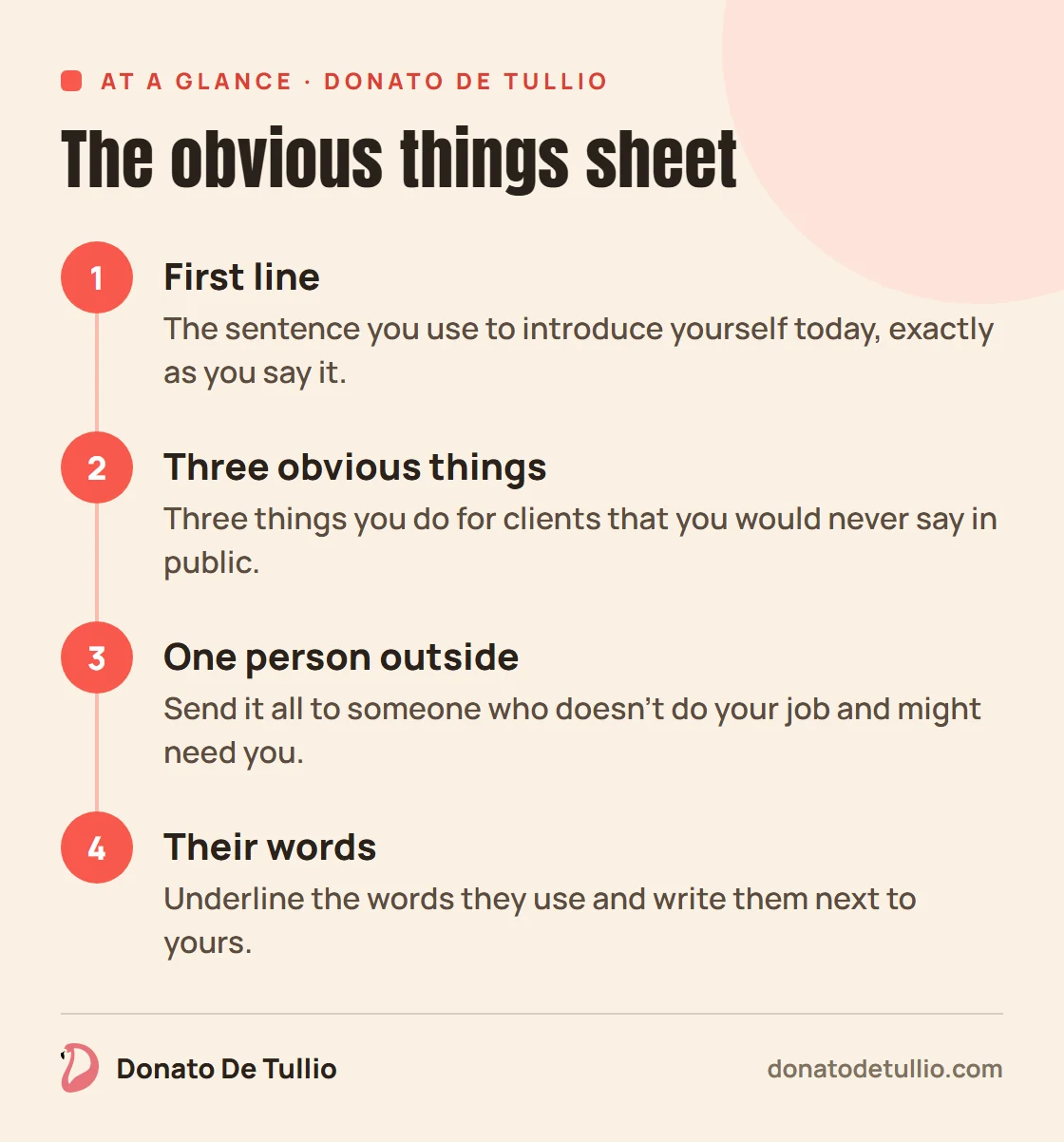
You need a sheet of paper and your phone. I call it the obvious things sheet.
- First line. Write the sentence you use to introduce yourself today, exactly as you say it.
- Three obvious things. Below it, write three things you do for clients that you would never say in public, because a colleague would reply “everybody knows that”.
- One person outside. Send it all to someone who doesn't do your job and might need you. Ask two questions. What do I do, in your words? Which of these three things interests you most?
- Their words. When they answer, underline the words they use and write them next to yours.
If their sentence is different from yours, you have a piece of data. If they pick one of the obvious things, you have two. You don't need one more opinion here, you need to see where the song stops getting through.
If you'd like to do this with someone who looks from outside and pushes back, that's the work of Position Lab, with me.
Frequently asked questions
What is the curse of knowledge, in plain words?
Once you know something, you can no longer imagine how people reason without knowing it. That's why what is obvious to you often doesn't exist for the client.
Where does the name come from?
From a study by Colin Camerer, George Loewenstein and Martin Weber, published in 1989 in the Journal of Political Economy. The most famous example is Elizabeth Newton's 1990 doctoral thesis at Stanford, on rhythms tapped with the fingers.
How do I know if it applies to me?
You introduce yourself with a sentence anyone in your field could say, you can only explain yourself to people who do your job, and work only comes through word of mouth. If that sounds familiar, show your sentence to someone outside your field and ask what you do, in their words.
Does this come before marketing?
Yes. If the message can't be understood, marketing only brings more people who don't understand it. First you get clear on what to say and to whom, then you think about how to get it across.
Was this useful? Get the next articles by email: leave your address here.

He did his PhD in chemistry with Merck, then spent more than ten years in European multinationals, working his way up from the warehouse floor to running logistics. Today he helps professionals and companies who make a living from their expertise get chosen by the right clients.
About meWhere to start: the positioning guide.