Entrepreneur loneliness is what happens when you talk to lots of people every day and have nobody to really think through your work with. It doesn't depend on how many people are around you. It costs you your view of your own work, because you're too far inside to see it. You start to get out of it by finding one person who understands your work and doesn't depend on you.
You've been talking all day. Clients, suppliers, your accountant, two calls in the car. In the evening someone asks how it went and you say «good, lots of work». That's no lie. Saying the rest would take too much explaining, and it's late.
Now ask yourself a simple question. Apart from the people you live with, who do you talk to about your work?
Talking about it means telling someone about Tuesday's doubt, the client you maybe should have turned down, the idea that seems good and may be nonsense. If a name comes to mind, you're lucky. If it takes you more than ten seconds, keep reading.
What is entrepreneur loneliness?
It's an odd kind of loneliness, because it doesn't show. You're surrounded by people and none of them sits on your side of the table. You only notice when you have something to say and don't know who to say it to.
I'm telling you this in the present tense: it's a pain I live with too. I'm not writing this article from the outside. What follows is how I look at it, with no recipes.
It's also different from the weight of making each big choice alone. There the issue is the decision of the moment. This is wider, and it covers all the days when there's nothing to decide and you still have nobody to tell how things are going. It often comes together with the habit of doing everything yourself.

Why don't you talk to anyone about it?
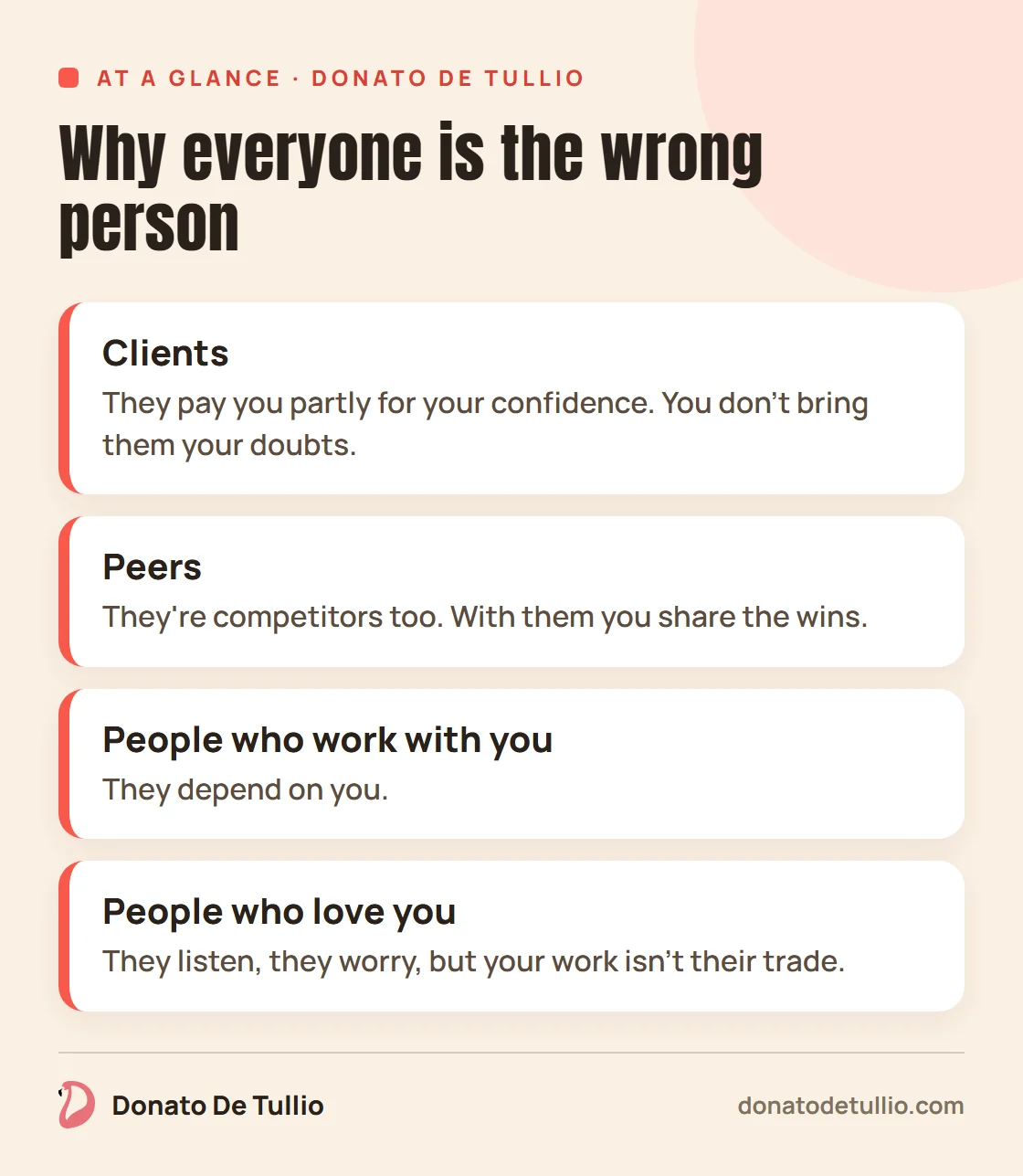
Because everyone, for a sensible reason, is the wrong person.
- Clients. They pay you partly for your confidence. You don't bring them your doubts.
- Peers. They know what you're talking about, but they're competitors too, and you worry what they'd think. With them you share the wins.
- People who work with you. They depend on you. Tell them you don't know where you're all heading and they'll stop sleeping.
- People who love you. They listen, they worry, or they tell you it'll all be fine. That's as it should be, but your work isn't their trade.
So you get used to it. After a few years it no longer feels like being alone. It feels like being a private person.
What does it cost you, in practice?
The most concrete cost is that you can no longer see your own work. People who are very good live inside a bubble, and you can't see a bubble from inside. With your clients you do this very well: you listen and spot right away what they don't. For yourself you can't, because you're too far inside. This has nothing to do with intelligence, nobody can look at the back of their own head.
The second cost is that you measure yourself badly. If you don't know how others are really doing, you compare yourself to their shop windows, as I wrote in the invisible work. The third is that it all stays in your head, and at night it goes round and round. The thought «I'm alone in deciding» rarely comes first, you usually find it underneath another problem, like revenue or too many hours.
There's a classic reference in the research. In Healthy Work from 1990, Karasek and Theorell describe job strain as the product of high demands and little control, with the support of the people around you as something that softens it. People who work for themselves often have a lot of control and little support. The findings are strong on demands and control and more debated on support, so take this as an indication.
Do you need a group, a partner or a coach?
It depends on what you're missing, and usually you're missing something specific. A person who understands your work well enough to ask you an awkward question, and who has nothing to lose if they don't like the answer. It could be a peer from another field, a group of people in your situation, or someone you pay for this. A business partner changes many other things, and it isn't something you take on to feel less alone.
Watch out for two shortcuts. The first is the friend who always agrees with you, who makes you feel good for an hour and changes nothing. The second is AI, which is available at two in the morning and also tends to agree with you.
And one serious caution. If you've been reaching the evening empty for months, or you can't see a way out, this article isn't enough. Talk to your doctor or a psychologist, it's their job.
Who have you really talked to this month?
Take a sheet of paper and write the names of the people you've really talked to about your work in the last thirty days. Leave out anyone you live with. Don't count clients, unless you told them a real doubt.
Next to each name, answer one question. Did this person ask me something I didn't expect? Add a mark if so.
Look at the sheet. If it's empty, that's a piece of data and not a fault. Then choose a name, even one not on the list, and send them a two-line message today. «I'm thinking something through about my work and could use an outside view. Do you have half an hour one of these days?» Written down it's less scary than it seems, and the worst that can happen is «I can't this week».
What does this have to do with repositioning?
Repositioning means deciding what work you want to do over the coming years, and that's a question you don't handle well alone. Your head holds the same arguments as always, and the same fears tend to win. You'll find the path in the guide to professional repositioning.
If you're looking for that person on the other side of the table, it's part of the work of Decision Lab, with me.
Frequently asked questions
Why do entrepreneurs feel lonely even around people?
Because they talk to many people and hardly any of them can hear their real doubts. Clients expect confidence, peers are also competitors, and the people who work with them depend on them.
Is entrepreneur loneliness the same as deciding alone?
Not quite. Deciding alone is the weight of a choice made with nobody to think it through with. Entrepreneur loneliness is wider, and it also covers the days when there's nothing to decide and nobody to talk to about your work.
Who can a business owner talk to about their work?
Someone who understands the work well enough to ask awkward questions and has nothing to lose from the answer. It could be a peer from another field, a peer group, or a person paid to do it.
When do you need medical or psychological help?
If you've been reaching the evening empty for months, have been sleeping badly for a long time, or can't see a way out, talk to your doctor or a psychologist. A conversation about work doesn't replace that kind of help.
Was this useful? Get the next articles by email: leave your address here.

He did his PhD in chemistry with Merck, then spent more than ten years in European multinationals, working his way up from the warehouse floor to running logistics. Today he helps professionals and companies who make a living from their expertise get chosen by the right clients.
About meWhere to start: the positioning guide.