An owner dependent business is one where, if the owner stops for two weeks, the work stops too, because decisions, clients and quotes all go through one person. The risk is that growth stalls at that person's personal capacity. You start by finding out what exists only in the owner's head, and that takes five minutes.
Second day of your holiday, under the beach umbrella. Your phone buzzes. «Sorry to bother you, just one thing.» You answer in two minutes, and part of you enjoys it, because without you they don't know where to start. By eleven there are four more. On the third day your laptop is on the apartment table.
«My business depends on me.» When you think that, two things sit inside it together, pride and fear.
Why does it happen to people who are good?
Because things go through you for a real reason. You do them better and faster. Clients have got used to talking to you, and if they call you they never go without an answer. Every time you fix something yourself, you teach everyone that all they need to do is call you.
Nobody did anything wrong, it was what the early days needed. But over time you've built a company with one indispensable employee, and that employee is you. You can't even fire yourself.

What does an owner dependent business cost you?
The biggest cost doesn't show. In The Goal, from 1984, Eliyahu Goldratt describes how every system has one point that limits everything else, and improving anywhere else doesn't get more out the other end. It's a method born in factories and widely used, more than a lab finding. Apply it to a small service business and that point is usually the owner.
You can rebuild the website and bring in more clients. They'll all line up at the same door, yours. Your capacity becomes the capacity of the business.
Then there's the rest. Holidays with the phone on. Getting sick, and worrying about the money before your health. Everything you know that isn't written down anywhere, which is a risk for the people who work with you too. And if you ever wanted to sell, anyone buying a business that rests on its owner also buys the problem of what happens when the owner leaves.
How can you tell if your business depends on you?
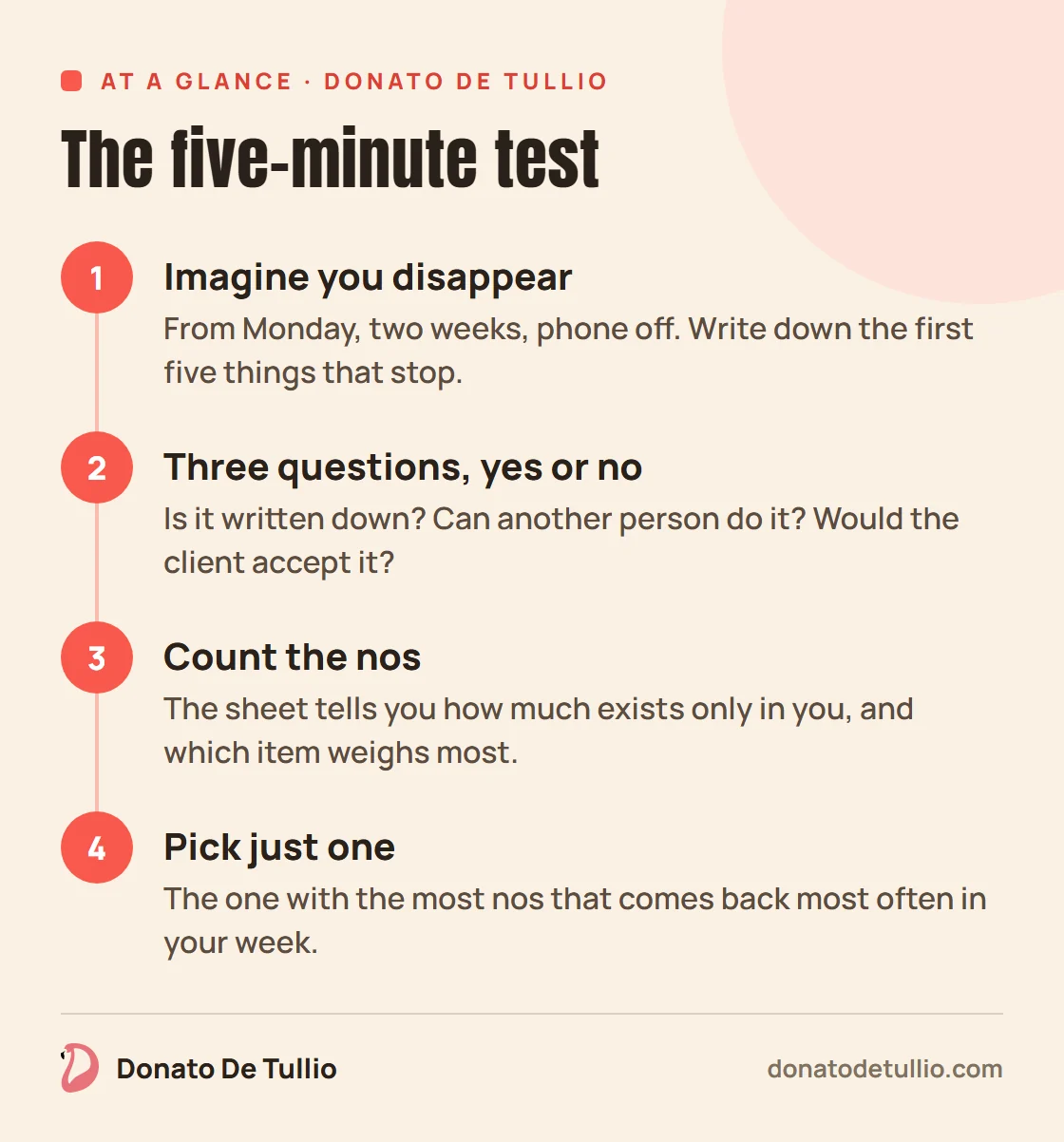
Take a sheet of paper. Imagine you disappear from Monday, two weeks, phone off. Write down the first five things that stop.
Next to each one, answer yes or no to three questions.
- Is it written down somewhere, so someone else could follow it?
- Is there another person who can do it right now, even if worse than you?
- Would the client accept the result if someone else did it?
For the third question, if you don't know, write «don't know» and count it as a no. Then count the nos across the whole sheet, fifteen at most. There's no official score, but the sheet already tells you two things. How much exists only in you, and which item weighs most.
Out of the five, pick the one with the most nos that comes back most often in your week. Pick just one. That's your starting point.
Does everything have to stop depending on you?
No. I talk about a business that no longer depends entirely on you, and the word that counts is entirely. If what you sell is what you know, part of the value is you, and that's fine.
Some things are worth keeping close. The direction. Decisions on price. The work you love and that people choose you for. The difference is between what depends on you because you decided it should, and what depends on you because nobody ever thought about it.
Where do you start stepping back?
- Write one procedure, just one. The one you picked with the sheet. Michael Gerber puts this at the heart of The E-Myth, a book based on experience with no scientific claims. The typical mistake is wanting to write a hundred before you've tried one. Write it with the person who'll do it.
- Work side by side, as well as writing. What you do without thinking is often something you can't even explain. In The Knowledge-Creating Company, Nonaka and Takeuchi call it tacit knowledge, and they say it passes on mostly through working together.
- Turn repeating decisions into rules. The discount, the Friday rush job, the client who pays late. A written rule answers for you.
- Choose people who can grow. When you bring someone in, look past today's task. Ask yourself what role they could have in two or three years. And expect things to go worse at first, as I explain in doing everything yourself.
- If you're alone, start with what isn't your craft. The admin, the website, the repeat answers. Your clients don't choose you for those.
Is stepping back about working less?
Not necessarily, and that isn't the point. If you free up ten hours without deciding what they're for, they fill themselves, often with the same things. The real question comes before delegating. What do you want to do with the hours you have in your hands?
Professional repositioning starts there, and it's about the owner before the business. If your days go on keeping the work moving, read work on your business, not in it. If you came up through a technical trade, there's also from technician to entrepreneur. And if you want to do it with someone, in Position Lab we work, with me, on the role you want.
Fill in the five-item sheet before your next holiday.
Frequently asked questions
What is an owner dependent business?
It's a business where decisions, clients and day-to-day knowledge all run through the owner, so the work stops when the owner stops. It's common in small service businesses, and it usually grows out of the owner being very good at the work.
How do I know if my business depends on me?
Imagine disappearing for two weeks with your phone off and write down the first five things that stop. For each, ask whether it's written down, whether someone else can do it, and whether the client would accept the result from someone else. The nos show where you're the bottleneck.
Can a solo freelancer stop being owner dependent?
Not completely, and there's no need to. You can choose which parts depend on you and which don't, such as admin, repeat answers or part of the service. The word that counts is entirely.
Will hiring someone fix it?
Not by itself. If decisions still go through you, you've got one more person asking you what to do. First write down what has to happen and who decides what, then work side by side.
Was this useful? Get the next articles by email: leave your address here.

He did his PhD in chemistry with Merck, then spent more than ten years in European multinationals, working his way up from the warehouse floor to running logistics. Today he helps professionals and companies who make a living from their expertise get chosen by the right clients.
About meWhere to start: the positioning guide.