Professional repositioning means redefining your role in your work: what you do yourself, who for, and where you want to be in ten or twenty years. You need it when you're good at what you do, you work hard, and you notice you've lost your direction. It doesn't have to mean changing jobs, and it comes before any work on your website or your offer.
A friend asks you over dinner how things are going. You say «good, lots of work». Driving home, you realize that's the same answer you gave five years ago. Same work, same phone calls, a few better clients and quite a bit more tiredness.
Nobody in that car is thinking «I have a positioning problem». The thoughts sound different. «I work too much.» «I've stopped growing.» «I don't recognize myself anymore.» «My business depends on me.» «I don't know what to do with the coming years.»
They're different sentences, and they often come from the same story. You used to be the strategist of your own business, and little by little you became its best worker. The work keeps moving, and nobody is deciding where it goes.
What is professional repositioning?
It's the moment you question the place you hold in your own work. What you do with your own hands, what you leave to others, who you work for, and where you want to be in ten or twenty years. It's about you, before it's about your business card.
You can do it in the same field, with the same clients, even in the same company. What changes is how you stand inside your work. Sometimes the job changes too in the end. That can happen, but it isn't where you start.

How is it different from changing jobs?
Changing jobs means changing places. You can resign, go freelance, move to another country, and two years later find yourself doing the same things the same way, with a different name on the invoices.
It works the other way round too. You can stay where you are and change almost everything: what you accept, what you turn down, what gets your best hours.
How is it different from market positioning?
Market positioning is the place you hold in the head of the person who has to choose you, the sentence a client uses when they talk about you to someone else. I wrote about it in positioning. It's about what the market understands about you.
Professional repositioning comes first, and it's about what you want to be. Positioning asks «who do I work for, and how do I get that across?». Repositioning asks «what work do I want to be doing, in the coming years, inside my own business?». Skip that second question and you may end up with a beautiful sentence for a life you no longer want.
Why does the owner come before the business?
When revenue stalls or the hours pile up, the first instinct is to work on the business. A new website, a new offer, a partner, someone to handle marketing. All sensible moves. Yet if the person deciding is still the one who answers everyone and signs everything, within a few months the new business takes the shape of the old one.
The way I put it is this: reposition the owner before you reposition the business. First you decide what role you want. Then the offer and the website follow that choice, and you also know what to remove. It applies if you're a freelancer and you are the business, even more so.
What are the signs you need it?
- You work more than you did five years ago, and the work itself hasn't changed.
- Other people's requests decide your days, and the big choices slide from month to month.
- If you stop for two weeks, almost everything stops.
- You're still good at what you do, and it weighs on you.
- Part of you is still working to prove something, and you no longer know to whom.
- When someone asks where you want to be in ten years, you change the subject.
If three of these sound like you, it's worth stopping for an hour to look. One caution, though. If you've been reaching the evening empty for months, start there. If you can't breathe you can't think strategically, and nobody decides their future out of breath.
How do you reposition with the 5D Method?
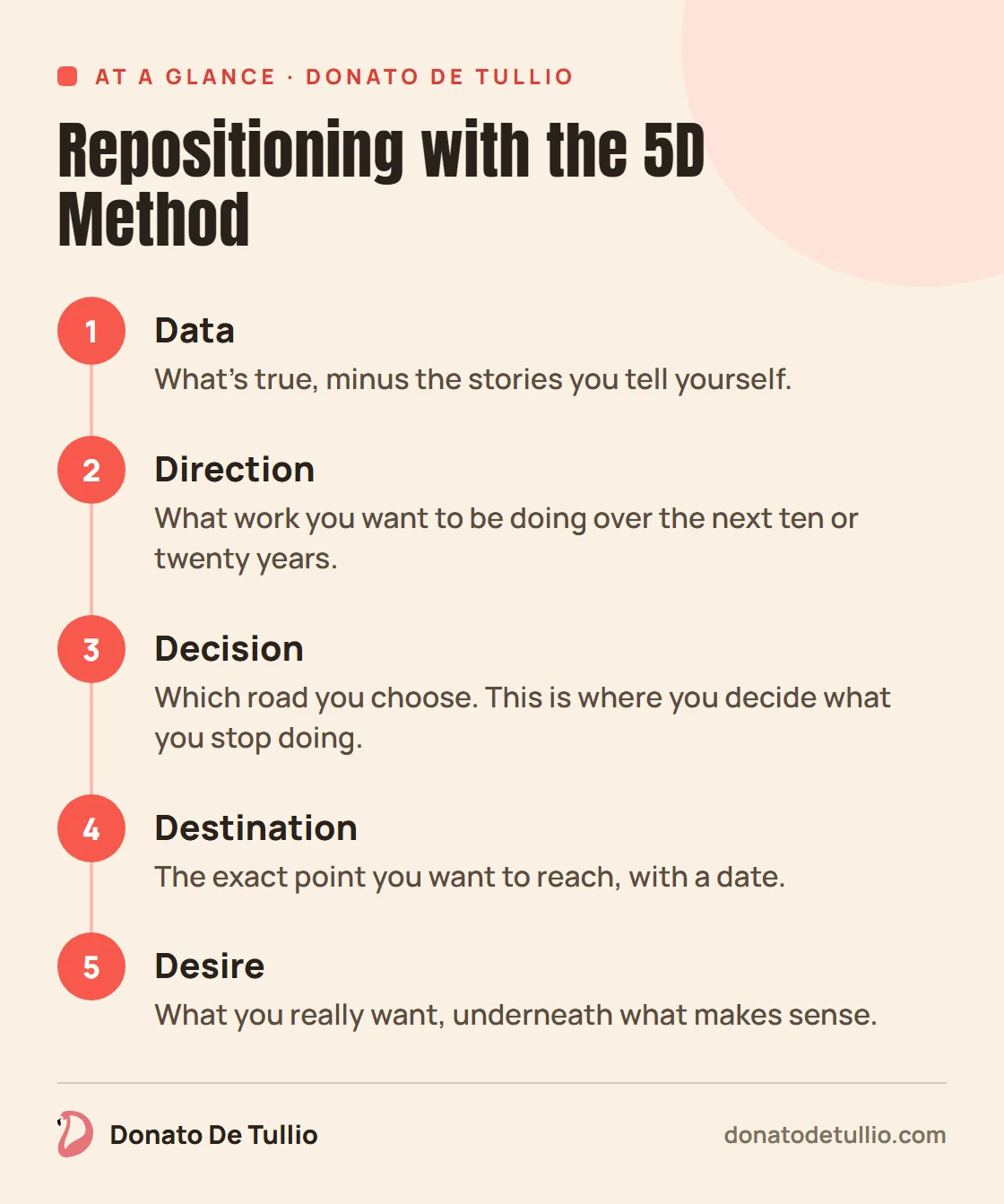
Repositioning is a big decision, made of quite a few things you give up. So I work on it with the 5D Method from my book Stay or Leave?. It has five steps, the same at every crossroads. I've also applied it to the market in positioning is a decision.
- Data. What's true, minus the stories you tell yourself. Where last month's hours went, which work keeps the business standing, what stops without you. Look at the years you've already spent in your trade as well. They won't come back whatever you do, and they keep voting on today's choices unless you call them by their name. Arkes and Blumer measured this in 1985 with theater season tickets: people who had paid full price went to more plays than people who got a discount.
- Direction. Which field makes sense to move in, even without a precise goal yet. What work you want to be doing over the next ten or twenty years, with which people, on which problems.
- Decision. Which road you choose, and what not choosing costs you. This is where you decide what you stop doing. It hurts, because it's often something you do very well and that brings in money.
- Destination. The exact point you want to reach, with a date. For example, by that day you've tried your new offer on five real people, and the work you want to leave no longer goes through you.
- Desire. What you really want, underneath what makes sense. Giving up a life spent proving yourself is often the hardest part, and it's also what keeps you going during the months when nothing shows yet.
One practical note. You can't settle all this on paper. In her 2003 book Working Identity, Herminia Ibarra argues that people changing direction mid career usually find out who they want to become by trying things in small ways, more than by analyzing from a standstill. The book is built on people's stories and it isn't an experiment, so take it as a guide. That's why the Destination step always includes a test with real people.
Does getting out of day-to-day work mean working less?
No, and be wary of anyone who promises that. It means putting your hours where you've chosen to put them. You may work as much as you do now, and for a while even more, because at first the old work stays and the new work comes on top. What changes is who decides where those hours go. More on that in work on your business, not in it.
How long does it take?
The decision takes a few weeks, if you really give it your attention. Trying it out in the real world takes a few months. Moving your work onto the new direction takes years, and that's fine. You're building the next ten or twenty years, and the next quarter is just the first piece.
Which mistakes are worth avoiding?
- Starting with the logo. You change the front and everything behind it stays as it was. A new website on top of a choice you haven't made won't last.
- Throwing everything out at once. Try first, leave later. Dropping paying clients before you've tested anything is courage badly spent.
- Deciding while exhausted. Tiredness picks the nearest exit. Often its only merit is being near.
- Deciding alone, at night. Your head holds the same arguments as always, and the same fears win.
- Looking for the final answer. A direction with a date is enough. Then the facts correct it.
Who are you today, and who in ten years?
Take a sheet of paper and finish two sentences. The first is «today I'm the one who…», written with what you actually do, leaving out the title on your business card. The second is «in ten years I want to be the one who…».
Then open last week's calendar and count the hours that served the second sentence. Write the number underneath. That's your first piece of data, and nobody can argue with it. If the second sentence won't come, you've still found your starting point.
If you want to do this with someone who pushes back, that's the work of Position Lab, working with me to decide what role you want and try it with real people.
Frequently asked questions
What is professional repositioning, in plain words?
It's the choice to redefine your role in your work: what you do yourself, who for, and where you want to be in ten or twenty years. It can lead to a job change, but it's often done in the same field or the same company.
What's the difference between professional repositioning and market positioning?
Market positioning is about what clients understand about you. Professional repositioning is about what you want to be and do, and it comes first. Without that choice you risk communicating very well a kind of work you no longer want.
Does repositioning mean working less?
No. It means putting your hours where you've chosen to put them. For a while you may even work more, because the old work stays while the new work starts.
How long does professional repositioning take?
The decision takes a few weeks, and testing it in the real world takes a few months. Really moving your work onto the new direction takes years.
Was this useful? Get the next articles by email: leave your address here.

He did his PhD in chemistry with Merck, then spent more than ten years in European multinationals, working his way up from the warehouse floor to running logistics. Today he helps professionals and companies who make a living from their expertise get chosen by the right clients.
About meWhere to start: the positioning guide.