To explain what you do, start from what changes for the person who pays you, in their words, and save how you do it for later. The real difficulty is that you're too deep inside your trade. The things that seem obvious to you are often what the client wants to hear, and on your own you rarely notice. That's why you need someone from outside asking you questions.
Imagine a phone call with a happy client. At some point they say: «What helped me most was when you told me to drop it.» You're taken aback. You said that in thirty seconds, between one point and the next, and you didn't even remember it.
It isn't on your website. Everything else is on your website, with all the right terms, written so that no colleague could find fault with it.
As long as work comes through word of mouth, you barely feel this problem, because whoever refers the client does the explaining. You feel it the day you want to be chosen by someone who doesn't know you. That day you notice you can only explain what you do to people who do the same job.
Why is it so hard to explain what you do?
The first reason is that you're too deep inside. Camerer, Loewenstein and Weber measured this in 1989: once you know something, it's hard to reason like someone who doesn't. That's the curse of knowledge, and the better you are, the heavier it gets.
The second reason is that you write for your colleagues. When you look for the words, you have in mind the one who's better than you, or the one who taught you the trade. You write so they can't say anything. A colleague, though, isn't going to buy from you, and the person who buys can't judge the rest. That's why being good isn't enough.
I did a PhD in chemistry, and there you write so the reviewer can't find fault. Excellent training for publishing. Terrible for telling someone why they should call you.

Why are the obvious things the right ones to say?
Something seems obvious to you for one reason only, which is that you've known it for years. Your client doesn't know it. For them it's exactly what they were looking for, and it's often why they'd pay you.
When I ask questions of people who are very good at their trade, I sometimes see this scene. They introduce themselves with a generic sentence. Then, question after question, it turns out their real work is far bigger than what they communicate. And when you ask why they don't say so, you find out it seems too basic to them, and they worry about what their colleagues would think.
That's shame, and it comes with the trade. But your colleagues aren't the people you're talking to. You only need to be the right one for a few people, and they've never heard your obvious sentence.
How do you explain what you do, in practice?
For the sentence itself there's already an article, the positioning statement, with its parts and how to test it. Here I care about what comes before it, the material you write it with.
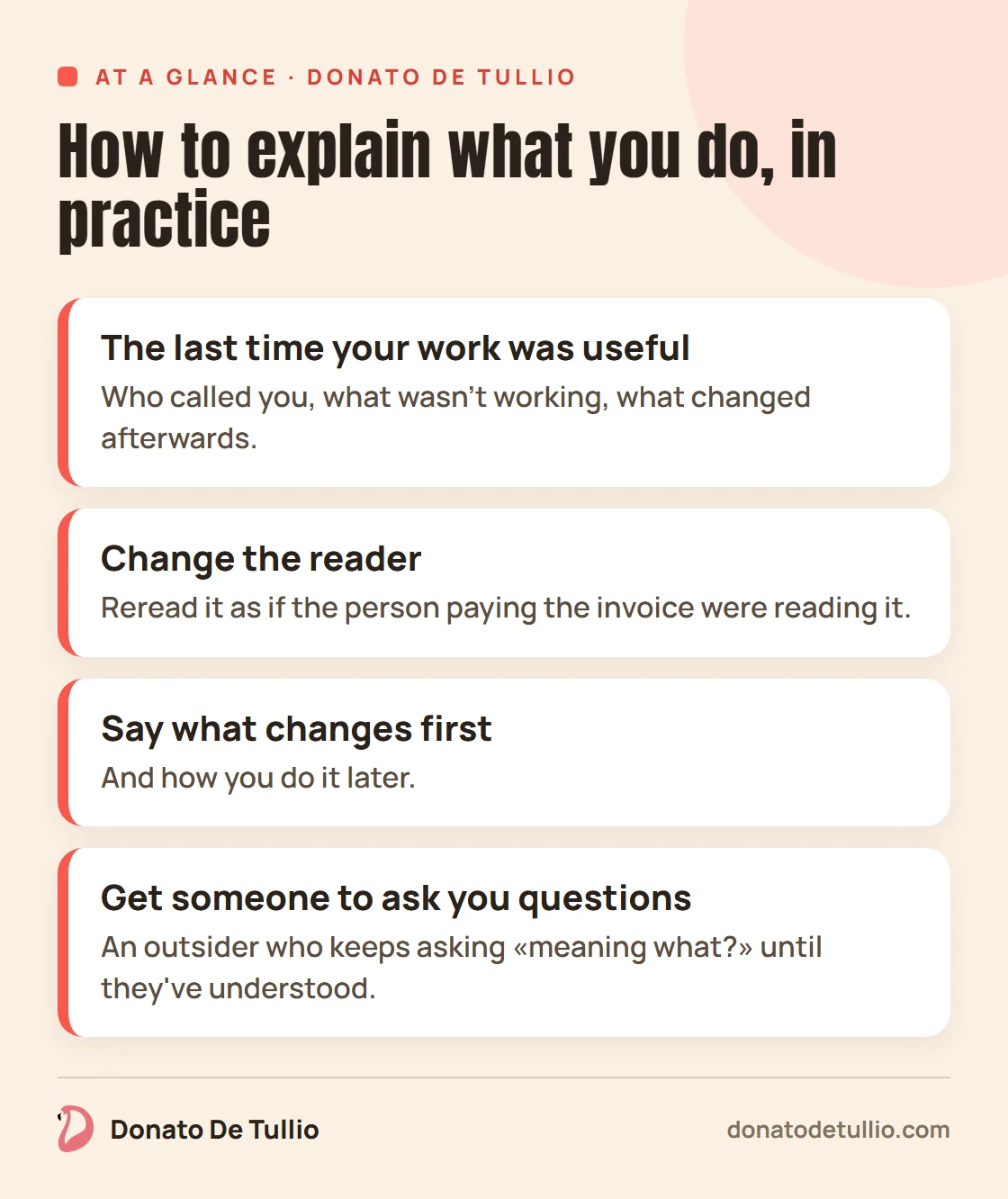
- Tell the last time your work was useful. Who called you, what wasn't working, what changed afterwards. A three-line story explains more than a list of services.
- Change the reader. Reread what you wrote as if the person paying the invoice were reading it. Every word they'd never use is yours, and it moves further down.
- Say what changes first, and how you do it later. The how is interesting, but only to someone who has already understood what you're for.
- Get someone to ask you questions. You need an outsider who keeps asking «meaning what?» until they've understood. You do this very well with your clients, and not with yourself. Even the best dentist can't fix their own teeth.
When should you simplify, and when shouldn't you?
Simplify when you're talking to someone who buys and isn't in your trade. That goes for your website, your profile, the first two minutes of a call, and anyone who has to introduce you to someone else.
Keep the technical terms in these cases.
- The person signing is your peer, and those terms tell them you know the trade.
- You're already at the second question, and they want to understand how you work.
- The simple version makes you promise something you can't guarantee.
Then there's the case where simplifying gets you nowhere. If you can't explain your work because you no longer know what you want to do, the problem isn't in the words. Start with the guide to professional repositioning. And if the words seem fine and you're wondering whether to hire someone to spread them, read marketing agency or positioning.
Which three things do you repeat to every client?
Take a sheet of paper and write down the three things you repeat to every client, the ones that bore you from saying them so often. Don't look for the clever ones. Look for the ones so obvious you can hardly be bothered to open your mouth.
Write them the way you'd say them on the phone. What comes out on paper becomes more real, and it's often the first time you see them lined up. Then open your website or your profile and check whether they're there, in words a client would understand. Usually they aren't.
Next chance you get, say one out loud to someone outside your trade and watch their face. If they ask «meaning what?», it's still written for your colleagues. If they ask «how do you do that?», you've found it.
If you want to do this with an outside eye asking the questions, it's part of the work of Position Lab, with me. We choose what to say and to whom, and we try it on real people.
Frequently asked questions
How do you explain what you do to people outside your field?
Start from what changes for the person who pays you, in their words, and tell the last time your work was useful. Save the how for when they ask.
Why is it so hard for me to say what I do?
Because you've been inside your trade for years and you take for granted things the client doesn't know. You also tend to write with your colleagues in mind, and they aren't the ones buying from you.
Should I remove all technical terms?
No. Remove them from first contact if the buyer isn't in your trade. Keep them with your peers and with anyone already at the second question, because there they show you know the work.
How can I tell if my explanation works?
Say it out loud to someone outside your trade and watch what they do. If they ask «meaning what?» or change the subject, rewrite it. If they ask how it's done, or tell you who could use it, it works.
Was this useful? Get the next articles by email: leave your address here.

He did his PhD in chemistry with Merck, then spent more than ten years in European multinationals, working his way up from the warehouse floor to running logistics. Today he helps professionals and companies who make a living from their expertise get chosen by the right clients.
About meWhere to start: the positioning guide.