If your work is technical, you'll rarely stand out on technique, because the client can't judge it. You stand out by choosing who you work for and which problem you take on, by combining experiences others don't have, and by showing proof that's hard to copy. Then you stay recognizable, with the same sentence, for years.
Search for your trade on Google, with the name of your city. Open the first five sites. Years of experience, quality, tailor-made solutions, attention to the client. Same words, same photos of a handshake. Now open yours.
If you feel a little embarrassed, you're in the right place. If your problem is being compared on the figure, start with clients compare you on price. The question here is different: where can you really be different when the work is the same?
Why doesn't technical skill set you apart?
First, because it can't be seen from the outside. Darby and Karni, in 1973, used the term credence goods for things a client can't assess even after buying them. Consulting and car repairs are the classic examples. A lot of technical work looks like this: the system runs, the software works, and the client doesn't know whether it was done well or they got lucky.
Second, because the tools are the same. Same software, same standards, same machines, same courses. I explain it with football: picture the same ball at your feet or at Cristiano Ronaldo's. The ball is identical, and the difference is who touches it. But for a client who doesn't understand football, you have to show more than a ball.
Where can you be different?
There are four places, all outside pure technique. You don't need all of them. One or two done well are enough to begin.
Who you work for
Michael Porter called it focus in 1980: a small player can serve a narrow group better than a large one serving everybody. There's a risk, because the group may be too small or disappear. And the niche success stories you hear at courses are hand-picked, so they aren't proof. Still, the logic holds. By narrowing, you remove competitors before you remove clients. If the choice blocks you, read how to choose a niche when you can do everything.
Which problem you take on
Two engineers do the same calculation. One sells «structural consulting». The other takes on people who received a notice from the city and have thirty days to reply. It's a made-up example, but you can feel the difference. The second gets the call at that exact moment. I also wanted to solve three hundred problems. You don't need to solve ten, you need to solve one.
The combination only you have
This is where nearly everyone falls, because they write down their values. Honesty, clarity, passion. All fine and not enough. Values are a reason to work with you, and they aren't a reason to choose you, because they aren't what makes you unique.
What makes you unique lies in the things you can do together. Another made-up example: a programmer who spent six years in a hospital pharmacy. There are plenty of programmers. Far fewer understand how a hospital's stockroom works. Your combination often looks like an accident to you, and it's the piece everyone else is missing.
How you work and what you give up
Your way of working can be a difference if it's a real choice. I, for example, don't show up with the right answer. I build it with you and stay beside you for the first stretch. Others hand down a verdict, and for some people that's better. To find out whether yours is a real choice, ask whether there's a client you lose because of it. If you lose nobody, you're describing good manners.
How do you prove it without saying «I'm the best»?
With signals that cost something. Michael Spence, who shared the Nobel Prize in economics in 2001, explained in 1973 that when one side knows more than the other, quality only gets across through signals too costly to imitate for those without it. A sentence on a website costs nothing. These things cost.
- Explaining in writing how you work, step by step, so anyone can check you.
- Publishing a case with its limits, including what didn't work.
- Telling a client they don't need that work, and invoicing less.
- Answering in public the awkward questions about costs and flaws. Marcus Sheridan tells this in his 2017 book, starting from his swimming pool company. It's a documented practice and not a study.
- Collecting testimonials with the before and after in place of «all perfect, thanks».
Degrees count too when they certify a skill. But people notice when you hide behind them, and authority comes more easily when you ask someone a question that shows them their problem from another side.
Do you really have to be different?
Some people think otherwise, and I owe it to you to say so. Romaniuk and Sharp, of the Ehrenberg-Bass Institute, argue that customers notice little difference between brands, and that being recognizable matters more than being different. The data come mostly from consumer goods. For services it's a plausible extension, but nobody has proved it in the same terms.
I take the practical part. Once you've chosen your difference, keep it. Same sentence, same face, same words for years. I say this as someone who has tried quite a few positionings, and started from zero each time.
How do I find what a competitor can't copy?
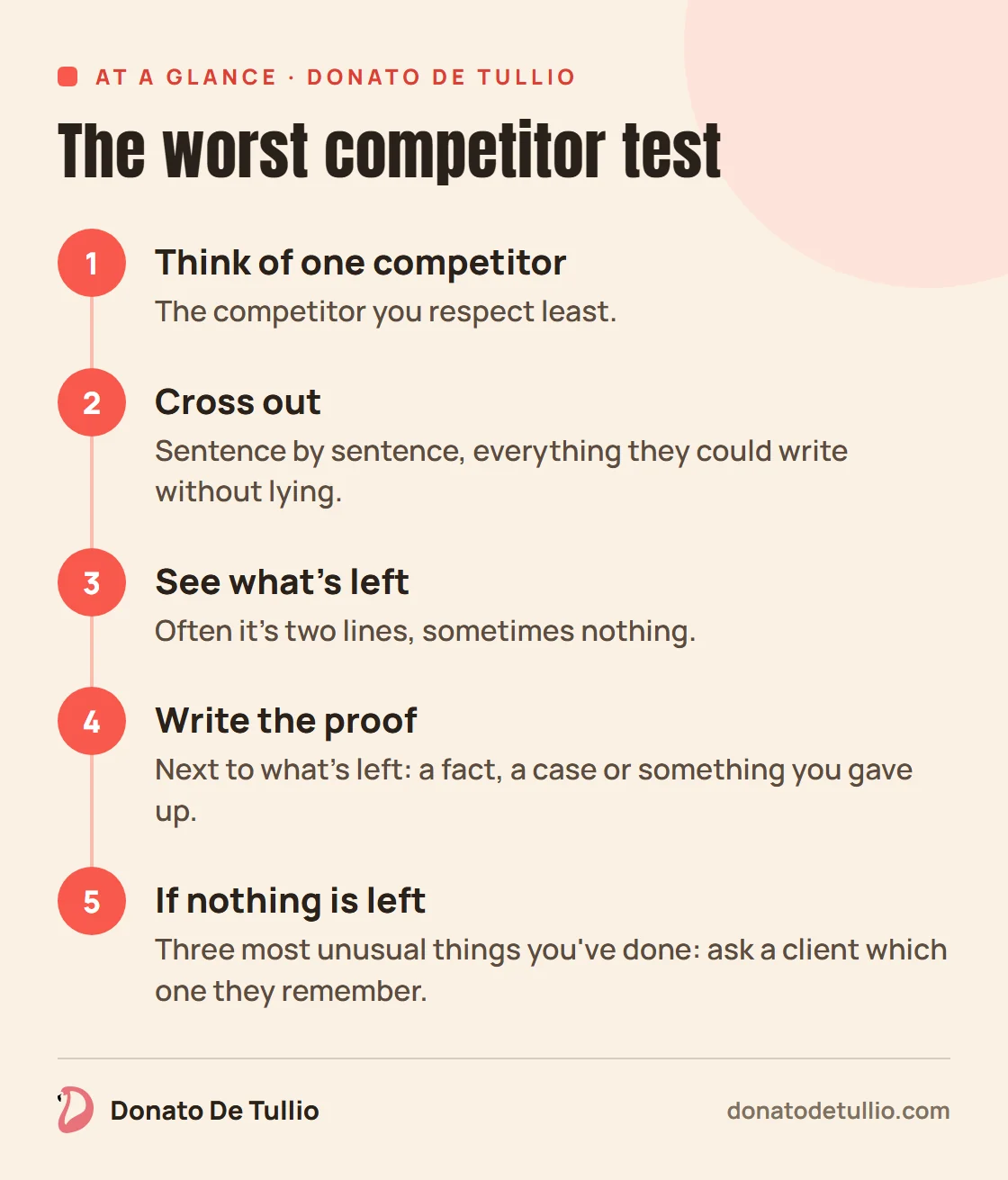
The tool is called the worst competitor test. You need your home page printed out and a pen.
- Think of the competitor you respect least.
- Reread the page sentence by sentence and cross out everything they could write without lying.
- See what's left. Often it's two lines, sometimes nothing.
- Next to what's left, write the proof, whether a fact, a case or something you gave up.
- If nothing is left, write down the three most unusual things you've done and ask a client which one they remember.
Now you know whether you have a problem of words or of choice. If something's left, it's words, and you can fix it with the positioning statement.
What if this isn't enough?
It depends on what's missing. If few people look for you, standing out helps little, because first they need to know you exist. I don't promise that a clear difference brings clients or money. It's there so that people who meet you can say why you.
The whole picture is in the professional repositioning guide. If you want to find your difference with someone who pushes back, and test it on the market, that's what we do in Position Lab. The first step is a thirty-minute coffee. Let's have a coffee (30 min).
Frequently asked questions
How do you stand out when you offer the same service as others?
You can choose who you work for, which problem you take on and at what moment you arrive. Then add the combination of experiences only you have. The service can stay the same, while the reason people call you changes.
Is being technically better enough to stand out?
Usually not, because clients often can't judge technical quality, sometimes not even when the work is done. Skill keeps them. To be chosen, you have to make it visible with proof others can't copy.
What are the most common mistakes?
Listing your values, adding services and changing everything every year. Anyone can write honesty and passion, one more service confuses people, and every change wipes out the recognition you had built.
Do I have to specialize?
Not necessarily in an industry. You can also stand out on the problem, the moment or the way you work. You do need a choice, though, because a difference that applies to every client and every job is invisible to the reader.
Was this useful? Get the next articles by email: leave your address here.
He did his PhD in chemistry with Merck, then spent more than ten years in European multinationals, working his way up from the warehouse floor to running logistics. Today he helps professionals and companies who make a living from their expertise get chosen by the right clients.
About meWhere to start: the positioning guide.