If less skilled competitors seem to get more clients, the client is usually judging something else. Technical skill is hard to see from outside, so people look at whether they understood what you do, whether you come to mind and whether you're easy to reach. You can work on those things, and you don't need to badmouth anyone.
Wednesday evening, on the sofa with your phone. Someone in your field announces a client, exactly the one you would have wanted. You know their work and you've formed an opinion. You put the phone down and a sentence rises up: how is that possible?
That irritation is normal, and there may even be some truth in it. You may really be better prepared. The problem is what happens if you stay there. Inside that sentence is an explanation that leaves you with nothing to do.
Why does «clients don't get it» keep you stuck?
In 1977 Lee Ross described a mistake we all make. When we explain what other people do, we give too much weight to their character and too little to the circumstances. Put simply, «clients don't get it» and «that one is just good at selling» are explanations about people.
Those explanations have a practical flaw. You can't change your clients' character, or someone else's work. As long as the cause sits there, all you can do is wait for the market to come to its senses. And people who work well usually get tired before the market does.

Can a client tell who's better?
Often not, and it isn't their fault. In 1973 Darby and Karni used the term credence goods for things a client can't assess even after buying them. If the work went well, they don't know how much of it was down to you. If it went badly, they don't know whether someone else would have done better.
You're measuring with a ruler only you own. You can see where a job was done well and where it was rushed, because you've been looking at them for years. The person choosing sees two people who say they can do the same thing. So they look at something else, and that's reasonable behavior.
What do people look at when they choose?
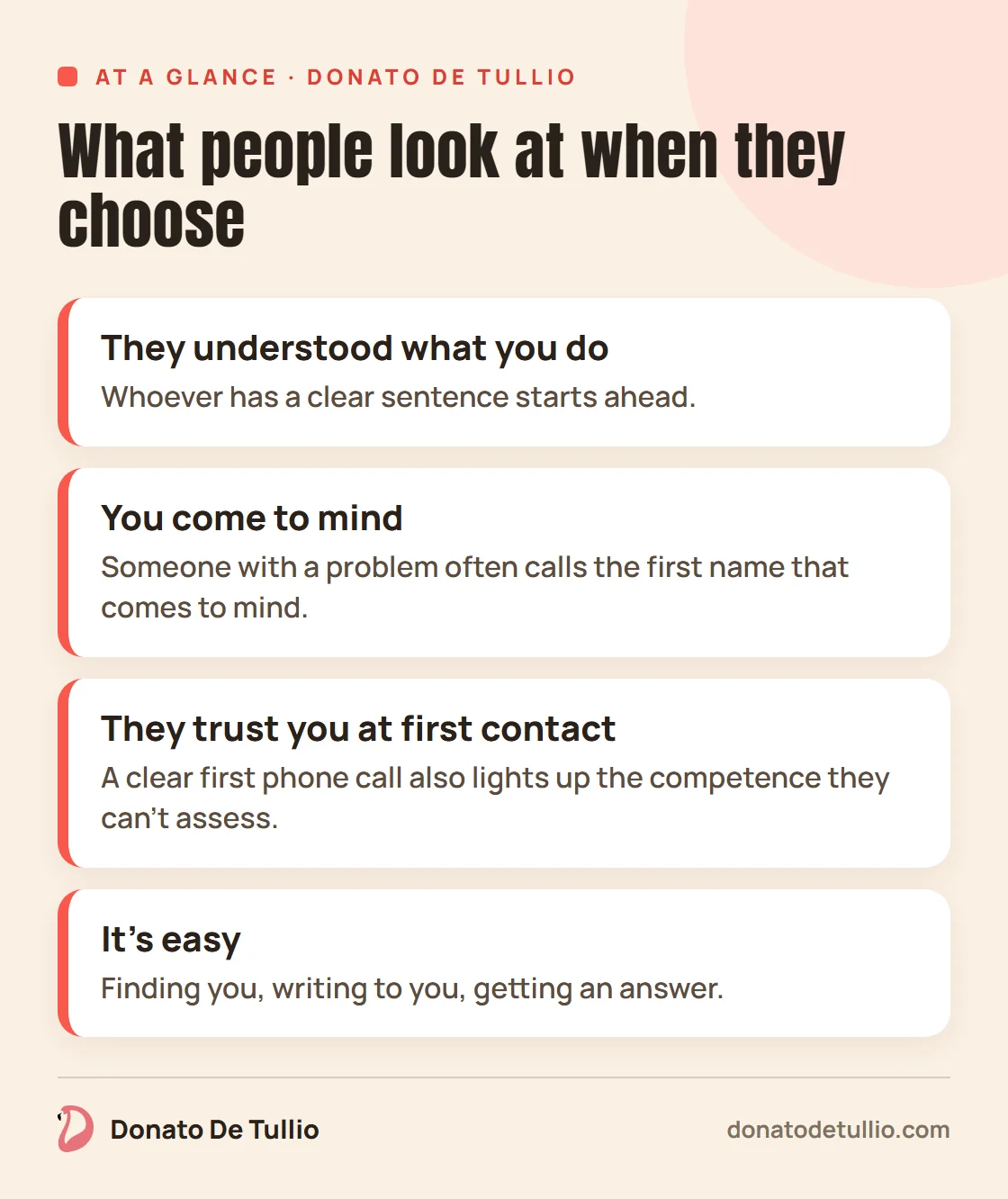
- Whether they understood what you do. If that takes effort, whoever has a clear sentence starts ahead, even when technically they're worth the same or less.
- Whether you come to mind. In How Brands Grow from 2010, Byron Sharp shows that brands grow partly because more people think of them in more situations. His data comes from consumer goods, and applying it to people who sell advice is my own stretch. Still, someone with a problem often calls the first name that comes to mind.
- Whether they trust you at first contact. In 1977 Nisbett and Wilson showed the halo effect: a good impression of one aspect spreads to the others, and the person judging doesn't even notice. A clear first phone call also lights up the competence they can't assess.
- Whether it's easy. Finding you, writing to you, getting an answer. These are small things, and they weigh more than a technical person would like.
What we call being good at selling yourself, seen from here, is a trade made of these things. Whoever does them well has learned something you may not have learned yet. Seen this way it irritates less, and it gives you a list of things to do.
So is being good pointless?
It matters a great deal, it just works at another moment. Being good makes you do the work well, brings clients back and lets you sleep at night. But people who haven't chosen you yet see little of it. You can keep studying as much as you like, and on top of that you have to add a piece you've left to chance until now.
An awkward question to ask yourself in private. Better at what, exactly? You may be better at the part that matters to you, and the other person better at the part that matters to that client. It could be speed, or making themselves understood, or staying next to someone who's scared. It's worth knowing before you call it unfair.
How do you respond without badmouthing anyone?
Badmouthing a competitor gets you nothing. Your listener can't check whether you're right, and all they remember about you is the grudge. If you really are good, you don't need it. Keep it off your website and out of your calls, and if someone asks and you mean it, feel free to say «I respect them for this», then talk about your own work.
The useful move is another one. Look closely at how they present themselves, as you would with a colleague you want to learn something from. There's nothing to copy, because their sentence is theirs. What you need is to understand what reaches a client. Then you work on your own difference, and for that I wrote how to stand out from competitors.
And before you buy advertising, stop for a moment. This is how I see it. «Everyone sells marketing, getting more clients. Nobody steps in before that: how do I improve my positioning, my message.» If your sentence is confused, advertising spreads the confusion. If you then find yourself cutting quotes to keep up, read clients only compare you on price.
How clear is your page next to theirs?
Pick the competitor who irritates you most. Open their page with a timer running, and pretend you know nothing about your field.
- Thirty seconds on their page. Write down what they do, who for, and how you'd contact them.
- Thirty seconds on yours. Write the same three things, with the same ignorance.
- Compare the two notes. Mark the lines where they're clearer.
- Pick one line only, and change it this week.
If you can't manage to pretend, that's normal. You're too far inside. Have someone outside your field do it, and explain nothing to them.
A different question may come out of it, namely whether you really want those clients. That irritation sometimes says what you want to become, and then the subject is professional repositioning. If you want to look at it with someone who has no need to agree with you, there's Position Lab, with me.
Frequently asked questions
Why do less skilled competitors get more clients?
Often because the client can't judge technical skill and looks at something else. What counts is whether they understood what those competitors do, whether they come to mind at the right time, whether first contact builds trust and whether they're easy to reach.
Should I tell clients my competitors do worse work?
No. The client can't check it, and what they mostly remember about you is the grudge. Talk about the problem you solve and how you work. If they ask about a competitor, say something good if you think it, then return to their problem.
Is being good enough to get clients?
Usually not. Being good makes you do the work well and brings clients back, but people who haven't chosen you yet see little of it. They need to understand quickly what you do and remember you when they have the problem.
What can I learn from a competitor without copying them?
Look at what a client understands from their page in thirty seconds. Compare with yours what they do, who for and how to contact them. Take the lines where they're clearer and rewrite yours in your own words, with true things.
Was this useful? Get the next articles by email: leave your address here.

He did his PhD in chemistry with Merck, then spent more than ten years in European multinationals, working his way up from the warehouse floor to running logistics. Today he helps professionals and companies who make a living from their expertise get chosen by the right clients.
About meWhere to start: the positioning guide.