Rebranding changes how you look: name, logo, colors and website. Professional repositioning changes what you do, who for and what role you have. If you've already decided that part and your image still tells the old story, rebranding makes sense. If you're hoping a new logo will fix the wrong clients, runaway hours or a lost direction, start with the person and leave the designer alone.
It's eleven at night and you have three versions of the logo in front of you. The blue changes. In the second it's a bit darker, in the third a bit greener. You've talked about it with two friends, and one of them said the first was better. Meanwhile there's a proposal that's been waiting for a month.
Deciding on a blue is pleasant. You see it straight away, nobody says no and you don't have to give anything up. The question of what work you want to be doing over the coming years, on the other hand, doesn't come in three versions to look at in the evening. That's why it's so easy to end up redoing the logo.
To people stuck there while their offer and their sales stand still, I put it like this: «You could even have no logo at all to make yourself understood, it wouldn't change much.» I mean it. Image does matter, it just comes later.
What's the difference between rebranding and repositioning?
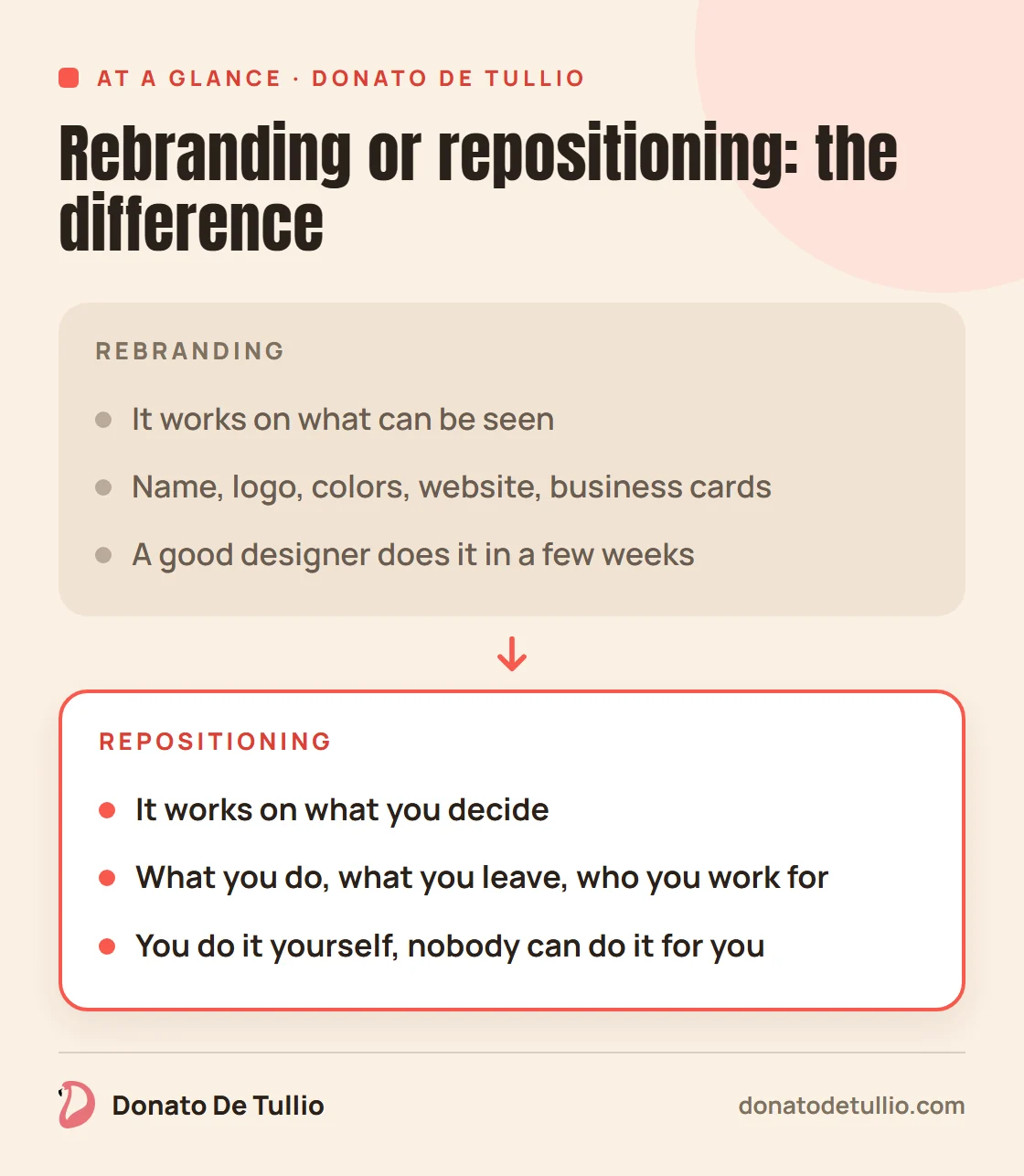
Rebranding works on what can be seen. Name, logo, colors, website, business cards. A good designer does it in a few weeks, and the next day everyone can look at it.
Repositioning works on what you decide. What you do with your own hands and what you leave, who you work for, what you want people to say about you when they send you a client. You do it yourself, and nobody can do it for you. At first the result is hard to see, because it lies in the things you stop accepting.
You can do both together, and that's a good thing when the decision is already there. The trouble starts when the first takes the place of the second.
Why do you start with the person?
Because a business takes the shape of whoever runs it. If you redo the whole front and the person deciding is still the one who answers everyone and signs everything, working in the business and not on it, six months later you have the same business with better colors. That holds for corporate repositioning too, when a whole brand is on the table. The way I put it is this: reposition the owner before you reposition the business.
The order I follow is this. First what you want to do, then who for, then what you sell and how you say it. Image comes last, and its job is not to contradict the rest. You'll find the whole path in the guide to professional repositioning.
I'm doing this myself right now. This autumn I rewrote the words on my website in three languages, and the colors stayed where they were. If I'd started with the blue, I'd still be choosing the blue.
What do you risk by changing your logo too early?
You risk throwing away the one thing you'd built without noticing, the fact that people recognize you. Jenni Romaniuk and Byron Sharp, in How Brands Grow Part 2 from 2016, argue that people tell brands apart more by colors, shapes and symbols than by real differences, and that these signs should be chosen early and kept for a long time.
One caution. They mostly studied consumer goods, so for a practice or a freelancer this is a reasonable extension and not something proven. My advice stays the same, though. If you change, change once. Every two years is the most expensive way of staying unknown.
When does a new logo make sense, and when doesn't it?
Change it in these cases.
- You've already changed what you do and who for, and your image still tells the story of the old work.
- The name ties you to a partner who has left or a service you no longer sell.
- The name gets confused with someone else's, or nobody can pronounce it in the countries where you work.
- Your best client would be embarrassed to forward your website to a colleague.
Leave it alone in these others.
- You have the wrong clients and you hope a logo will bring different ones.
- Revenue has stalled and you're looking for something to do.
- You're tired of looking at it. You see it every day, your clients don't.
- You can't say what you'd do differently the next day.
If you're also wondering who to trust with how you present yourself, there's a separate article on marketing agency or positioning. And if you're wondering how long all this takes, I cover it in how long does repositioning take.
What if you've already rebranded and nothing changed?
Keep it. Redoing it now would be the same move, with one more invoice. The money you spent won't come back, and that work can still serve you once you've decided what to put on top of it.
Work on the words and the choices. Decide what you stop doing, try the new sentence out loud on real people, and change the website copy only once you've seen what happens.
Do you need a new logo or a decision?
The test has two steps. The first is a sentence to finish on a sheet of paper: «The day after the new logo I'll stop… and I'll start…». If two precise things come out, you're already on the right road. If what comes out is «I'll feel better», your problem won't be solved by a designer.
The second you do with your hands. Open the first page of your website and cover the logo and the name with your palm. Read what's left, as if you'd found yourself by chance. Is it clear what you do and who for? If not, a new logo would sit on top of the same text.
If the test says the work to do is the first kind, on the person, that's the work of Position Lab, working with me to decide what role you want and try it with real people. If it says you need a designer, call one, and I'd tell you the same over coffee.
Frequently asked questions
What's the difference between rebranding and repositioning?
Rebranding changes what can be seen, such as name, logo, colors and website. Repositioning changes what you decide, meaning what you do, who for and what role you have. The first makes sense once the second is done.
When does it make sense to change your logo?
When you've already changed what you do and who for and your image tells the story of the old work, when the name ties you to a past that's gone, or when it's really too neglected for your best client.
Will rebranding help me find better clients?
Rarely on its own. Clients choose based on what they understand about you. If the message stays the same, a new image attracts the same people as before.
Does repositioning mean changing your name or logo?
Not necessarily. You can reposition with the same name and the same logo, changing what you do, what you turn down and what you say. You only touch the image if it contradicts the choice you've made.
Was this useful? Get the next articles by email: leave your address here.

He did his PhD in chemistry with Merck, then spent more than ten years in European multinationals, working his way up from the warehouse floor to running logistics. Today he helps professionals and companies who make a living from their expertise get chosen by the right clients.
About meWhere to start: the positioning guide.