If people who hear you can't say what you do and who for, you need positioning first, because an agency would put more people in front of a message nobody understands. If people who reach you get it straight away and choose you, and the problem is that few people know you, you need the agency. You can tell which in five minutes, with the test at the end.
You open the email and there's the agency's proposal. Content plan, campaigns, new website, a chart with an arrow going up. It all seems sensible. Then you reach the form to fill in before the meeting, which says «describe in two lines what you do and who for». You've been staring at that empty box for ten minutes.
The reasoning that got you there holds up. You have clients, the work is good, and it only comes through word of mouth. You watch people less skilled than you win the clients you'd like. So you need marketing. The market agrees, because everyone sells marketing and everyone talks about getting more clients. Hardly anyone stands one step earlier and asks what you're saying, and to whom.
That earlier step is my job, so keep my interest in mind. It's also why I'll tell you when the agency is the better choice.
What's the difference between marketing and positioning?
Positioning decides what you say and to whom. Marketing takes that to more people, more often. Think of a megaphone: it works very well, and it has no idea what to shout. Shout a sentence anyone in your field could say and plenty of people will hear it, and it will still be a sentence anyone could say.
Ries and Trout wrote this in 1981, in their book Positioning. Positioning happens in the head of the person who has to choose you, and a crowded head only has room for someone who holds a precise place. It's a classic of the trade and not a lab experiment, so take it as a way of thinking.

Why can't you see what to say on your own?
Because you're too deep inside your own trade. Camerer, Loewenstein and Weber showed this in 1989 with economics experiments: once you know something, it's hard to reason like someone who doesn't. It's called the curse of knowledge, and it's why experts talk to their colleagues while someone else does the buying.
An agency starts from what you tell it, so it inherits the problem. It can write far better copy than yours around the same blurry sentence. The good ones notice and ask you awkward questions, and those are worth holding on to.
Why do people less skilled than you win?
George Akerlof explained this in 1970, talking about used cars. When buyers can't judge quality, whoever has the best goods struggles to get paid what they're worth. That work later earned him a Nobel Prize.
Applying it to people who sell expertise is my own reading. Your client often can't judge how good you are, and picks the person they understood. So the first thing to fix is being understood, and for that you need to know what to say. Campaigns come later.
When is an agency worth it, and when isn't it?
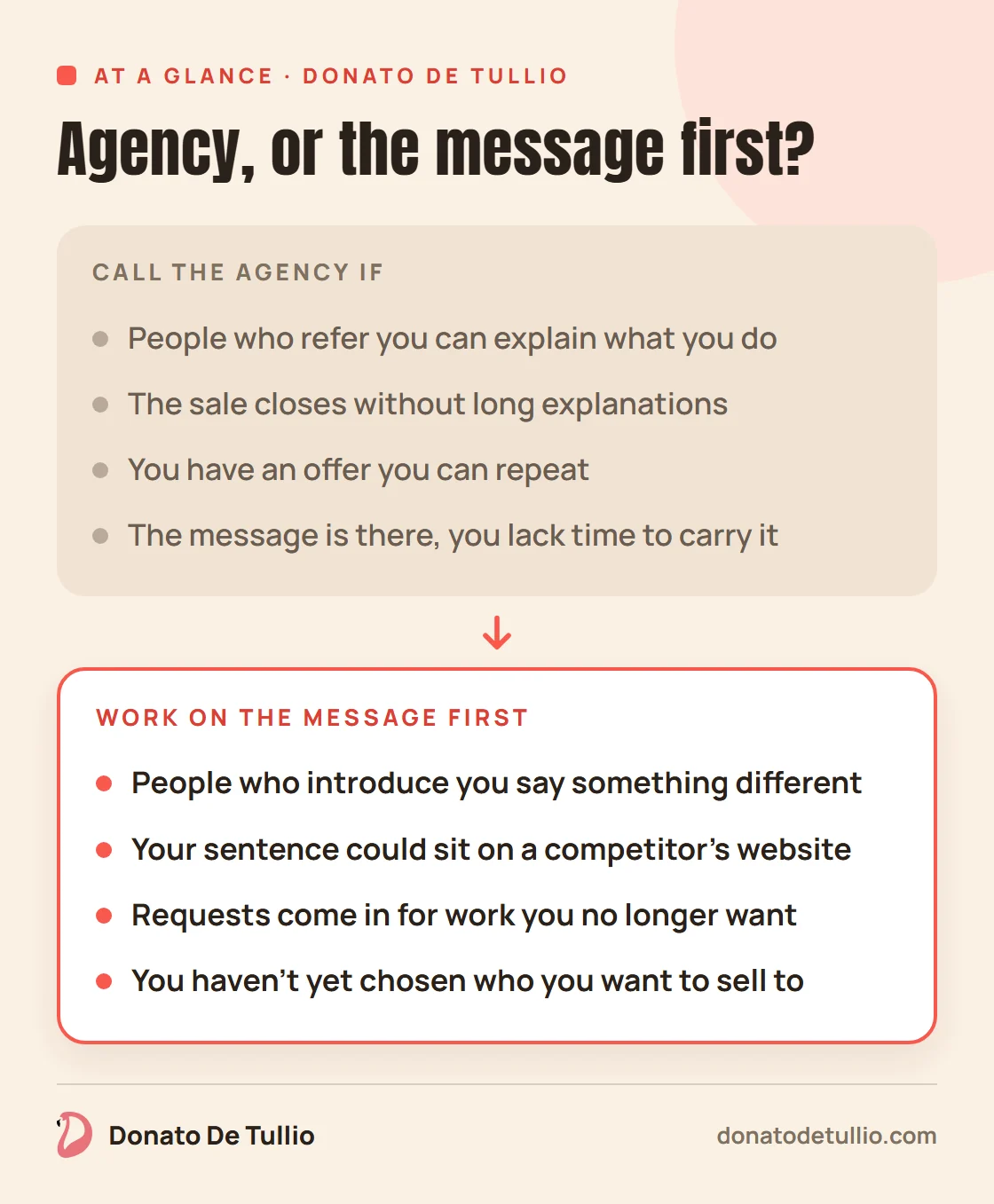
Call the agency if these lines sound like you.
- People who refer clients to you can already explain what you do, in roughly your words.
- When you talk to the right person, the sale closes without long explanations.
- You have an offer you can repeat, at a price that holds.
- You sell something clients already know they're looking for, and you just need to be found.
- The message is there, and you lack the time or the wish to spread it.
Wait, and work on the message first, if these sound like you.
- People who introduce you say something different each time.
- Your sentence could sit on a competitor's website.
- Requests come in, but for the work you no longer want.
- Clients only compare you on price.
- You haven't yet chosen who you want to sell to.
Positioning alone doesn't bring clients. A clear sentence shut in a drawer reaches nobody, and sooner or later someone has to spread it, you or an agency. And if your real question is what work you want to be doing in ten years, it comes before both, and it starts with the guide to professional repositioning.
What should you ask an agency before signing?
Ask it to write you one sentence on who it would be talking to, and why that person should choose you. If a competitor could use the same sentence, you have a problem to solve before the first campaign. If it's precise and one of your clients recognizes themselves in it, you've found who you need.
Either way the order stays the same. Choose what to say, try it out loud on real people, see what happens and adjust. Then hand it to whoever carries it around. I've covered how to write that sentence in «So what do you do?».
What do your last five requests tell you?
Take the last five requests you received, including those that never became work. Next to each one, answer two questions with a yes or a no. Was this person looking for what you want to sell? Had they understood what you do before you explained it?
Then count how many have two yeses. With four or five, the message holds and you're short of people, so call the agency. With two or fewer, more people would mean more wrong requests. The thresholds are mine, by eye, and they only help you decide where to start. If you can't find five requests even going back six months, try a different test and ask your clients to explain what you do in their own words.
If you land on the second path and can't see what to say on your own, you need an outside eye. That's the work of Position Lab, working with me to choose your positioning, try it on real people and look at the data. I won't do your marketing for you, and if that's what you need I'll tell you over coffee.
That box on the form is still empty. Fill it in before you sign.
Frequently asked questions
Do I need a marketing agency or positioning first?
It depends on what people understand when they hear you. If they can't say what you do and who for, positioning comes first. If they understand and choose you, but few people know you, the agency is the right move.
Does positioning bring clients on its own?
No. It makes clear what you say and to whom, so the people who meet you can choose you. Then someone has to carry that message around, you or an agency.
Can a marketing agency handle positioning too?
Some can, and they do it well. You can tell from the questions they ask about who buys, and from a sentence about you that a competitor couldn't use. Before any campaign, try that sentence out loud on real people.
How do I know if the message is the problem?
Look at your last five requests. If those people wanted what you want to sell and already understood what you do, the message holds. If they wanted something else or you had to explain everything from scratch, that's the problem.
Was this useful? Get the next articles by email: leave your address here.

He did his PhD in chemistry with Merck, then spent more than ten years in European multinationals, working his way up from the warehouse floor to running logistics. Today he helps professionals and companies who make a living from their expertise get chosen by the right clients.
About meWhere to start: the positioning guide.