Marketing yourself as a consultant is hard because you're looking at your own work from too close. You can see what a client should cut and say, because you stand outside their business. Time is rarely the real problem. What you lack is distance, and you can get some with written answers or with another person.
Thursday afternoon. A client shows you their problem, and in ten minutes you've told them what to cut, what to put first and who to talk to. They take notes, and you leave pleased.
That evening you open your own presentation, the one you've been meaning to fix for two years. You change a word, then change it back. At eleven you close the laptop and tell yourself you'll get to it when you have a free moment.
As the saying goes, the cobbler's children have no shoes, and we usually laugh about it. We blame time, since the cobbler is always busy. Yet the free moment comes, and the presentation stays as it is. What's missing is distance.
Why can you do it for clients and not for yourself?
With a client you stand outside. You see the whole picture, no line carries a memory for you, and cutting something doesn't hurt. With your own work you're inside, and from inside you see very little. Four things keep you there.
- You know too much. Camerer, Loewenstein and Weber studied this in 1989. It's called the curse of knowledge, and it means that once you know something, you can no longer picture how someone thinks without knowing it.
- You've grown attached. Norton, Mochon and Ariely found in 2012 that we value what we've put together with our own hands more highly. They measured it on flat-pack boxes, and extending it to a working life is my own step. Still, anyone who has tried to drop one of their services will recognize it.
- You judge yourself through your peers' eyes. The true things sound too basic, and you're embarrassed to say them when you think of people in your own trade. To a client you'd say the same things without a second thought.
- This time the risk is yours. If you advise a client badly, you gave a bad piece of advice. If you get it wrong about yourself, it feels like you got yourself wrong. So you keep editing and you publish nothing.

Does this happen to people who do this for a living?
Yes, and I'm telling you from the inside. My job is helping people decide what to say about themselves. With my own words, though, I've changed course more than once.
From the inside I didn't notice. I saw it when I looked at myself from the outside, the way I would with a client.
Will more time or another course fix it?
Usually not. A free week gives you more hours to circle the same sentence. A course teaches you things you already know, often well enough to teach them yourself. What stays the same is the place you're looking from.
Marketing can wait as well. If it isn't clear yet what you want to say and to whom, a well-run campaign just carries that confusion around faster.
How do you look at yourself from outside?
The moves are the ones you already use with clients. You just have to do them properly, as if the client were paying.
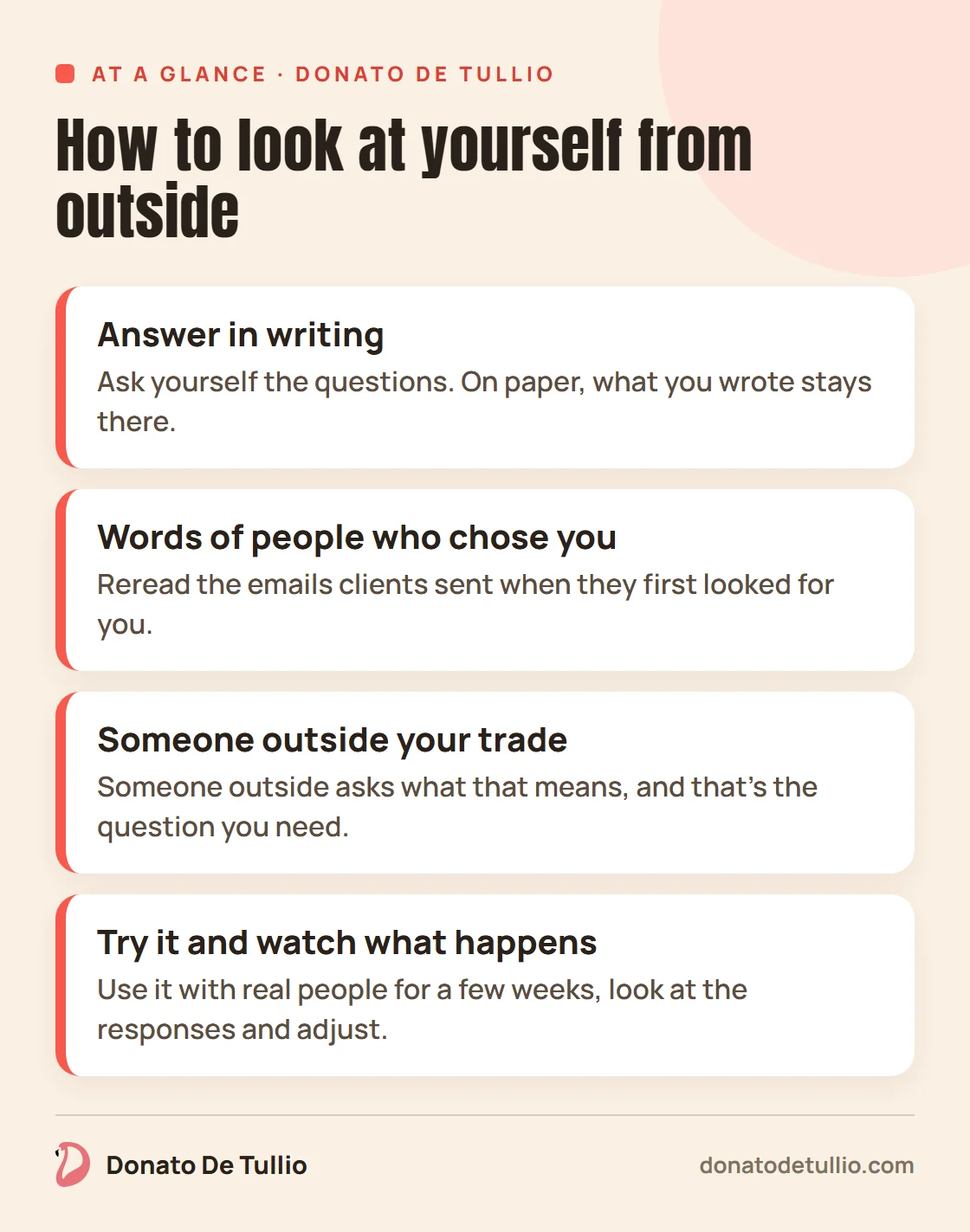
- Ask yourself the questions, and answer in writing. In your head you can change your mind every ten seconds. On paper, what you wrote stays there.
- Use the words of people who already chose you. Reread the emails clients sent when they first looked for you. They often describe your work better than you do, and they call it something else.
- Find someone who doesn't know your trade. People in your trade finish your sentences for you. Someone outside asks what that means, and that's the question you need.
- Try it and watch what happens. Choose how you introduce yourself, use it with real people for a few weeks, look at the responses and adjust. You'll never find out from your desk.
Do you have to pay someone?
No. You can swap with someone very good from another field. An hour each, each asks the other what they'd ask a client, and neither tries to be polite. It works if you tell each other how things are.
The limit is keeping it going. After two meetings one of you hits a deadline and the swap stops. And people who like you tend to agree with you at exactly the moments you need the opposite.
What would you tell yourself as a client?
Take a sheet of paper and write your name at the top, as if it were the file of a new client. Then answer these questions in the third person, writing «he does…» or «she should…». It's a small trick, and it buys you one step of distance.
- What problem made the last happy client look for this person? Write it in the client's words.
- What do people always ask this person, that seems obvious to them?
- What does this person say about themselves that a new client doesn't care about?
- What would you tell them to cut first?
Don't fix anything today. The way I say it to the people I work with, what comes out on paper becomes more real. Reread the sheet tomorrow. If a way of introducing yourself comes out of it, you can build it with the positioning statement.
A bigger question may come out instead, namely what work you want to be doing in the coming years. Then the subject is professional repositioning, and it's worth starting there.
If you want to do this with someone who stands outside and pushes back, that's the work of Position Lab, with me.
Take your shoes to another cobbler.
Frequently asked questions
Why is marketing yourself so much harder than marketing a client?
Because you look at your own work from inside. You know too much, you're attached to what you built, you think about what your peers will say and the risk is all yours. With a client none of this weighs the same.
How should a consultant start marketing themselves?
Start by getting clear on what to say and to whom. Answer in writing the questions you'd ask a client, use the words your clients used when they first looked for you, then try your message on real people.
Can I get unstuck on my own?
Partly, yes. Written answers to the questions you'd ask a client already give you some distance. For bigger choices it helps to have someone outside your trade who asks what your words mean.
Should I do marketing first or work out what to say?
Work out what to say first. Marketing spreads your message, so a confused message spreads confusion. Once it's clear, you can try it with real people and correct it by looking at the responses.
Was this useful? Get the next articles by email: leave your address here.

He did his PhD in chemistry with Merck, then spent more than ten years in European multinationals, working his way up from the warehouse floor to running logistics. Today he helps professionals and companies who make a living from their expertise get chosen by the right clients.
About meWhere to start: the positioning guide.