If clients only compare you on price, they see no other difference between you and the rest, so they look at the one number they understand. The way out is to decide who you want to be compared with and to say what only you have, before you touch the quote.
Tuesday evening, the email arrives. «Thanks, a very interesting proposal. We do have another one at a lower price, though. Can you meet us halfway?» You reopen the quote, take off ten percent and send it back. They reply the next day with a thank you, and you feel relieved and a little robbed at the same time.
That ten percent is the small part of the problem.
Who does the client really compare you with?
You think of your colleagues, because they're the people you watch. The client has three things in mind, and often none of them looks like you. They can compare you with the other two quotes, with «I'll do it myself», or with «I'll leave things as they are».
The third is the strongest. Samuelson and Zeckhauser measured it in 1988 and called it status quo bias: all else being equal, we prefer things to stay as they are. If your real opponent is doing nothing, you can lower the price all you like. You'll always cost more than zero.
Try this week. Write to your last five clients and ask: «If you hadn't worked with me, what would you have done?» The answers tell you who you're really racing against. It's often a different race from the one you were running.

Why does price become the only topic?
Because the client can't judge the technical quality of what you do. You can see the difference between work done well and work done badly. They see two documents with two numbers at the bottom.
Good people usually believe the work speaks for itself. It doesn't. The market rewards people who position themselves, and those who stay quiet end up giving their work away. If you don't give the client a way to choose, they use the one already in their pocket, the number.
Why does lowering your price make everything worse?
First, the arithmetic. If you keep 40 percent of a job, a 10 percent discount forces you to sell a third more work just to stay where you are. So more hours, and less time to think about how to get out of this.
Second, the habit. Mela, Gupta and Lehmann followed eight years of consumer goods data and saw that constant promotions make customers more sensitive to price. I carry that over to services with caution, because it's an extrapolation. Still, anyone who has given discounts knows the feeling: the client has learned that asking is enough.
Third, what it says about you. Every time you cut the price without removing anything from the work, you're saying the earlier number was inflated.
What do only you have?
Let me show you on myself. Line me up with other consultants and I don't win, because the world is full of good consultants. But I did my PhD in chemistry with Merck, I pushed carts in a Decathlon warehouse, and I still run logistics for eight sites. One by one, someone else has done these things too. All together, in the same person, it gets harder to find.
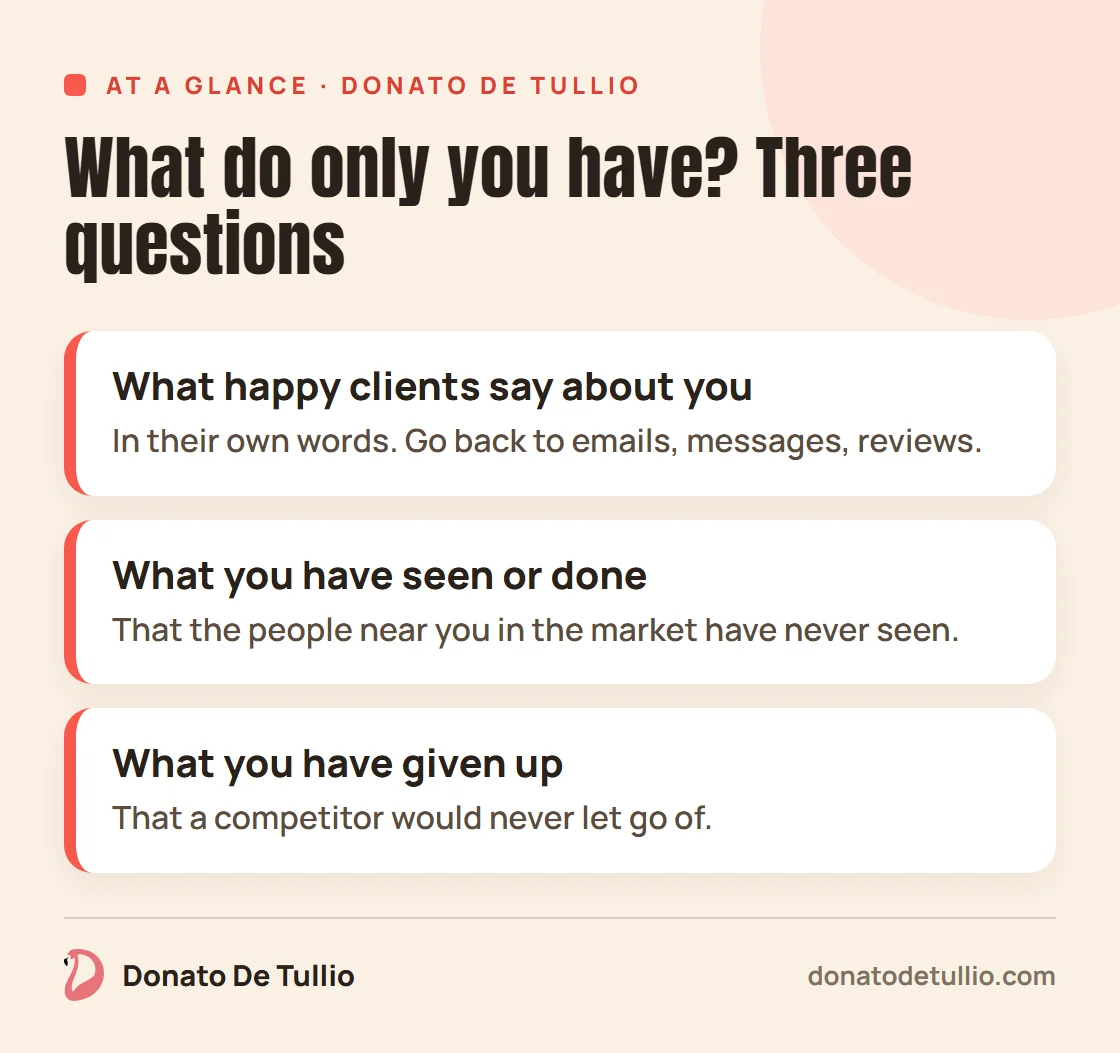
Look for yours with three questions, and write down the answers.
- What do your happy clients say about you, in their own words? Go back to emails, messages, reviews.
- What have you seen or done that the people near you in the market have never seen?
- What have you given up that a competitor would never let go of?
The test is simple. If a competitor could copy your sentence onto their website without lying, you haven't found it yet. Anyone can write «quality, professionalism, client focus».
Then that difference has to become a sentence the client can repeat. You'll find how in the positioning statement.
What do I do with the next quote?
If they ask you to come down, try removing before lowering. Less money means less work, and you write that down. Which part do we take out? Often the client discovers they needed that part, and the conversation stops being about the number.
If they ask for something you don't want to do, try the opposite proposal: a higher price, with limits written in advance. The worst that can happen is that they say no.
«If I raise my price I'll lose everything» is a hypothesis, like all fears of this kind. Test it on three quotes, with a date. If the fear of asking is what stops you, read afraid to sell. The whole picture is in the article on positioning.
This is exactly what we work on in Position Lab, on your real numbers and your real quotes. To see if it fits you, thirty minutes will do. Let's have a coffee (30 min).
Frequently asked questions
How do I stand out if I offer the same thing as my competitors?
Start from who you serve and which problem you solve, before what you do. Two people with the same service can speak to different clients, at different moments. Then add what only you have lived, which nobody can copy.
Should I raise my prices right away?
First decide who you want to be compared with and change how you introduce yourself, then test the new price on a few quotes with a date. People who double the number and change nothing else usually retreat at the first objection.
What if the client really has little money?
Then offer less work for less money, with the limits written down. That respects their budget and your work. If that group of clients can never pay, the real question is whether it's the right group for you.
Why do competitors who are less good than me sell more?
Because clients choose what they understand, and those competitors explain themselves better, or were in the client's head before you. It's frustrating, but it tells you where to act. You already have the competence. What's missing is the sentence.
Was this useful? Get the next articles by email: leave your address here.

He did his PhD in chemistry with Merck, then spent more than ten years in European multinationals, working his way up from the warehouse floor to running logistics. Today he helps professionals and companies who make a living from their expertise get chosen by the right clients.
About meWhere to start: the positioning guide.