To introduce yourself professionally, say what problem people call you for and at what moment, in words your client would use. Your title and years of work come after. A good introduction is a sentence a peer couldn't repeat word for word, and one the listener can pass on to someone else when you're not in the room.
A hotel meeting room, the round of introductions. The person before you says: «I do business consulting, with a tailored approach.» Everyone nods. Now it's your turn, and the sentence you have ready is almost the same.
You say it anyway. Everyone nods again. Over coffee nobody asks you anything, and the next day nobody remembers what you do.
People who introduce themselves this way are usually good. And often their real work is much bigger, or much more precise, than what they manage to say in those ten seconds.
Why do so many experts say the same sentence?
Because it's comfortable. Nobody can argue with «tailored consulting». It doesn't expose you, it can't be wrong, and it shuts the door on no possible client. The price is that it doesn't open one either.
There's also a reason that's less comfortable to admit. Ask an expert questions for ten minutes, and it turns out they know the right things to say. Those things just seem basic to them, and they hold back because they're thinking of what the peers in that room would say. So they talk to their peers, and the people who might buy are left out of the conversation.

Why does the sentence matter if your work comes from referrals?
That's when it matters most. If your work comes almost entirely through referrals, your most important introduction is made by someone else, in a room you're not in. They'll use the words you gave them.
Keller and Fay, in The Face-to-Face Book from 2012, report that the great majority of conversations about brands happen in person. The data comes from market research by people working in that field, so take it with that warning. The point holds anyway. You'll never hear most of what gets said about you.
Berger and Schwartz noticed something else useful in 2011. Lasting word of mouth grows from a link to something people come across often. They studied products, and carrying it over to services is my own step. Still, if your sentence is tied to a specific moment, people who pass near that moment remember you. «They're good» ties you to no moment at all.
What does an introduction look like before and after?
These examples are made up, to show how it works. Watch what happens when the moment a client looks for you comes in.
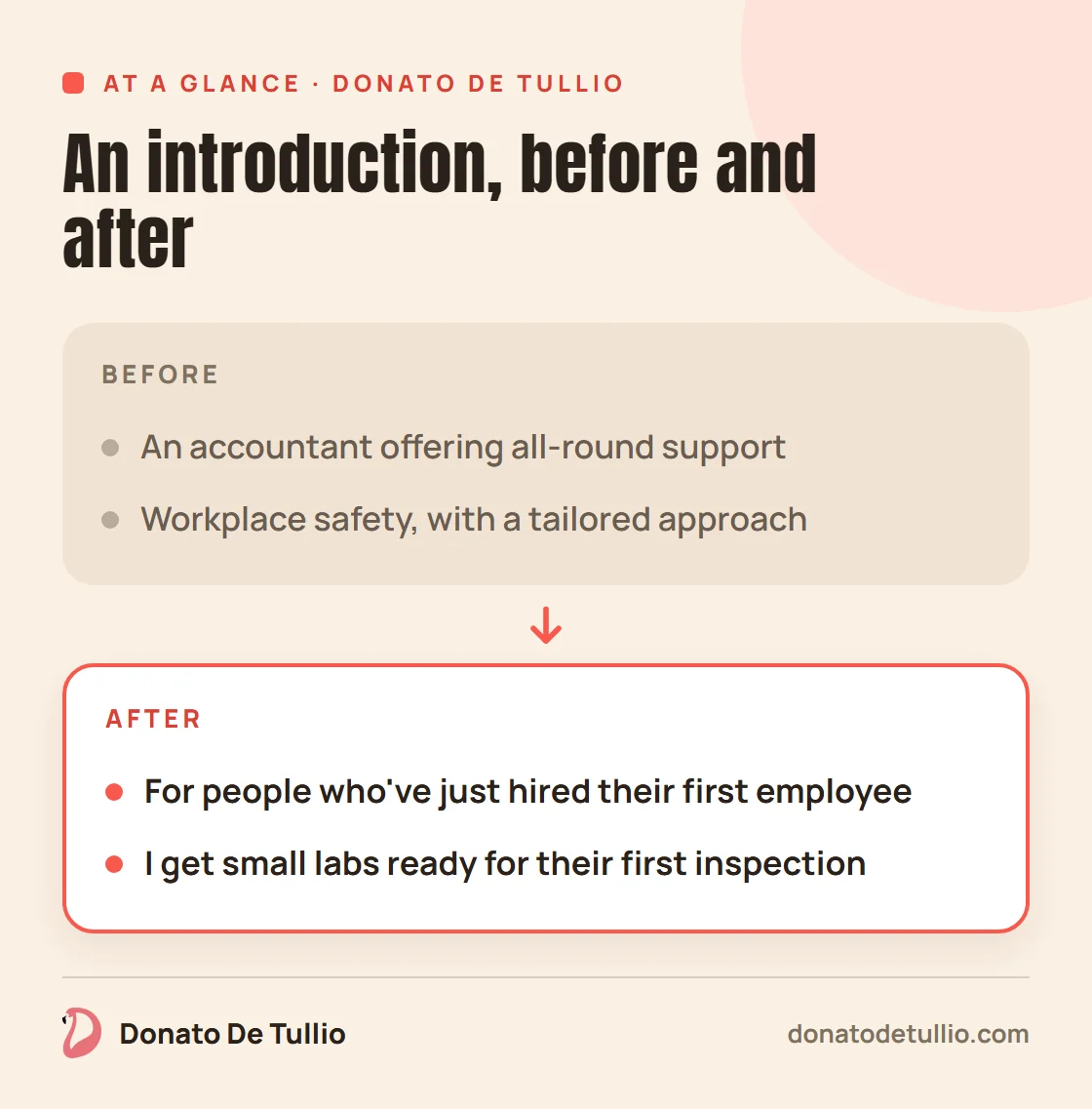
- Before: «I'm an accountant, offering all-round support to companies and professionals.»
- After: «I'm an accountant. I work with people who've just hired their first employee and want to know what it really costs them.»
- Before: «I work in workplace safety, with a tailored approach.»
- After: «I get small labs ready for their first inspection, when nobody inside has time to handle it.»
In the second version the title can stay, and the rest of the trade hasn't gone anywhere. Now, though, the listener can think of someone they know. To build your own sentence piece by piece, the structure is in the positioning statement. What matters here is where to use it.
What do you say out loud, by email and on your profile?
- Out loud. One sentence, then stop. Those two seconds of silence weigh more on you than on the listener. If the sentence works, they ask you a question and the conversation is under way.
- In an email to someone who doesn't know you. The sentence, one concrete piece of proof, and why you're writing to that person. Three lines are enough, and your CV can wait.
- On your online profile. The sentence on the first line, your titles underneath. Readers decide in seconds whether to carry on, and a title only tells them your category.
- When they ask you to explain more. That's when you can tell one job from start to finish, in everyday words. I cover that in how to explain what you do.
Won't a precise sentence cut me off from other clients?
It's the most reasonable fear, and it's normal to feel it. Nobody signs a contract on that sentence. If they need something else they ask, and you can still do everything you could do yesterday. The sentence only decides where the talk begins.
And there's one thing to accept. I like to put it like this: «Uniqueness exists, but not in everyone's head. It exists in the heads of the few.» When you talk so that everyone will understand, nobody feels called. Your sentence will mean nothing to some people, and that's fine, because you weren't talking to them.
What if it feels like I'm stating the obvious?
Check who it's obvious to. It is to you, because you've done it for years. Maybe to a peer as well. To someone who has the problem right now, it may be the first time anyone has put it in words they understand.
The next coffee is a simple test. Say it to someone who doesn't do your job and watch their face. If they say «meaning what?», you still have work to do. If they say «then you should talk to my brother-in-law», you can keep it.
How do you rewrite your own sentence?
- Write down the sentence you last used to introduce yourself, without improving it.
- Below it, write the last problem a client brought you, in the words they used.
- Below that, write something you did for them that seemed too basic to mention.
- Rewrite the first sentence using the other two.
- Cross out every word that could stand unchanged in a peer's introduction.
What's left will be ugly, and that's fine. Read it out loud, record yourself on your phone and listen back. Then adjust it until you'd say it at a bar.
You may get this far and not know what to write, because you're no longer clear what work you want to do. Then the sentence is the least of your problems, and professional repositioning is the place to start. If you want to work on it with an outside eye, there's Position Lab, working with me, with sentences tried on real people and the results reviewed together.
Frequently asked questions
How do you introduce yourself professionally in a few words?
Say what problem people call you for and at what moment, in the words your client would use. Then stop and let the other person ask a question. Your title and years of experience can come later, if they're needed.
How do you introduce yourself by email to someone who doesn't know you?
Three lines are enough. The sentence that says what you do and for whom, one concrete piece of proof of your work, and why you're writing to that person. Send your CV if they ask for it.
Should I mention my job title when I introduce myself?
You can, if it helps people understand or if your profession requires it. On its own, though, it only tells them your category. What sets you apart comes from the problem you solve and the moment people look for you.
Won't a precise introduction put off potential clients?
Usually not, because people who need something else will ask, and you can still do the rest. A precise sentence decides where the conversation begins. A generic one may stop it from beginning at all.
Was this useful? Get the next articles by email: leave your address here.

He did his PhD in chemistry with Merck, then spent more than ten years in European multinationals, working his way up from the warehouse floor to running logistics. Today he helps professionals and companies who make a living from their expertise get chosen by the right clients.
About meWhere to start: the positioning guide.