Your ideal client is the person your work is worth most to and whom you're glad to work with. You don't invent this profile at a desk. You find it by looking at the clients you've already had, because if you've worked with all sorts, the right ones are usually in there among the others. Choosing a profile doesn't mean turning everyone else away. It decides who you talk to when you communicate.
Someone asks you what clients you have. You start listing them. A big company, a private individual, the one who called about a small job, the one who has been with you for years. Halfway through you stop, because you notice there's no common thread. Nearly all of them pay you, and side by side they look like the clients of five different people.
As long as work keeps coming, this feels like luck. Then you try to write two lines for your website, or explain to a friend who they should send your way, and nothing comes out. Or what comes out is a sentence anyone could say.
Meanwhile there's a thought you keep to yourself. «I'm better than the people getting the clients I'd like.» It may well be true. They can make themselves understood, though, and you can't yet.
What is an ideal client, in plain words?
It's someone with a precise problem, who feels it now, and for whom your way of working is the right one. You need two things together. Your work has to be worth a lot to them, and working with them has to be worth the effort to you.
Forget the sheets with age, hobbies and favorite magazine. What you need to know is what was happening on the day they looked for you. When I do this work with someone, I ask for two or three profiles and have them give each one a first name. With a name in front of you, you know who you're writing for, and you stop writing for «companies».

Why do you end up with every kind of client?
Because nobody decided otherwise. At the start you say yes to everyone, and you're right to. You can do a lot of things, so every request looks within reach. One client brings another who is not much like them. After a few years your work has the shape of whoever happened to pass by, and you're the person holding it together.
There's a reasonable fear underneath too. If I say who I'm talking to, will the others leave? I'll come to that shortly.
Why do good people struggle to say who they serve?
For me this is the real problem, and it has a name, the curse of knowledge. Once you know something, you can no longer imagine how people think without knowing it.
The things that seem obvious to you are often exactly the right things to say, and you don't say them because you worry what your peers would think. So you write to win their approval, while the people who buy are somewhere else and don't follow.
The typical thought goes like this. «I can only explain what I do to people who do the same job.» If that sounds like you, you're speaking to the wrong room, and your skill has little to do with it.
Does choosing an ideal client lose you clients?
Usually not, because you're choosing who you talk to, and that's different from who you accept. If a job outside your profile turns up tomorrow and it suits you, take it. What changes is what you say in public.
The idea is old. In 1981 Ries and Trout wrote that whoever tries to be everything to everyone holds no place in the mind of the person who has to choose. In 1980 Porter described the small player who serves a narrow group better than a larger generalist can. These are strategic frameworks and not experiments, so take them as a guide. The risk is that the group can be too small, and that's why you test first.
If your question is bigger, meaning which market to be in, I've covered that in how to choose a niche when you can do everything.
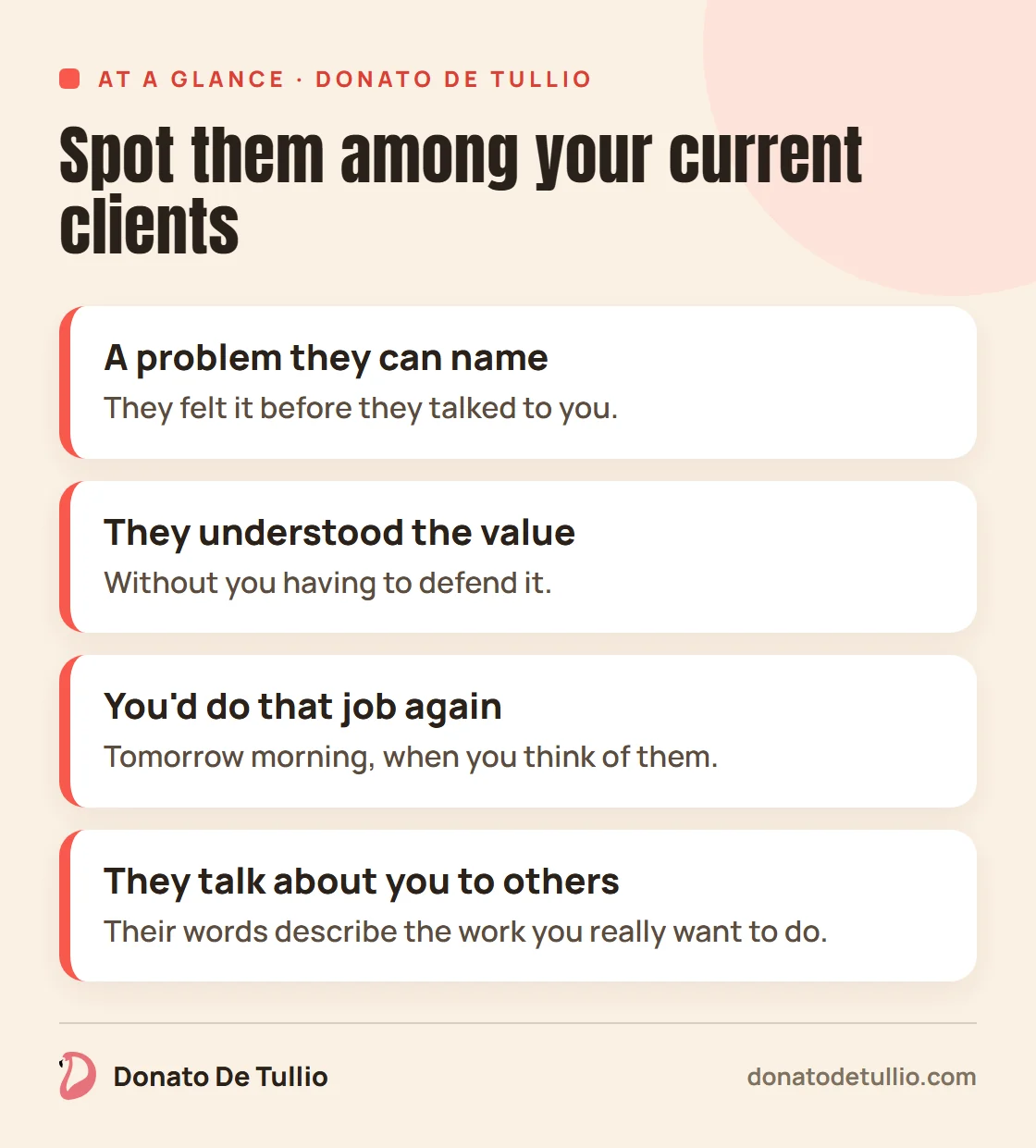
How do you spot them among your current clients?
- They came to you for a problem they can name, and they felt it before they talked to you.
- They understood the value of the work without you having to defend it.
- When you think of them, you'd do that job again tomorrow morning.
- They talk about you to others, and their words describe the work you really want to do.
A made-up example, to make it concrete. A workplace safety consultant writes «I support companies with safety». Looking at her best clients, she sees they were nearly all owners of small building firms right after their first inspection report. The sentence becomes «I work with owners of small building firms who have just received their first inspection report». To her peers it sounds like very little. The owner with that report on the desk thinks she's talking about him.
Which of your last ten clients would you take again?
Take a sheet of paper and write down your last ten clients, one per line. Next to each, write the problem they came to you for, in the words they used. Then add a mark if you'd do that job again tomorrow morning, and another mark if they understood the value without you having to defend it.
Circle the ones with two marks. See what those lines have in common, then finish this sentence, «I work with [who] when [what has just happened]». It won't come out beautiful, and that's fine. If not a single line has two marks, the clients you want aren't finding you yet.
How do you test it before deciding?
You don't need a new website. You choose, you test, you look at the data, you adjust. Use the sentence in your next five conversations and note what happens. Do people ask «how does that work?», or do they change the subject? If the sentence holds up, refine it with a positioning statement.
What does this have to do with repositioning?
The sheet tells you who you work well with today. A bigger question remains, which is who you want to work with over the coming years. You may find that your best clients belong to a kind of work you no longer want. That's why the choice about you comes first, and I've explained it in the guide to professional repositioning.
This exercise has a limit. With your clients you can see things they can't, and with yourself you can't, because you're too far inside. If you want to do it with an outside eye, that's the work of Position Lab, with me.
Next time someone asks what clients you have, try saying just one name.
Frequently asked questions
What's the difference between an ideal client and a niche?
A niche is the market you choose to be in. An ideal client is the precise person inside that market, with a problem they feel now. You can work on the second even before you've settled the first.
Do I have to turn away clients who aren't ideal?
No. Your ideal client decides who you talk to when you communicate. If a job outside your profile comes along and it suits you, you can take it. In time you'll see for yourself which ones to keep.
How many ideal client profiles do I need?
Two or three at most, each with a first name. If you have more, you're putting off the choice.
What if none of my clients is ideal?
It means the clients you want aren't finding you yet, or that the work you do is no longer the work you want. In that case the first question is about you and your role.
Was this useful? Get the next articles by email: leave your address here.

He did his PhD in chemistry with Merck, then spent more than ten years in European multinationals, working his way up from the warehouse floor to running logistics. Today he helps professionals and companies who make a living from their expertise get chosen by the right clients.
About meWhere to start: the positioning guide.