Neither LinkedIn nor Instagram is better in absolute terms. Choose the one where your clients are when they think about the problem you solve, and which you can keep up for months. To find out, look at your last few clients and ask some of them where they look. General statistics about the audience of each platform tell you little about them.
In the morning you open your favorite platform. You like it, you're at ease there, you've learned how it works. Your last post did well, with hearts and comments, three of them from peers you respect. That feels good.
Then, at a meeting, a new client tells you they've never seen anything of yours. They don't even know you publish. And you notice something that bothers you. All those people following you do the same job you do.
If this has happened to you, the question about which platform to use has changed shape. It used to be which one you like. Now it's where they are.
Is LinkedIn or Instagram better for your business?
It depends on who has to buy from you, and I won't give you percentages on the audience of either platform. Those numbers change quickly and describe millions of people, while you care about perhaps two hundred. Your own people's data is enough.
Two questions will do. Where are your clients when they think about the problem you solve? And can you keep showing up there, for months? You need yes to both. If either is no, that platform won't help you, even if it looks perfect on paper.

Why do you end up on the platform you like?
Because that's normal. You're already there, you know how to use it, and it answers you right away. On top of that, the first to applaud are your peers. They understand what you write and they compliment you, so you keep writing for them, and the people who ought to buy get lost along the way. I've written about this in positioning.
Likes are pleasant and measure little. They tell you who appreciated something, and those people usually do your job.
How do you find out where your clients really are?
By looking and by asking, in that order. First look at whether they have a profile and when they last used it. Then ask three of them: «The last time you looked for someone for a problem like this, where did you look?».
Watch out for one difference. Being there doesn't mean using it for work. The same person may spend evenings on one platform for fun and never think of finding a professional there, while reading another in the morning over coffee. And often the answer will be something else: Google, a colleague, a newsletter.
An idea from Byron Sharp helps here, from How Brands Grow in 2010. A brand grows if more people think of it and if it's easy to find and buy. His data comes from consumer goods, so applying it to professional services is a reasonable stretch and not proof. For you it means something simple. You have to be where people look for you, at the moment they look, and your favorite living room may not be that place.
What if you don't like your clients' platform?
Try changing the format first and then, if needed, the platform. Sometimes it isn't the platform that weighs on you, it's the way you use it. If video blocks you, write. If writing tires you, talk and have it transcribed. I've written about showing yourself in show your face.
If you really can't stand it, a slightly less suitable platform you can keep alive beats the perfect one you abandon after three weeks. But be clear with yourself that you're choosing your own comfort, and measure whether it's enough.
Do you need to be on both?
Not at the start. Choose one and leave it at that. You can add others later, if they're needed at all, by reusing what you've already made.
And don't lose weeks on this. I tell people who get stuck here not to overthink it. Choosing a platform can become an elegant form of procrastination: you compare them, you read articles like this one, and meanwhile you publish nothing.
What if your clients aren't on either one?
That happens often. Then your work goes through other roads, like Google searches, former clients, phone calls, industry meetings. They're less fun to talk about, and they work just the same. See how to sell your services.
Where are your last five clients active?
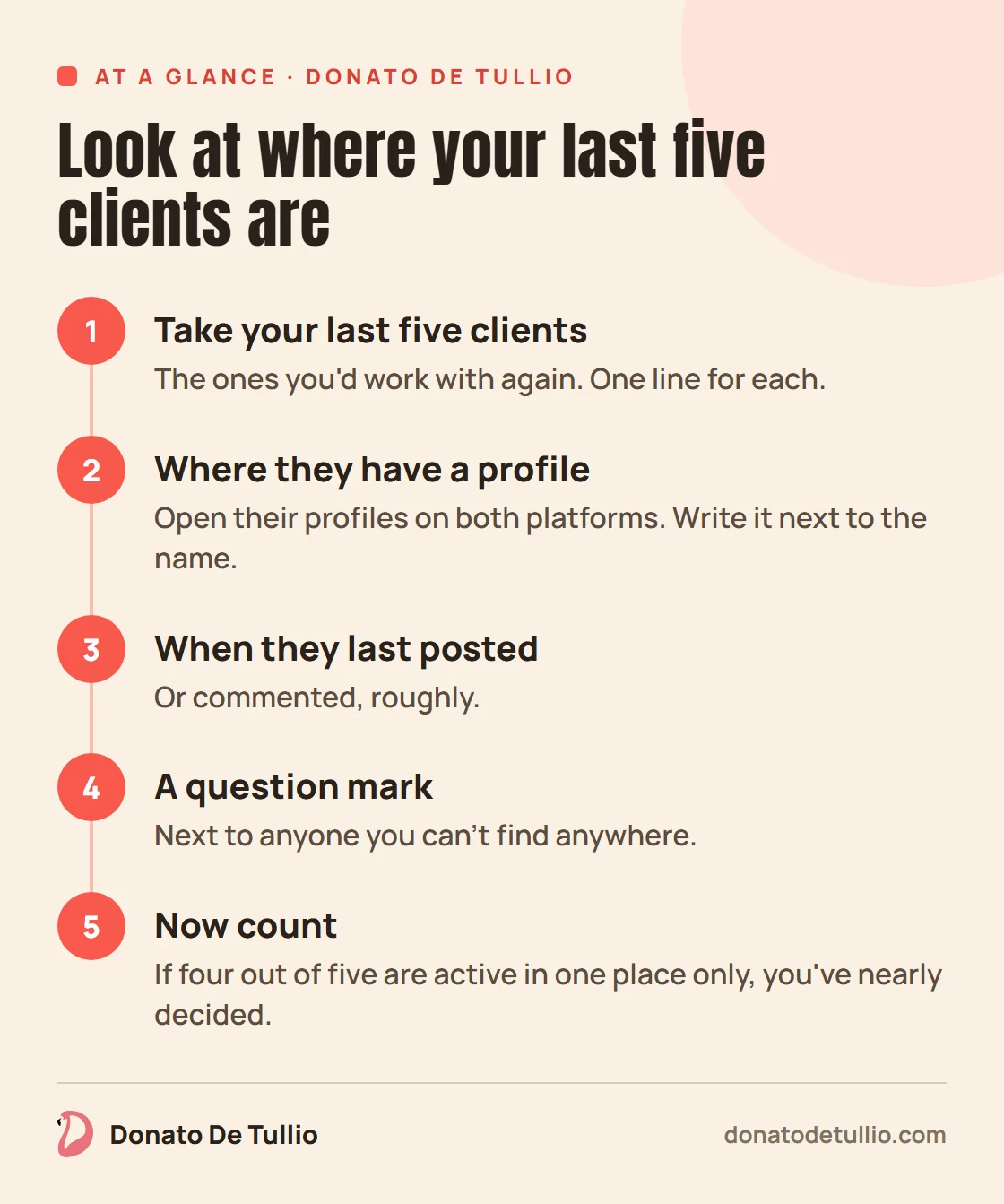
Take your last five clients, the ones you'd work with again. Make one line for each and open their profiles on both platforms.
- Next to the name, write where they have a profile.
- Add when they last posted or commented, roughly.
- Put a question mark next to anyone you can't find anywhere.
Now count. If four out of five are active in one place only, you've nearly decided. If most lines are question marks, the problem isn't which platform to choose. And send one of them the question from before, «where did you look?». Five clients are few and they don't make a statistic, but they tell you more than a chart about millions of users.
How do you know if it worked?
Forget the hearts. Give the chosen platform three months and then look at the real data. How many people who could buy have written to you? How many visited your profile and then got in touch? How many of your posts has a client mentioned in a conversation? If the number is zero and your message is clear, change platform. If your message isn't clear, changing platform won't help at all.
What does this have to do with repositioning?
Choosing a platform comes after choosing who you want to serve. If over the next few years you want to work with different clients from today's, run the check on the ones you want, and the platform may change as a result. The full reasoning is in the guide to professional repositioning.
If you want to look at this with someone from outside, that's the work of Position Lab, with me.
Frequently asked questions
LinkedIn vs Instagram: which is better for a professional?
Neither in absolute terms. The better one is where your clients are when they think about the problem you solve, provided you can keep showing up there for months.
Can I use the same content on LinkedIn and Instagram?
Yes, you can reuse the idea and adapt the format. At the start, though, it's better to look after one platform and add the second once the first is holding up.
How do I find out where my clients are?
Look at the profiles of your last few clients and ask three of them where they looked the last time they needed someone for that problem. The answer is often outside social media.
How long should I give a platform before changing it?
At least three months of regular presence. Then look at how many people who could buy have written to you, not at how many likes you got. Nobody can guarantee a result within a set time.
Was this useful? Get the next articles by email: leave your address here.

He did his PhD in chemistry with Merck, then spent more than ten years in European multinationals, working his way up from the warehouse floor to running logistics. Today he helps professionals and companies who make a living from their expertise get chosen by the right clients.
About meWhere to start: the positioning guide.