Staying consistent with content doesn't depend on how fired up you are when you start. That runs out, usually in the first full week of work. It depends on a small rhythm, decided in advance, that holds up even in your worst week. So choose how much you can do when everything goes wrong, write down when you'll do it, and treat missed weeks as normal.
You come back from an event with a full notebook. A course, a conference, two days with people who lit you up. On Monday you open a file and write twelve ideas. On Tuesday you publish. On Thursday you publish again, and you wonder why you didn't do this sooner.
In the third week an urgent job lands. You skip Tuesday and tell yourself you'll catch up on Thursday. You skip Thursday too. A month later the idea file is still there, and each time you see it you feel a little guilty.
If this has happened to you more than once, it's worth understanding how it works before the next event.
Why do you restart after an event and then stop?
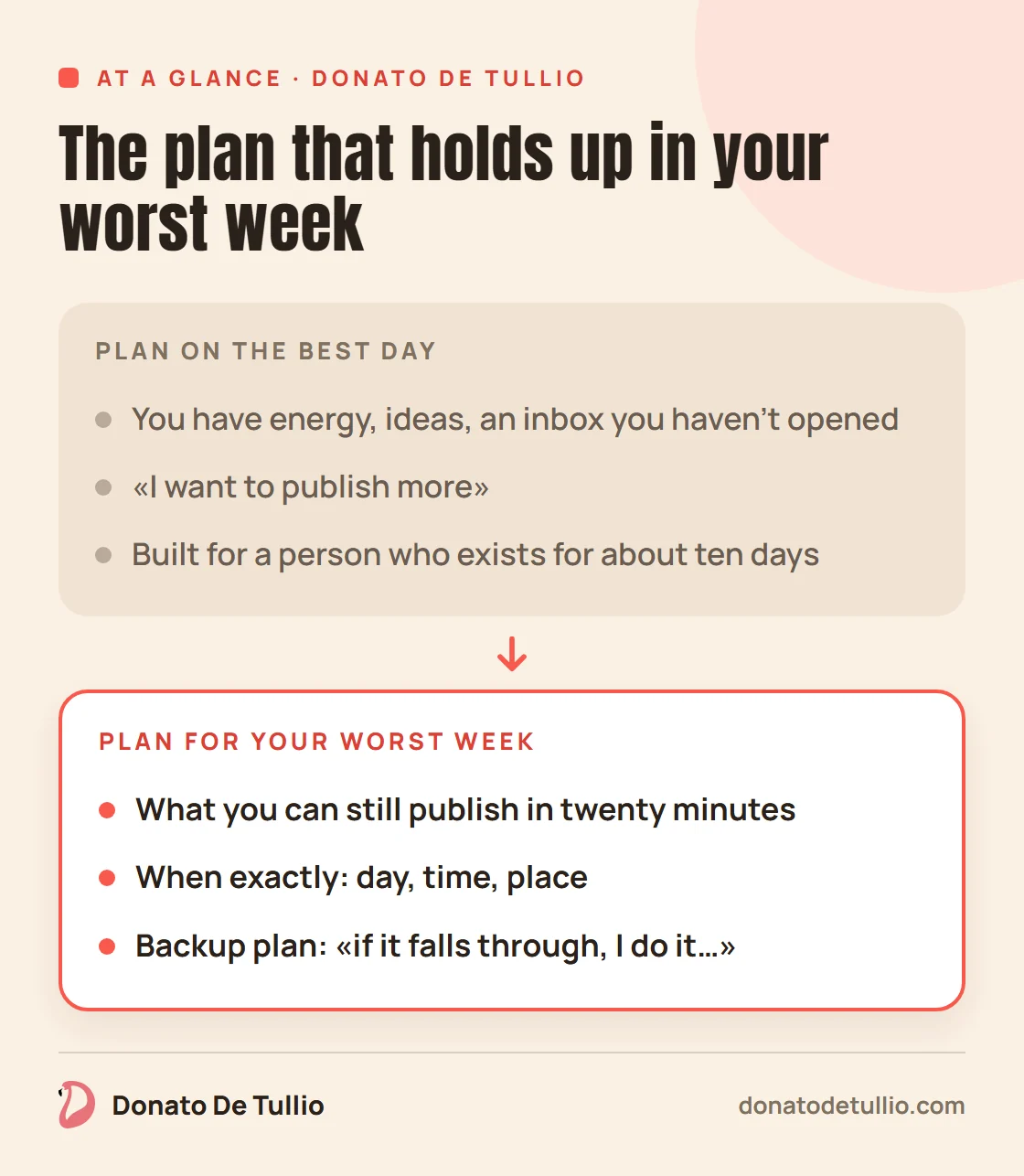
Because you write the plan on the best day of the year. You have energy, you have ideas, you haven't opened your inbox yet. That plan is built for a person who exists for about ten days.
The event gives you a push, and a push is a fine thing. But it doesn't tell you what to do on the Tuesday a client calls you at eight. No event can, because that Tuesday wasn't in the room.

Do you lack discipline?
Hardly ever. People reading this have usually been running difficult work for years with nobody checking on them. They have discipline. Client work has a deadline and a person waiting, and content has neither. So each time the two collide, clients win, and rightly so.
I'm saying this as someone short of time. I still have I run logistics for eight sites, and I build my business alongside that. When people ask where my consistency comes from, I say I know how I want to feel. That clarity is what others call being organized.
How often do you need to publish?
Less than you think, and you have to decide it in advance. There are two honest ways to work. One is in planned peaks, like a shop at Christmas: you know the peak is coming, you get organized, and you don't feel guilty the rest of the year. The other is steady, more or less the same thing all the time. Both are fine. The trouble is not having chosen, and living through a peak believing you promised a steady rhythm.
As a steady starting point, I think in terms of one hour a week. That isn't much, and that's exactly why it holds. If you wonder whether that's too much for your readers, I've answered in afraid of bothering people.
How long until it becomes a habit?
Longer than the three weeks you gave yourself. The famous «twenty-one days» doesn't come from any study. It comes from an observation by the surgeon Maxwell Maltz in the 1960s.
The serious study is by Phillippa Lally and colleagues, from 2010, on 96 people repeating a new action in the same context. The central figure was 66 days, with huge differences, from 18 to 254. And missing a single day didn't ruin the process. It was about daily habits and not content, so take it as an order of magnitude. I care about one thing here. If you quit in week three, you quit long before the point where it would have got easier.
How do you stop depending on motivation?
Write one sentence in advance, with a time and a place. Peter Gollwitzer called these implementation intentions: «if this happens, then I'll do that». A 2006 meta-analysis with Paschal Sheeran, covering 94 tests, found a medium to large effect. It's one of the simplest and best tested tools there is.
«I want to publish more» doesn't do much. «On Tuesday at 8, before I open my email, I write for thirty minutes at the kitchen table» moves the decision away from your mood. Then add the one that saves you. «If Tuesday falls through, I do it on Thursday at 8.» And that's all, no heroic catching up.
Does being consistent really matter?
It matters for longer than you'd like. Someone reading you today usually doesn't need you today. In 1968 Robert Zajonc showed that seeing something repeatedly makes people like it more, in and of itself. Getting from the lab to a professional's content is my own reasoning and not a study, but the sense is this. Three months of presence and then silence leave little behind, because when the moment comes they no longer remember you.
If what stops you is the very idea of promoting yourself, that's a different problem, and I've covered it in the article on whether marketing yourself is vanity. If you'd rather not be on camera, see show your face.
What can you publish in your worst week?
Make the plan for your worst week. Take a sheet of paper and answer two questions.
- In the worst week of the year, with everything on fire, what can you still publish in twenty minutes? A question a client asked you, with your answer in five lines, usually fits.
- When exactly do you do it? Day, time, place. Then write the backup plan, «if it falls through, I do it…».
Put it in your calendar now, for the next twelve weeks. Anything more you do is a gift. Meanwhile, your event notebook becomes your stock of questions.
What does this have to do with repositioning?
Consistency alone isn't enough, you can be very consistent at saying things anyone could say. People often stop for that reason too. They don't know what they want to become, so every piece of content is a decision made from scratch, and after three weeks they're tired of deciding. If that's you, start with the guide to professional repositioning. When you know where you're going, you also know what to talk about.
And if you need someone who asks you now and then how it went, that's part of the work of Position Lab, with me.
Frequently asked questions
How often should I publish to be consistent?
There's no right number for everyone. Choose what you can still do in your worst week. As a starting point, one hour a week holds up better than three posts promised and never made.
Does a habit really form in 21 days?
No, that number doesn't come from a study. In the 2010 research by Lally and colleagues the central figure is 66 days, with big differences between people, from 18 to 254.
What should I do if I miss a week?
Pick up again the following week, without catching up. In Lally's study, missing a single opportunity didn't ruin the process. The damage comes from turning one missed week into a months-long break.
What do I write about when I have no ideas?
The questions clients ask you. Write one down with your answer in five lines. What seems obvious to you is often exactly what your reader needs to hear.
Was this useful? Get the next articles by email: leave your address here.

He did his PhD in chemistry with Merck, then spent more than ten years in European multinationals, working his way up from the warehouse floor to running logistics. Today he helps professionals and companies who make a living from their expertise get chosen by the right clients.
About meWhere to start: the positioning guide.