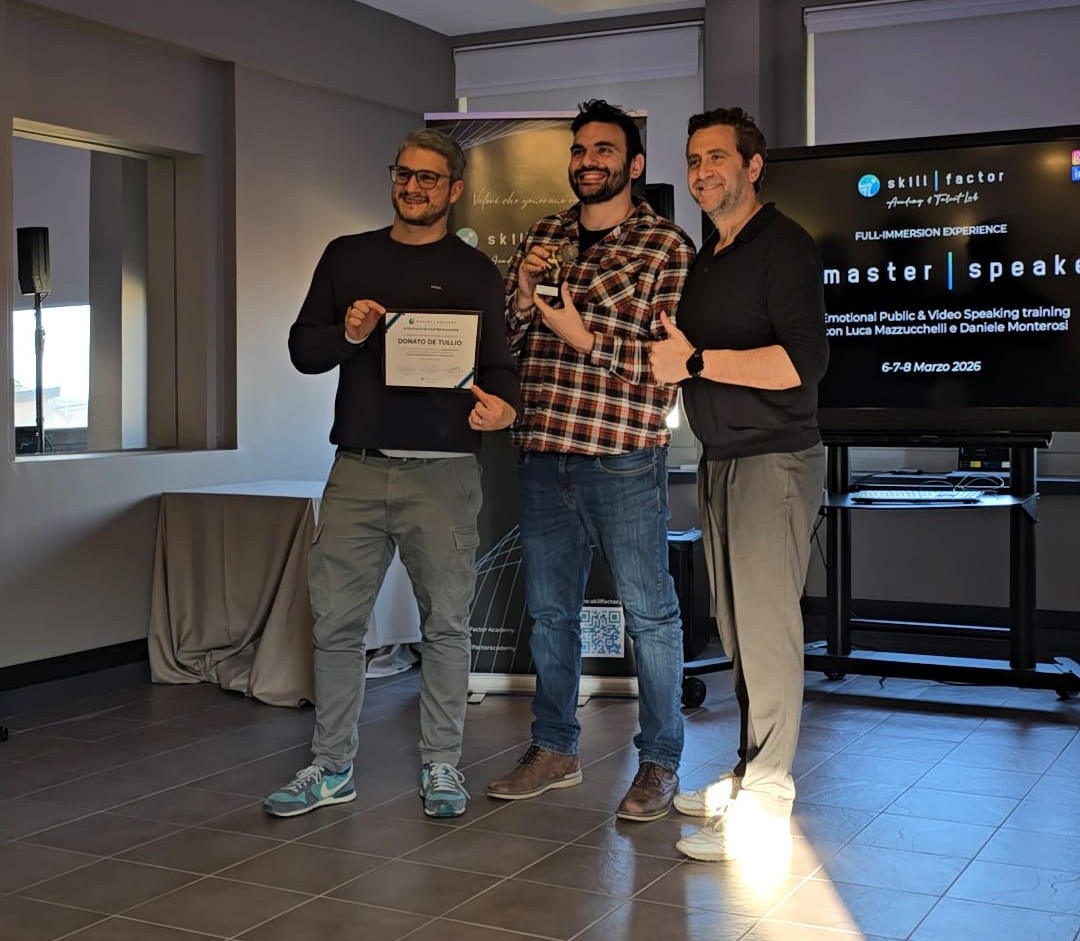
The short answer: if you run a business and live off your expertise, you need persuasive communication every time you speak to someone who has to choose you. I, Donato De Tullio, define it like this. Persuasive communication means influencing others by speaking in front of people, to position yourself in their minds and get something in return. You do it openly, with three questions to ask yourself before you speak, and the third one, what's in it for them, is the one that wins.
Say you have twenty minutes with someone who could become your client. You've prepared everything. You explain well, you answer every question, she nods.
At the end she says “very interesting, I'll think about it”. And you never hear from her again.
If this has happened to you, the expertise was all there. You were missing one question, the one almost nobody asks before walking in.
What is persuasive communication, in one line?
To me, persuading means influencing others. It happens every time you speak in front of people, even far from a stage, for example with a decision maker or with a client.
The goal is to position yourself in the listener's mind, and get something in return. In the workbook of my workshop I put it in these words: “We communicate because we want to get something.”
Many call it the art of persuasion, as if it were a gift you're born with. I treat it as a craft, something you prepare and practise like any other.
Why do you have to persuade to position yourself?
Market positioning is the place you hold in the mind of the person who has to choose you. You decide it at your desk, but it only comes to life when you say it to someone and that someone chooses you. So, to position yourself, you have to persuade.
People who live off their expertise often trip up here. You are unique in what you do, and the same as everyone in how you talk about it. So you hear things like “they tell me I'm good, but then they don't buy”, and you think you need more marketing. Often what makes you different is already in your work, and it gets lost along the way when you talk about it.
Then there's AI. It has made everything easier, and the average has gone up. If the average used to be 5 on a scale from 1 to 10, today it is 7. Anyone can write a clean presentation in ten seconds. What AI can't bring into the room is you, with your message and the energy you say it with.
Deciding what to say about yourself, and to whom, is the work we do in Position Lab. Below you'll find how to make it reach the people listening.
How to convince someone: the three questions to ask yourself before you speak
In my workshop this part comes before the slides. In the workbook I put it like this: “What is my job, what do I want to get, and what's in it for them. The third question is where speeches are won.”
The first tells you what you have to do in those minutes. Explain, for example, or ask for a decision. The second forces you to name the yes you want to take home, one precise thing the other person does after listening to you.
The third is the one the best people skip. They know so much about their work that they talk about their method and their years of experience. Meanwhile the listener is only wondering what changes for them.
You can be the best in the room and still lose, because you answered the wrong question.
Before the three questions, though, comes the audience. In the workbook I say it bluntly: “‘The industry’ is not an audience.” One specific person, with a name and a problem, is.
Clarity, charisma, energy: what does each one do?
Clarity is knowing the message you want to give. In the workbook the rule is one sentence, under fifteen words, with no asides. “If it needs an ‘and also’, you have two speeches.” If you can't finish that sentence, you're not ready to build the speech.
Charisma is being yourself when you speak. It starts from your values and from what you know deeply, and it gives you a calm that no technique can imitate. I've written about it at length, because charisma can be learned.
Energy is reaching people. A well prepared speech delivered without energy moves nobody. In the workbook I write it for anyone who speaks: “High energy. A little above what feels natural to you. From the seats it always comes across lower.”
Do persuasion techniques work? An exercise from my workshop
It's an exercise in pairs. Pick a random object in the room. You have sixty seconds to convince your partner that it's essential for their work.
Then you do it again. This time you have thirty seconds, and you have to fit in a number and a story.
The object is random, so you have no expertise to hold on to, and what really convinces is left exposed: the link with the other person's work. It's the third question again.
The second round adds the tools. A story is remembered far more easily than a concept, and a concrete example makes the numbers believable. So persuasion techniques do help, when they work for a message that is already there. That's what we train in Persuasion Lab, on your feet, on the real speech.
The five-minute tool: the three questions sheet
Take a sheet of paper and think about your next conversation that matters, with a client or with a decision maker. Write one line per point, in this order.
- Who I'm talking to. One specific person or one specific group, never a category.
- My job. What I have to do in those minutes, in one verb. For example explain, or ask.
- What I want to get. The precise yes, that is what the other person does after listening to me.
- What's in it for them. At least two things, written in the words they would use. If you get stuck here, stop and work only on this line.
- The one sentence. The message in under fifteen words, with no “and also”.
At the end you hold the sentence to open with and the request to close with. You already know how to do the rest, because you've been doing it for years.
A filled-in example of the sheet
Here's a made-up example. A consultant sorts out the accounts of small businesses and lives off her expertise. She has half an hour with a business owner who found her through word of mouth.
Who she's talking to. A business owner with little time, already let down by another consultant. Her job is to understand whether his problem is one of the ones she solves. She wants to get a second meeting, with the real numbers on the table.
What's in it for him. Knowing every month how much he has left, and setting his prices on that number. The one sentence is “At the end of the month you'll know how much you have left, before you decide anything else.”
Before the sheet she would have opened with her method and her certifications. Now she opens with his problem. The method comes later, when he asks “and how do you do that?”.
Persuasive communication starts long before you open your mouth, when you decide what to say about yourself and to whom. If you want to see how it applies to your business, let's grab an espresso together: a free thirty-minute conversation to get to know each other. It's the first step of Position Lab.
Frequently asked questions
What is persuasive communication?
It's the way of speaking that brings people over to your side. I define it as influencing others by speaking in front of people, to position yourself in their minds and get something in return. You do it openly, without tricks.
How do you convince someone without manipulating them?
You say what you want to get and you show what's in it for them. Before you speak you answer three questions: my job, what I want to get and what's in it for them. If the third answer is missing, no technique can replace it.
Do persuasion techniques work?
They work when they serve a clear message. The story, the concrete example, the voice and the pauses help it get across. If there's no message, the technique spins in the void.
What does persuasive communication have to do with positioning?
Positioning is the place you hold in the mind of the person who has to choose you. You decide it at your desk, but it only comes to life when you say it to someone and that someone chooses you. So, to position yourself, you have to persuade.