Market positioning is the place you hold in the mind of the person who has to choose you, when they put you next to the alternatives they have. If you make a living from your expertise, you don't find it by writing a sentence. You decide it in five pieces, in a precise order, and the sentence comes last. Then you take it outside and test it with real clients.
Let me tell you a real scene, one of mine. Years ago I worked at Decathlon, in Germany, on our own brand of bikes. The Germans didn't want them. They didn't trust them.
For them, a serious e-bike had a specific motor inside, and that motor had a name everybody knew. Bosch.
I was the product manager, and my job was to bring our bikes with the Bosch motor to Germany. The bike was the same. But now there was a name inside that the German customer already had in mind, and the customer started buying.
That was my first hands-on lesson in positioning. The customer looks at what you offer through what they already know. If they don't find something to hold on to, they move on, even when the product is good.
If you make a living from your expertise, you know this scene from the other side. “People tell me I'm good, but then they don't buy.” You are unique in what you do, and the same as everyone else in how you talk about it.
What is market positioning, in one line?
I, Donato De Tullio, define it like this: market positioning is the place you hold in the mind of the right client when they compare you with their alternatives.
What counts is the client's mind, not yours. You know very well what you're worth. They see you for a few minutes, line you up with what they already know, and decide.
Many people treat positioning and marketing as one thing. They are two different jobs, one after the other. Marketing amplifies what already exists. If what exists is confused, it amplifies the confusion, and you pay for it twice. That's why I say marketing is the race, and this work is the training. I wrote about it at length in marketing agency or positioning.
Why does positioning in the market matter more in the age of AI?
AI has made everything easier, and the average has gone up. I explain how in positioning in the age of AI.
Clean texts and tidy websites are something everybody has now. Those who had the potential to stand above now have to make it clearer, because from the outside the difference shows less than before.
The sentence “I help X do Y” is something AI writes in ten seconds today. If your positioning is only that sentence, you have the same one as a thousand others. The real work comes before, in deciding.
What are the five pieces of a positioning strategy?
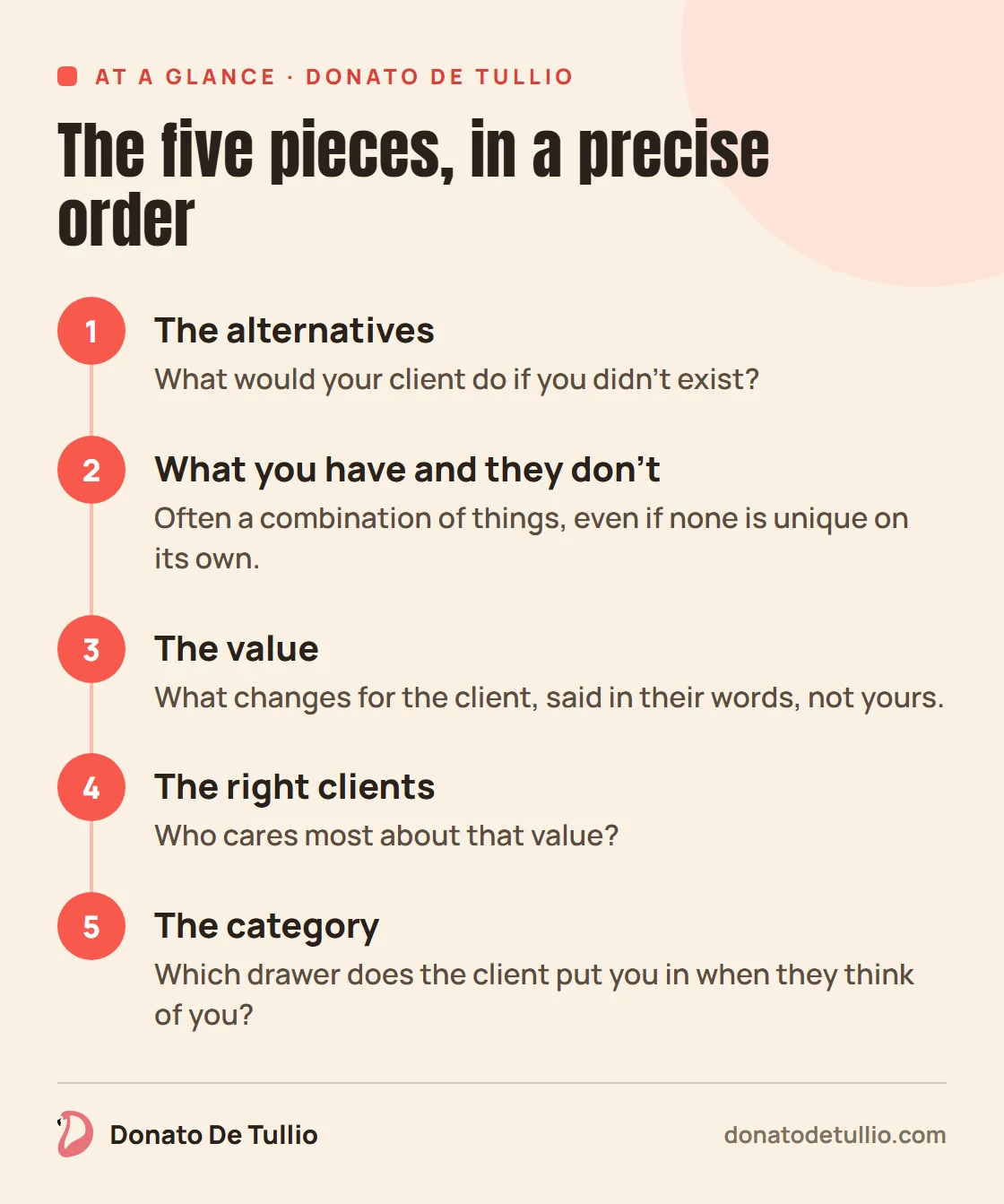
The clearest method I know is April Dunford's, from her book “Obviously Awesome”. She works with software companies. I use it with people who make a living from their expertise, where the company is often you. There are five pieces, and the order matters.
One, the alternatives. What would your client do if you didn't exist? Usually they don't pick a famous competitor. They call a colleague who costs less, try to do it themselves, ask ChatGPT, or do nothing and keep the problem. You always start here, and from their point of view.
Two, what you have and they don't. A piece of your career, a way of working, an experience that seems normal to you. Often the difference lies in a combination of things, even if none of them is unique on its own. Good people usually don't see it, because they look at it from inside the trade, where everybody can do it.
Three, the value. What changes for the client thanks to those things? It has to be said in their words, not yours. “I have a method” is your sentence. “My work gets approved on the first round” is theirs.
Four, the right clients. Who cares most about that value? A specific group of people who get it right away and pay for it gladly. They are the ones who choose you without needing to be convinced, and who stay.
Five, the category. Which drawer does the client put you in when they think of you? This is the piece that decides who they compare you with, and so also how much they are willing to pay you.
Do you need to invent a new category to stand out?
No. Inventing a category nobody knows looks like the fastest way to seem unique. In practice it forces the client to learn a new word before they even understand what you do, and usually they don't feel like it.
Go back to the bike scene. We gave the Germans something to hold on to that they already had in mind, and from there they trusted us.
Your business works the same way. Pick a category the client already knows, and inside it take a precise sub-niche. The client understands right away where to put you, and at the same time sees that you are different from the others in the same drawer. If you want a simple way to narrow it down, try the 3 Ps of positioning.
What does a strategic positioning look like, filled in from start to finish?
Let me give you an example. It's made up, and the names are fictional.
Giulia is a translator with an engineering degree. She has been working for years, she has clients and word of mouth, and yet people always compare her on price per word. Let's line up her five pieces.
The alternatives. A big translation agency, or machine translation with someone in the office who checks it afterwards.
What she has. She understands drawings and machines, because she studied them. The agency usually doesn't, and neither does the machine.
The value. The translated manual doesn't come back full of corrections, and the client delivers the machine on time.
The right clients. Small companies that build machinery and sell it abroad, with nobody in house who knows the language of that country well.
The category. Technical translation, which the client already knows. Inside it, a precise sub-niche: machine manuals for exporters.
Only now does Giulia write the sentence. “I translate machine manuals for small companies that export, and the manual doesn't come back.” It holds up because there are four decisions already made underneath it. Without them it would be just another slogan.
That's why the sentence comes last. If you start there, you write something nice that takes you nowhere. If you get there at the end, it almost writes itself. You'll find how to work on it in positioning statement.
How do you decide your positioning in the market, and how do you test it?
On paper the five pieces are clear. Then you sit down to choose them and you freeze, because every choice feels like a door closing. Between the book and practice there is a gap, and you only fill it by trying and measuring.
Positioning works the same way. For me it is a crossroads, and a crossroads is decided with a method. I use the 5D Method, which starts from the data and gets to what you really want to do. Desire matters, because you can't hold on for long to a positioning you don't like.
Then you take it outside. You use it when you introduce yourself and when you write a quote, and you watch what happens. Before you start, you set four numbers of your own, in plain words: how much you spend to find a client, how many you close, how much they pay you, how many stay. After a few months you read them again. If they move in the right direction, you decided well. If not, you check the five pieces again, starting from the alternatives.
This is the work we do in Position Lab, in practice and with real people. If you want to understand why it's harder for people who are good at what they do, also read positioning for people who make a living from their expertise.
Five questions about your last three clients
Take a sheet of paper. Think of the last three clients who chose you gladly and stayed. Then answer these questions, in order.
- If I hadn't been there, what would they have done?
- What did I have that the alternative didn't?
- What changed for them, in their own words?
- What do these clients have in common?
- Which drawer did they put me in when they recommended me to someone?
If you can't answer the first question, stop there. It's the piece that is missing most often, and everything else depends on it. Leave the sentence alone for now.
Positioning is a form of delegation. When the five pieces are decided and tested, the market understands who you are even when you're not in the room, and you go back to being the strategist, not the hired hand of your own business. If you want to see how it applies to your work, let's grab an espresso together: a free thirty-minute conversation to get to know each other. It's the first step of Position Lab.
Frequently asked questions
What is market positioning?
It's the place you hold in the mind of the right client when they compare you with their alternatives. If you make a living from your expertise, it depends more on how buyers see you than on how good you are. You decide it in five pieces, and the sentence comes last.
What is the difference between positioning and marketing?
Positioning decides what you sell, to whom, and which drawer the client puts you in. Marketing amplifies what you have decided. If you do marketing first, you amplify a confused message and often spend without seeing results.
How long does it take to decide your positioning?
Lining up the five pieces takes weeks of real work, not an afternoon. Then it takes a few months to test them in the market and read your numbers again. After that you check again, because clients and alternatives change.
Can I have AI write my positioning?
AI writes you a sentence in ten seconds, and that's exactly why everybody has that sentence now. It can help you put your ideas in order, if you give it your context. But the decisions on the five pieces stay yours, and they need to be tested with real clients.