If your business lives on your expertise, positioning in the age of AI starts from one fact. Artificial intelligence has raised the average, and clean copy, tidy websites and well-written sentences are now things everyone has. AI writes the line “I help X do Y” in ten seconds, so on its own it no longer sets you apart. What's left for you is the work that can't be copied: deciding what you sell and to whom, giving your context and testing it with real clients.
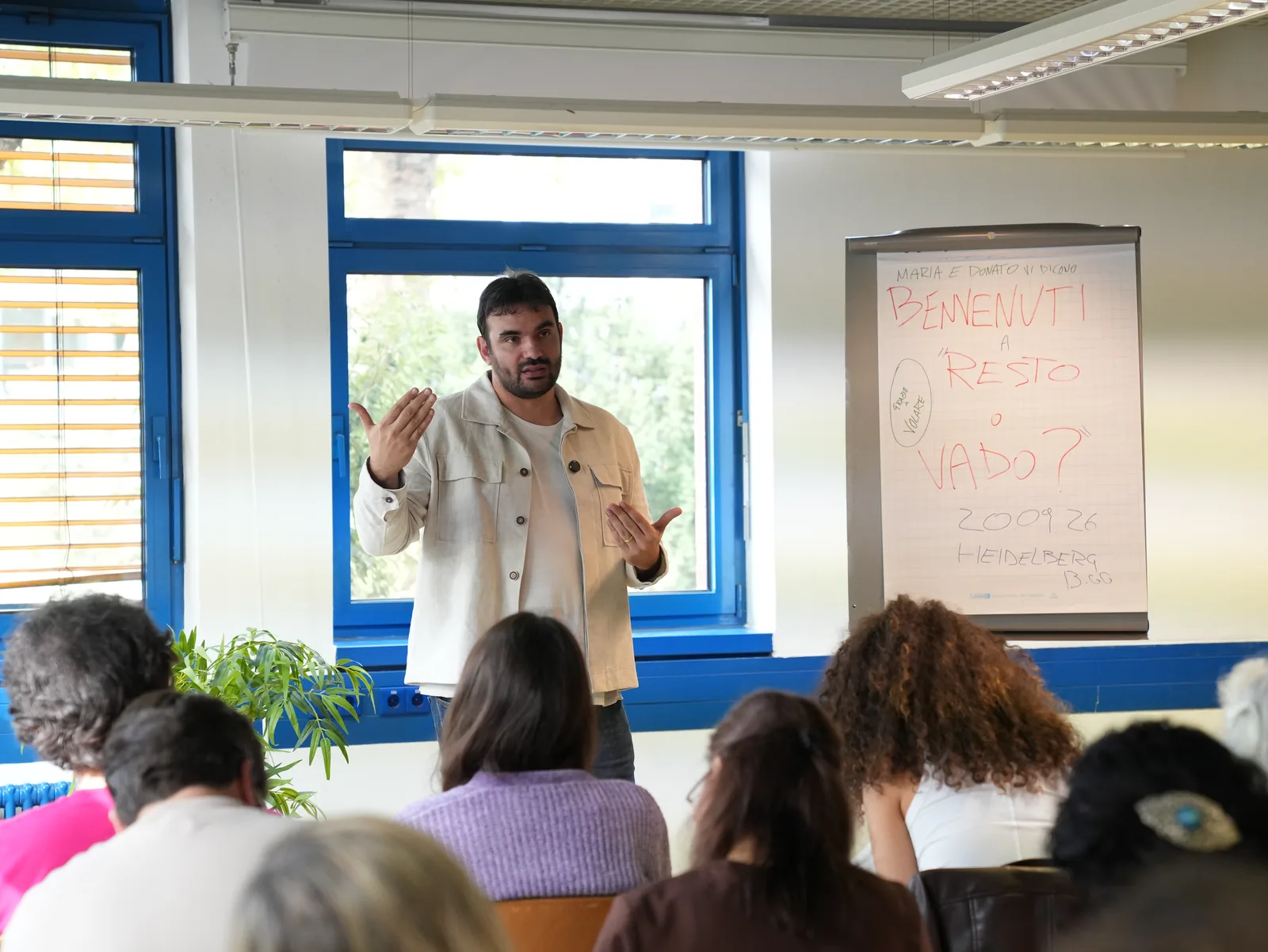
Let me share an image I use often. It comes from my PhD in chemistry, done with Merck.
Chemistry, in the books, is crystal clear. You study, you understand, you pass the exam. Then you walk into the lab, you have the test tubes in front of you, and you can't apply anything you studied. In between there's a gap, and it only fills up by working with your hands. You make a hypothesis, you try it, you measure, and you start again.
The same thing happens with positioning, and AI has made that gap wider. Today it explains the theory to you in a minute, and writes the sentence in ten seconds. The test tubes, though, stay on the bench, and they're your job.
If you live on your expertise, maybe you already feel it. “I do marketing but it doesn't work.” “People tell me I'm good, but then they don't buy.”
What is positioning in the age of AI, in one line?
I, Donato De Tullio, define it like this: positioning in the age of AI means deciding what you sell and to whom, and making it understood, in a market where writing well no longer sets anyone apart.
Brand positioning is the place you hold in the right client's mind when they put you next to their alternatives. I explained how to build it piece by piece in market positioning. April Dunford, in her book “Obviously Awesome”, describes it as the context that helps the client understand who they are comparing you with and who you're for. The slogan comes later, and it's the easy part.
Why has AI raised the average, and what changes for people who are good?
Think of it like school, with grades from one to ten. Before, the average was five. People who were good stood above it almost without noticing, because many wrote badly, had an old website and answered late.
Today, with AI, the average is seven. Anyone can produce clean copy or a tidy page in an afternoon. What used to make you look like a serious professional is now something everyone has.
Research points the same way. Erik Brynjolfsson, Danielle Li and Lindsey Raymond, in 2023, followed people in a customer service team using an AI assistant, and the less experienced ones improved much more than those who were already good. AI shortens the distance between those below and those above.
For you, with the potential to stand above, the difference is still there. It's just less visible from the outside than before. And now you have to make it understood better.
Why is the line “I help X do Y” no longer enough?
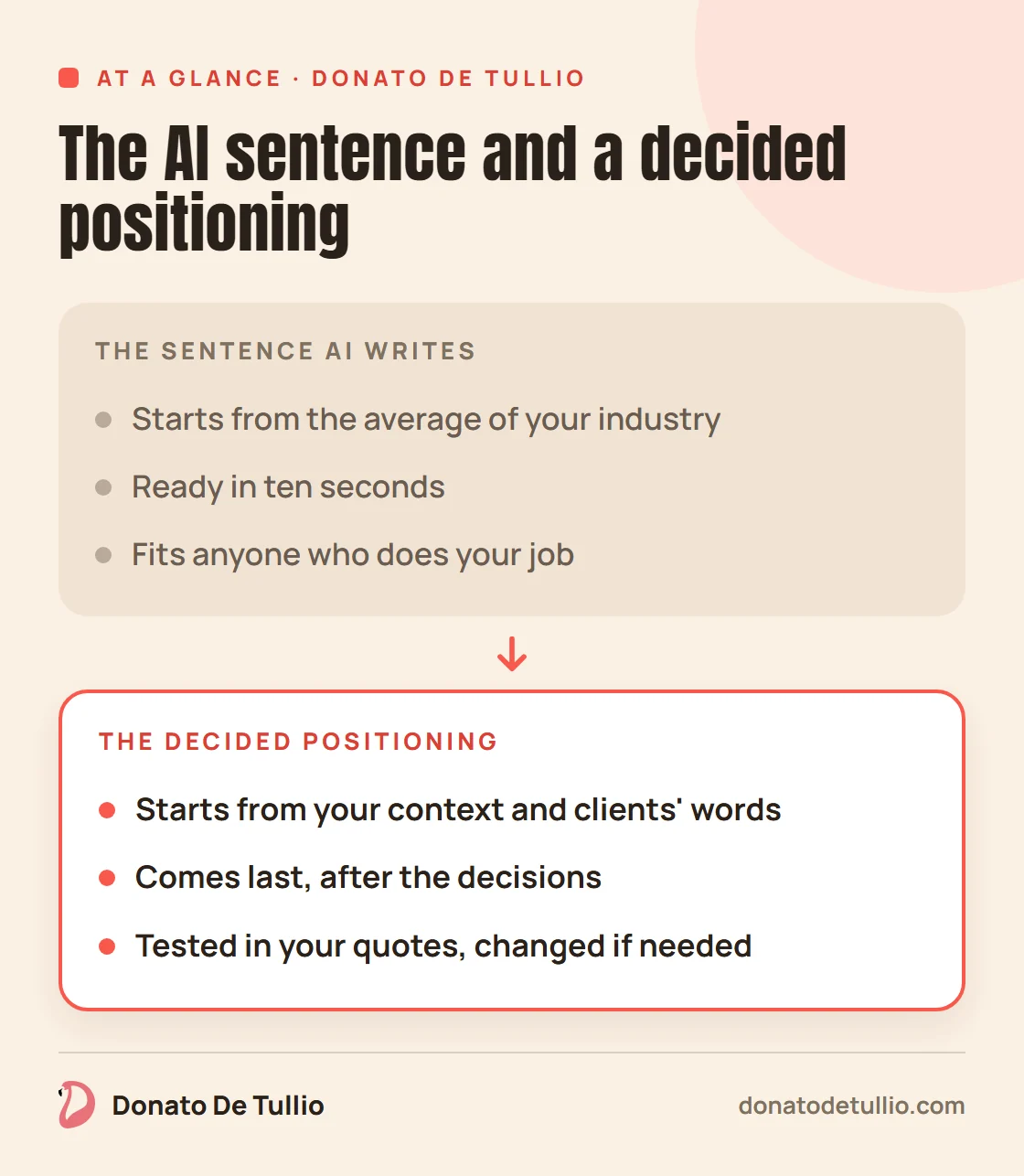
Try this. Ask ChatGPT for a positioning statement for someone who does your job. It will answer with something like “I help small businesses grow with tailor-made solutions and a personalised approach”. Beautifully written, and the same as a thousand others.
AI works on the average of what it has read. If you ask it who you are without telling it anything about yourself, it gives you back the average of your industry, and many websites today look as if the same person wrote them.
The formula “I help [who] to [solve what]” is still useful. I use it as the start of the journey, a hypothesis that gives you a first bit of clarity. Then you test it with real clients, and if needed you change it. The trouble starts when you mistake it for finished positioning.
Positioning is much more than writing a sentence. You understand, you decide, you take it outside and you test it on the market. The sentence comes last, and that's why I call it a lab.
AI marketing: what can artificial intelligence not do for you?
Using artificial intelligence in marketing is great for drafts and copy that needs polishing. In positioning, though, four things stay with you.
- Deciding. Who to say no to, and which problem you want to be remembered for. If you get it wrong, the bill comes to you, not to the machine.
- Giving your context. AI works when you give it the right context, like your clients' exact words. Without it, it makes you write like everyone else.
- Taking it outside and testing it. A sentence on a sheet of paper tells you nothing. The client tells you, by listening, nodding, and then buying or not.
- Checking it again. Positioning is a crossroads. You decide it with a method, you test it, and after a few months you look at the numbers and question it again.
I separated the work to hand to AI from the decisions to keep for yourself in AI for business owners.
There's also a reason why people who are good now struggle more to stand out. You look at your skill from inside the craft, where all your colleagues can do it too. It seems normal to you, sometimes luck. I often put it this way. “If you think you've been lucky, you're not looking at your own strengths.”
Then there's the curse of knowledge. You know so much that you speak in the words of the trade, and the people buying can't follow you. Before, you got by anyway, because the average was low. Now the client lines you up with the others, looks at the price, and along come the “they don't pay me what I'm worth”.
I call it the expertise trap. You got there through skill, and skill alone is no longer enough to get you chosen. Standing out from the competition today comes from what you decide and what you can prove.
What does a decided positioning look like, next to the AI sentence?
A made-up example, with fictional names.
Elena is an architect. She has been working for years and word of mouth works, but she often loses quotes to people who cost less.
She asks AI for her sentence and gets this. “I help families and businesses transform their spaces with tailor-made projects, from idea to handover.” It fits any architect in Italy.
Then she works on her context. Without her, her clients would call the building company that also does the design. She, instead, over the years has handled almost only renovations with the family still living in the house, and she knows how to organise the site room by room. She rereads the messages from happy clients and always finds the same sentence, “we didn't have to move out”.
Only now does she write the hypothesis. “I renovate your home while you live in it, room by room, without making you move out.” Then she takes it into her next quotes and watches whether the people listening react differently. If nothing happens, she changes it.
The first sentence was written by AI in ten seconds. The second was written by Elena after she had decided.
How do you know if positioning works with new clients?
With your own numbers, set at the start and reread after a few months. There are four, always in this order. They pay you fairly, you close more, you spend less to find clients, they stay.
They remain your numbers, never a promise. They help you see whether the decision holds up on the market, and if nothing has moved after a few months you go back to the crossroads. To me, client acquisition means getting chosen by the right ones and keeping them.
All of this comes before marketing. Marketing amplifies what already exists, and if what exists is the average sentence written by AI, you amplify the average and pay for it.
The ten-second test
You need a sheet of paper, a pen and a chat with AI.
First. Ask AI: “Write the positioning statement of a [your job]”. Copy it onto the sheet.
Second. Below it, copy the sentence you use to introduce yourself today, exactly as it is on your website.
Third. Circle the words that appear in both. “Tailor-made”, “personalised”, “quality”, “experience”, “360 degrees”. Count them.
Fourth. Next to each circled word, write something only you can prove. A fact from your story, or a sentence a client said in their own words.
If there are more than two circled words, anyone could have written your sentence. You've found where to start, and you need a decision before a new sentence. It's the work we do in Position Lab, where I work as a sparring partner.
Why a decided positioning keeps working when you're not in the room is in the article on market positioning. If you want to see how it applies to your business, let's grab an espresso together: a free thirty-minute conversation to get to know each other. It's the first step of Position Lab.
Frequently asked questions
What is positioning in the age of AI?
It means deciding what you sell and to whom, and making it understood, in a market where writing well no longer sets anyone apart. AI has raised the average, and clean copy and websites are things everyone has. What's left for you is the part that can't be copied: your decisions, your context and testing with real clients.
Can I have ChatGPT write my positioning?
You can get help writing the sentence, once you've decided. If you ask it who you are without giving it your context, it gives you back the average of your industry. The sentence comes last, after the decisions and the tests with clients.
Why do good professionals struggle more to stand out with AI?
Before, the average was low and skill was noticed almost by itself. Today AI has raised the average, and from the outside the difference is less visible. Those with the potential to stand above have to make it understood better, with words and proof only they have.
How can I tell if my positioning is the same as everyone else's?
Do the ten-second test. Ask AI for the sentence for your job, put it next to yours and circle the words they share. If there are more than two, anyone could have written your sentence, and the work starts from the decisions.