If you always put off the same things, the problem usually sits before the task. Underneath there is a decision you have not made yet, and as long as that is missing the task cannot be done well, so you move it to the following week. To stop putting things off you need to find that decision, write it down with a date and make the first move by tomorrow. More willpower is not what you need.
Let me tell you a scene. It is made up, but if you run your own business I bet you recognise it.
Monday morning, coffee still hot, you open your notebook and write the list for the week. To save time you copy the items left over from Friday's page. Fix the website. Review the price list. Call back that client who always pays late. Write the new presentation.
Then a doubt creeps in and you leaf back. The same four items were there a month ago too. And two months ago. The handwriting changes, the colour of the pen changes, the items stay the same.
Meanwhile you have worked an enormous amount. You delivered, you answered everyone. Other people's things, you did all of them. Yours are still in the notebook.
Why do I keep putting off the same things?
If you ask yourself this question, the first answer you give is almost always the same. I have no time. Or, on the days when you are harder on yourself, I am lazy.
Look at your week, though. People who work for themselves and put things off are usually not sitting idle. They work ten hours, answer messages in the evening, do hard things for clients without blinking. Effort does not scare them.
So the point lies somewhere else. The things you put off once are boring tasks, and sooner or later you do them. The things you always put off, week after week, have something different inside. The fact that they keep coming back is already a piece of information, and it is worth reading.
I have written at length about procrastination, and why you put things off even when you know what to do. Here I want to look at something more precise, the list that gets copied out unchanged.
What is underneath the things you have been putting off for months?
Take one of the items that keep coming back and try to do it now, in your head. “Review the price list.” You sit down, open the price sheet, and after two minutes you stop. Because before writing a number you would need to know who you want to sell to, which service you want to push and which one you would like to let die.
The block is all here. The task looks small, but to do it well it asks you to decide something big. And since that big thing is not on the list, the task stays there and you move it.
The same happens with the other items. “Call back the client who pays late” is really asking you to decide whether you still want that client. “Write the new presentation” is asking you to decide what you want people to understand about you in one minute.
From the outside you look like someone who never finds the right hour. From the inside you are facing a decision that looks like a task. You would find the hours, if the decision were already made.
Why do you put off the website, the profile, the presentation in particular?
I say this as someone who sees it often. Among the things experienced people put off most, there are almost always the ones that talk about them. The website to redo, the text that explains what you do.
The reason is simple, even if it is not pleasant. To write the first line of your page you need to have decided who you work for and what you give up. If that choice is missing, every sentence feels wrong, because in fact it is. It speaks to everyone, so it reaches no one.
That is why I often repeat that before marketing there is a decision. You can change the design or try another social network. If the decision underneath is not there, you end up with a prettier website that says the same vague things as before. You are better than you look from the outside, but from the outside nobody notices.
I have been through it myself. For more than ten years I worked in European multinationals, and today I run the logistics of eight centres. Deciding fast is part of my job. And yet on my own things, the ones that said who I am and who I work for, I stayed stuck for a long time inside the trap of day-to-day operations. I did everything, except the one thing that would have changed the rest.
What does always putting things off cost you, even if you do not see it?
The most obvious cost is the time lost. But that is the least serious one.
The real cost is the weight you carry around. Bluma Zeigarnik, a psychologist working in Berlin, published experiments in 1927 showing that things left half done stay in the mind longer than things finished. Much later, in 2011, two American researchers, E. J. Masicampo and Roy Baumeister, observed something that matters a great deal to anyone who puts things off. In the laboratory, when people wrote a precise plan for a pending goal, that thought stopped disturbing them while they did other things. These are small experiments, and later studies do not all agree, so take them as a clue. But the clue points in the right direction.
Translated into your work, every item that gets copied out again steals a small piece of your attention every day. You do not do it, but you think about it. In the shower, or on Sunday evening.
Then there is the cost to the business. A frozen price list means working at the same price as years ago. The client who pays late takes the place of a better one. The vague website brings in the wrong enquiries, which you then spend your time handling. The business stays as it is, and you keep running to hold it up.
How to stop putting things off: find the decision under the list
You need a sheet of paper, a pen and your list for this week. If you do not have a list, open your calendar or the notes on your phone and look at what you have written down in the last few weeks.
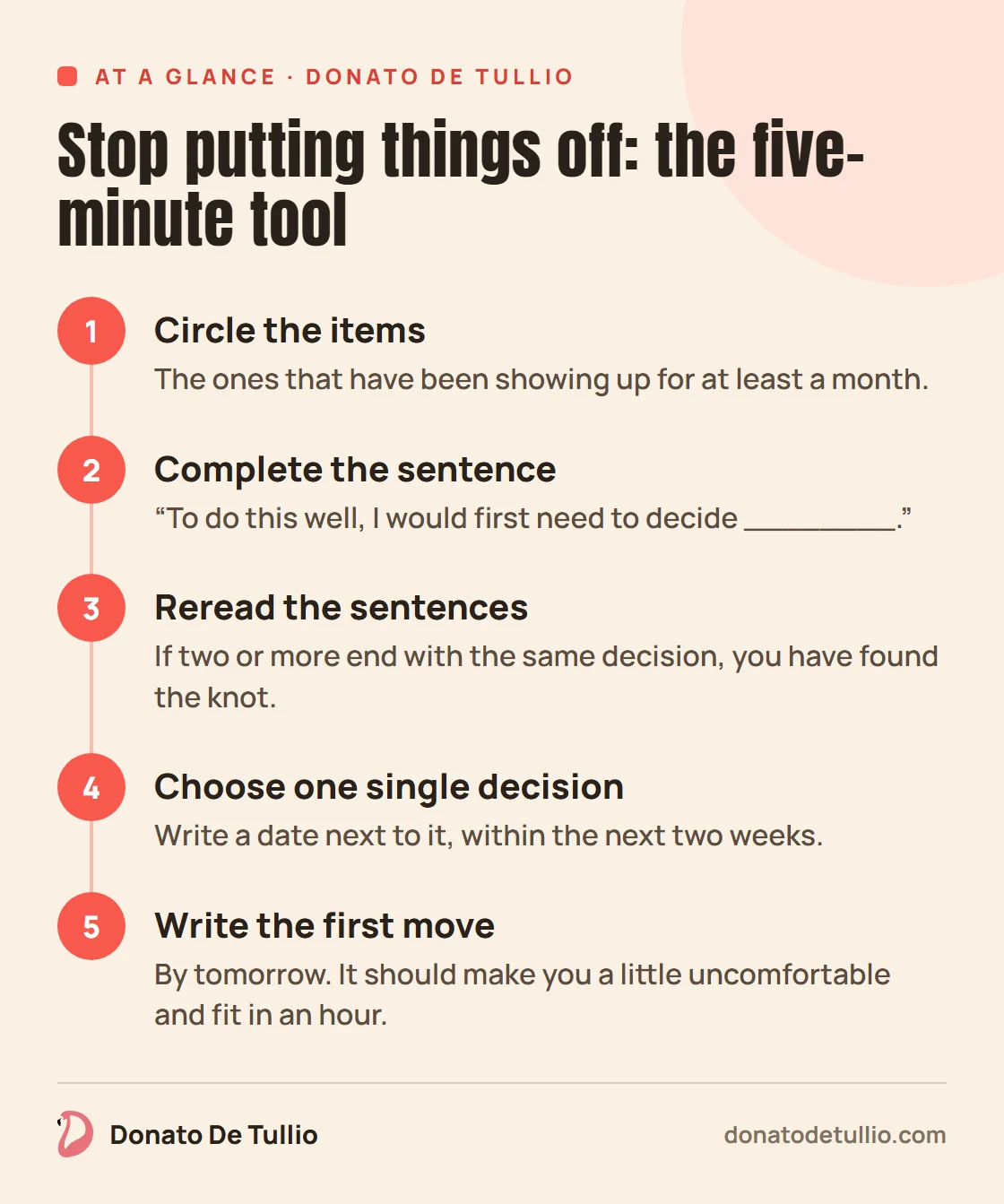
- Circle the items that have been showing up for at least a month. There are usually few of them, and you recognise them straight away.
- Next to each one complete this sentence. “To do this well, I would first need to decide ________.”
- Reread the sentences. If two or more end with the same decision, you have found the knot.
- Choose one single decision and write a date next to it, within the next two weeks.
- Write the first move you can make by tomorrow. It should make you a little uncomfortable and fit in an hour.
Done. Five minutes, if you are honest with yourself.
Often there is a small surprise. Four or five different items come down to one or two decisions. The website, the price list and the presentation were all waiting for the same answer, that is, who you work for. And the client who pays late was waiting for an answer you probably already know.
One rule only, while you do it. Do not write “decide what to do”. It is too broad, and it ends up on next Monday's list. Write a decision that has a yes and a no, like “decide whether I keep hourly consulting”.
And then, with the decision you chose, what do I do?
Now you have a decision with a date and a first move for tomorrow. Make that move first, in the morning, before opening your email. If you wait for the afternoon, someone else fills your day.
If you notice that everything feels urgent and the move never finds room, the question becomes how to set priorities when everything seems urgent. One way is to defend one single thing per week.
If instead the decision you found is a big one, the kind that keeps you awake, do not tackle it by brooding. For hard decisions I use a method that starts from the facts and leaves the fears in another column.
If you want to find, with me, the decision that is holding your list still, let's have a thirty-minute coffee. That decision is often where to stand in the mind of the people who should choose you, which is what market positioning is about. That is where Decision Lab begins: half a day of work on one decision.
Frequently asked questions
Why do I keep putting off the same things even though I work so much?
Because the things you always put off are rarely just boring tasks. Almost always they hide a decision you have not made yet, and without it the task cannot be done well. Working hard on other people's things is the most comfortable way of not looking at it.
Is putting things off a sign of laziness?
Usually not, especially if you work for yourself. The person who always puts off the same things is often the one who works the most. They put off the items that ask them to choose, and in the meantime they do everything else with great commitment.
How do you stop putting things off?
Circle the items you have been copying onto your list for at least a month and write next to each one which decision you would need to make first. Choose one, give it a date and make the first move by tomorrow. Willpower is of little use if the decision underneath stays open.
Why do I put off the website and my own presentation in particular?
Because to write them you need to have decided who you work for and what you give up. If that choice is missing, every sentence feels wrong and the work stops. Before marketing there is a decision, and the website is waiting for that one.