If you work for yourself and keep procrastinating, laziness rarely has anything to do with it. Almost always you are avoiding a decision, and dressing it up as a lack of time. Stopping procrastination takes less discipline than you think. What you need is to give the hidden decision a name and, by tomorrow, make the first move that makes you a little uncomfortable.
The message had been ready for three weeks. Two hundred words to pitch myself to a company I had wanted to work with for months. I had the right contact, and the right service too. Every morning I opened the draft, changed a comma, closed it again. “I have calls today, I'll send it tomorrow.” And tomorrow there were the invoices, and the day after a document to finish. Three weeks like that.
What stung was the comparison. For more than ten years I have worked in European multinationals, and today I run the logistics of eight centres. Shifts, trucks, yards full at six in the morning, people waiting for an answer. There, deciding is my job. And that same guy, in front of two hundred words with his name at the bottom, could not press send.
So I did what I do with anything I don't understand. I stopped judging it and started measuring it. For two weeks I wrote down everything I was putting off, with the excuse I told myself next to it. By the end of the list the script was so clear that I felt stupid for not having seen it before.
Why do I know what to do and still not do it?
My list had two families of entries. The first were boring but clear tasks. The invoices, an insurance form, the computer backup. Those I put off for a few days, then I did them, and that was that.
The second family was different. The message to the company. My prices, unchanged since I started. A service I kept offering even though I knew, numbers in hand, that it didn't pay. These entries I wasn't putting off for days, I was putting them off for months. And they all had the same thing inside, an uncertain outcome that was about me.
The message could get a no. The new prices could make a long-standing client frown. Closing the service meant admitting I was keeping it alive out of affection, more than out of calculation.
When you say “I know what to do but I don't do it”, it is usually half true. You know what should be done. What is missing is the decision to accept what can happen afterwards.
What is procrastination from an avoided decision?
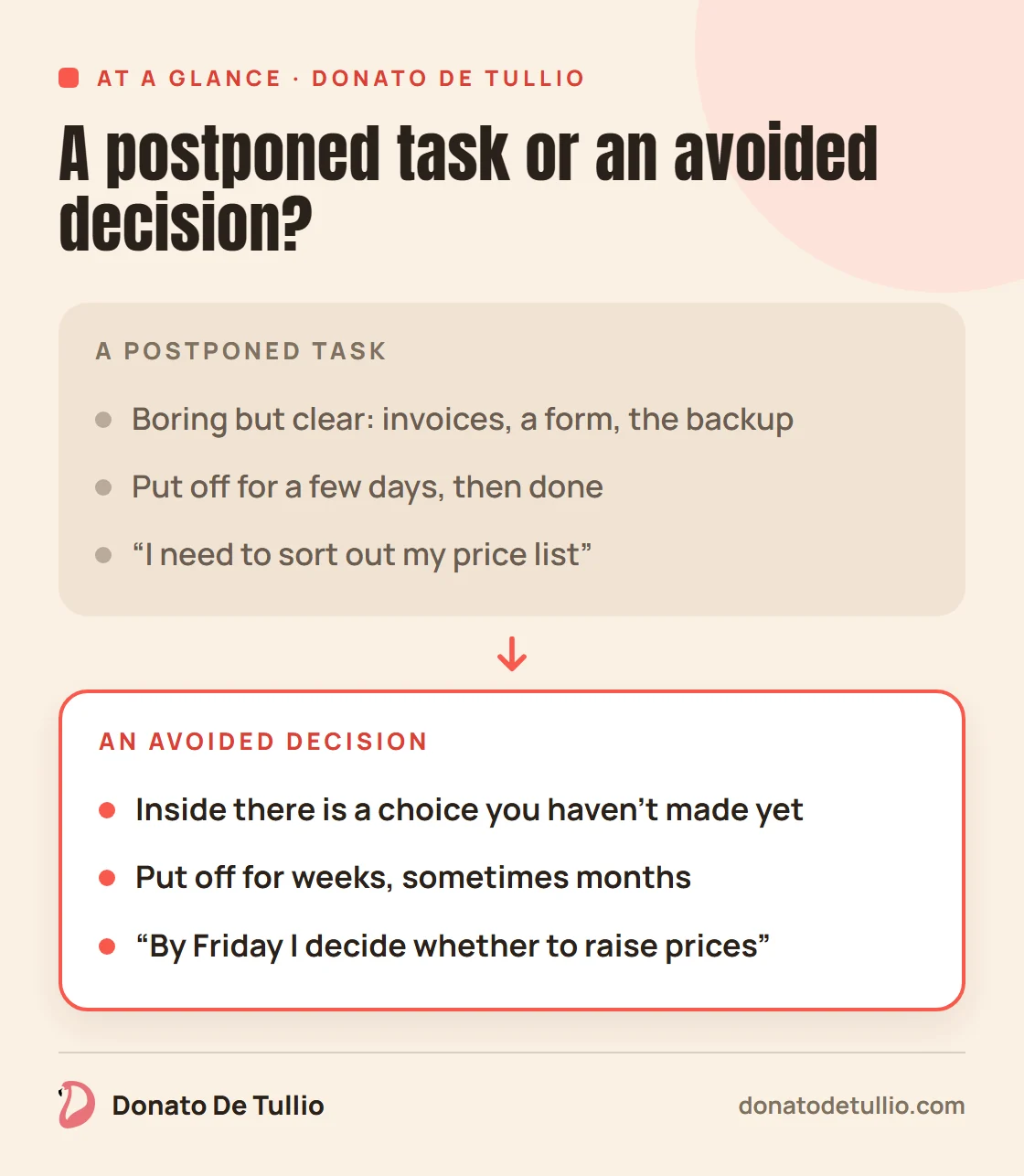
There is more than one kind of procrastination. There is the boring-task kind, which sooner or later you clear because you have no alternative. And then there is the kind that really weighs on you if you run your own business. I call it procrastination from an avoided decision.
The task looks like any other task. “I need to sort out my price list.” “I need to write to that company.” Inside, though, there is a choice you haven't made yet. And as long as the choice sits there, the task doesn't start. You recognise it from a few signs.
- You have been putting it off for weeks, sometimes months, each time with a different excuse.
- You circle around it with little preparation jobs (you reread, you tidy up, you look for one more piece of information).
- In the evening, when you think about it, you feel a small weight in your stomach.
- When someone asks how it's going, you answer “I'm working on it”.
The disguise holds up very well, because you really are short of time. There is always something urgent to fill the gap. Except that you are the one who chooses what is urgent. And, funnily enough, you always choose the things that can't say no to you.
If instead you feel you can't decide anything at all, the story changes a little, and I write about it in another piece, “I can't decide”. Here we are talking about one decision. The one you know perfectly well.
What does the research say about people who procrastinate?
Piers Steel, a psychologist who teaches in Canada, in 2007 pulled together hundreds of studies on procrastination and drew a kind of formula out of them. I am simplifying a lot, his is more refined. We put things off when the discomfort is near and certain, and the reward is far and uncertain.
The mind discounts future things, the way a bank discounts a promissory note. A new client in six months weighs little, if on the other side there is an embarrassment tonight.
Apply it to working for yourself and the sums add up. Raising your prices has the discomfort today (the email to clients, the risk that someone leaves) and the benefit months away. Pitching a company has the possible no right now and the contract who knows when. No boss sets you deadlines. And the decisions that make a business grow almost all have the cost now and the reward later.
One thing takes away some of the guilt. In Steel's formula laziness doesn't appear. And what I see, in myself and around me, is that people who procrastinate often work enormously hard. They put things off while working. They shift the effort onto a hundred safe tasks rather than touch the one uncertain thing.
Why, when you work for yourself, do you put off precisely the decisions that count?
Because nobody brings you the big decisions. Nobody calls you into a meeting to decide who to sell to, what to stop doing, how much to charge. And if nobody puts them on the agenda, everyday work covers them all.
I call it the operational trap, and I have been through it. I wrote about it in work on your business, not in it. The days are full, the clients are happy, and meanwhile the few choices that would change your year stay at the bottom of the list.
It happens often with marketing. You tell yourself you need to redo the website, write more, get yourself seen. And you put it off. Many times the reason is simple. Before marketing there is a decision, who you work for and what you give up, and until you have made it every post feels wrong. So you put off the post, and the choice underneath it you don't even see.
Is it a postponed task or an avoided decision?
The test I use, on myself and with the people I work with, starts from a question. What have you been putting off for more than a month? A real task, however hateful, you clear sooner or later. The paperwork gets done, the backup too. What survives a month of postponements almost always has a decision inside.
Then comes the second question. If tomorrow you had a completely empty day, would you do it? If the honest answer is “yes, finally”, yours is a diary problem, and you solve it with the diary. If the answer is “I would probably find something else to do”, time has nothing to do with it. You are avoiding an outcome, be it a no, a number you don't want to see or a client who is upset.
At that point call it by its name. “I need to sort out my price list” is a task, and it can wait forever without bothering you. “By Friday I decide whether to raise prices for long-standing clients” is a decision, with a yes, a no and a date. In my case the sentence was brutal, “I am avoiding finding out whether that company wants me”.
How do you stop procrastinating in five minutes?
Take a sheet of paper. Write down the things you have been putting off for more than a month, even just two or three. Next to each one complete the sentence “I am avoiding deciding whether...”.
Then reread the sentences out loud and choose the one that makes you most uncomfortable. Almost always it is the decision that counts.
Last step, write the first move. The right size is the one I use for everything. It has to make you a little uncomfortable and you have to be able to do it by tomorrow. If it doesn't make you uncomfortable, it is too small to teach you anything. If it doesn't fit inside tomorrow, it is too big and will end up like the rest.
The decisions that come out of there deserve a proper process. I use the 5D Method, which starts from the data precisely so that fear doesn't get the last word.
How did it end with the message?
I sent it on a Thursday morning, at twenty past eight, before opening anything else. The reply came four days later. A no, a polite one, but a no. And here I should tell you that they later changed their minds and called me back. It didn't happen.
And yet that week was one of the best of my year. Along with the message I raised my prices and closed the service that didn't pay. Decisions avoided for months, closed in five days. And my head, I swear, weighed half as much.
If you have written more than one sentence starting with “I am avoiding deciding”, an article is not enough. More often than not, the decision you keep postponing is where to stand in the mind of the people who should choose you. Let's have a thirty-minute coffee and look at those sentences together. If it then makes sense to go on, there is Decision Lab, half a day of work with me on the decision you keep putting off. There, every postponed decision gets a date, and there is someone who asks you about it.
Frequently asked questions
Why do I procrastinate even when I know what to do?
Often because behind the task there is a decision you haven't made yet. You know what should be done, but you haven't decided whether to accept what can happen afterwards, like a no or an unhappy client. As long as the decision stays hidden, the task doesn't start.
What is procrastination from an avoided decision?
It is when you put off something that looks like a task, for example sorting out your price list or writing to a company, but inside it there is a choice with an uncertain outcome. You recognise it because it has lasted more than a month and the excuse changes every time.
How do you stop procrastinating when you work for yourself?
Write down what you have been putting off for more than a month and, next to it, the sentence “I am avoiding deciding whether...”. Choose the entry that makes you most uncomfortable and set a first move to make by tomorrow. The name you give the decision matters more than discipline.
Does procrastinating mean being lazy?
Almost never, for people who work for themselves. Those who procrastinate often work enormously hard and fill their days with safe tasks. They put off precisely the few things that have an uncertain outcome and that are about them.