The short answer: if your business lives on your expertise, the right buyer persona is not something you make up at a desk. It is the portrait of your ideal customer, the person for whom your work is worth the most and whom you are happy to work with, and you find it among the clients who have already chosen you. Look at who bought gladly and stayed, ask them three questions and write down their answers in their own words.
Someone asks you what clients you have and you start listing them. A big company, a private person, the one who called you for a small job, the one who has been with you for years. Halfway through you stop, because you notice there is no common thread. Almost all of them pay you, and lined up together they look like the clients of five different people.
As long as the work keeps coming, it feels like luck. Then you try to write two lines for your website, or to explain to a friend who they should send your way, and nothing comes out. Or what comes out is a sentence anyone could say.
Meanwhile a thought keeps going round in your head that you tell no one. “I’m better than the people who get the clients I want.” It may even be true. But they make themselves understood, and you don’t.
What is a buyer persona, and how is it different from your ideal customer?
Your ideal customer is someone who has a specific problem, feels it right now, and for whom your way of working is the right one. You need two things at once. For them your work has to be worth a lot, and for you working with them has to be worth the effort.
The buyer persona is their written portrait. For me, Donato De Tullio, a buyer persona is the description of a real client who has already chosen you, with the moment they went looking for you and the words they use to describe you.
Forget the profiles with age, hobbies and favourite magazine. What you need to know is what was happening on the day they went looking for you. Stop at two or three profiles and give each one a first name. With a name in front of you, you know who you are writing for, and you stop writing for “businesses”.
Why is a buyer persona written by AI no longer enough?
Today you ask an AI “write me my customer’s buyer persona” and in ten seconds you have a clean profile, with a name, a job, fears and dreams. It looks perfect. The problem is that it describes someone who might exist, and it writes the same one for you and for your competitors.
With AI the average has gone up. If the average used to be five on a scale from one to ten, today it is seven. People who have the potential to stand above it now have to make that clearer, and a generic profile won’t do it. You stay unique in your work and identical in the market.
What AI doesn’t have is your clients, their words and the reason they chose you. That is the part that sets you apart, and you have to get it from them.
Why do skilled people struggle to say who they are talking to?
At the beginning you say yes to everyone, and you are right to. You can do many things, so every request seems within your reach. One client brings another who is not much like them. After a few years your work has the shape of whoever happened to pass by, and you are the person holding it together.
The problem has a name: the curse of knowledge. Once you know something, you can no longer imagine how people think without knowing it. The idea comes from a 1989 study by Camerer, Loewenstein and Weber, and the most famous example is a 1990 doctoral thesis by Elizabeth Newton at Stanford. People who tapped out the rhythm of a well-known song with their fingers thought about half of the listeners would recognise it. About 2.5 percent did.
The same happens at work. You hear the song, your reader hears only some taps. The things that seem obvious to you are often exactly the right things to say. You don’t say them because you worry what your peers would think, so you write to win their approval, while the people who buy are somewhere else and don’t understand. If you recognise yourself in “people tell me I’m good, but then they don’t buy”, you are talking to the wrong room, and your skill has little to do with it.
Why start from the clients who chose you, and not from the ones you lost?
Between 2016 and 2018 I opened and ran a Decathlon store in Schwetzingen, Germany, connected to the e-commerce warehouse. In that store I talked with hundreds, if not thousands, of customers, learning why they came, what they wanted to buy and how they bought.
Those are the three things I ask you to look at in your clients: why they came to you, what they really wanted and how they decided. You ask them of the people who walked in and bought.
April Dunford lists among the most common mistakes studying the deals you lost and never the ones you won. People who said no to you usually leave you an excuse, “it costs too much” or “I need to think about it”. People who said yes saw a precise value in you, and often they can name it better than you can.
To find out whether the buyer persona is the right one, look at your numbers again after a few months: how much clients pay you, how many you close, how much you spend to find them and how many stay. They are your own numbers, to be set at the start, so that later you have something to compare them with.
Which three questions should you ask the clients who chose you?
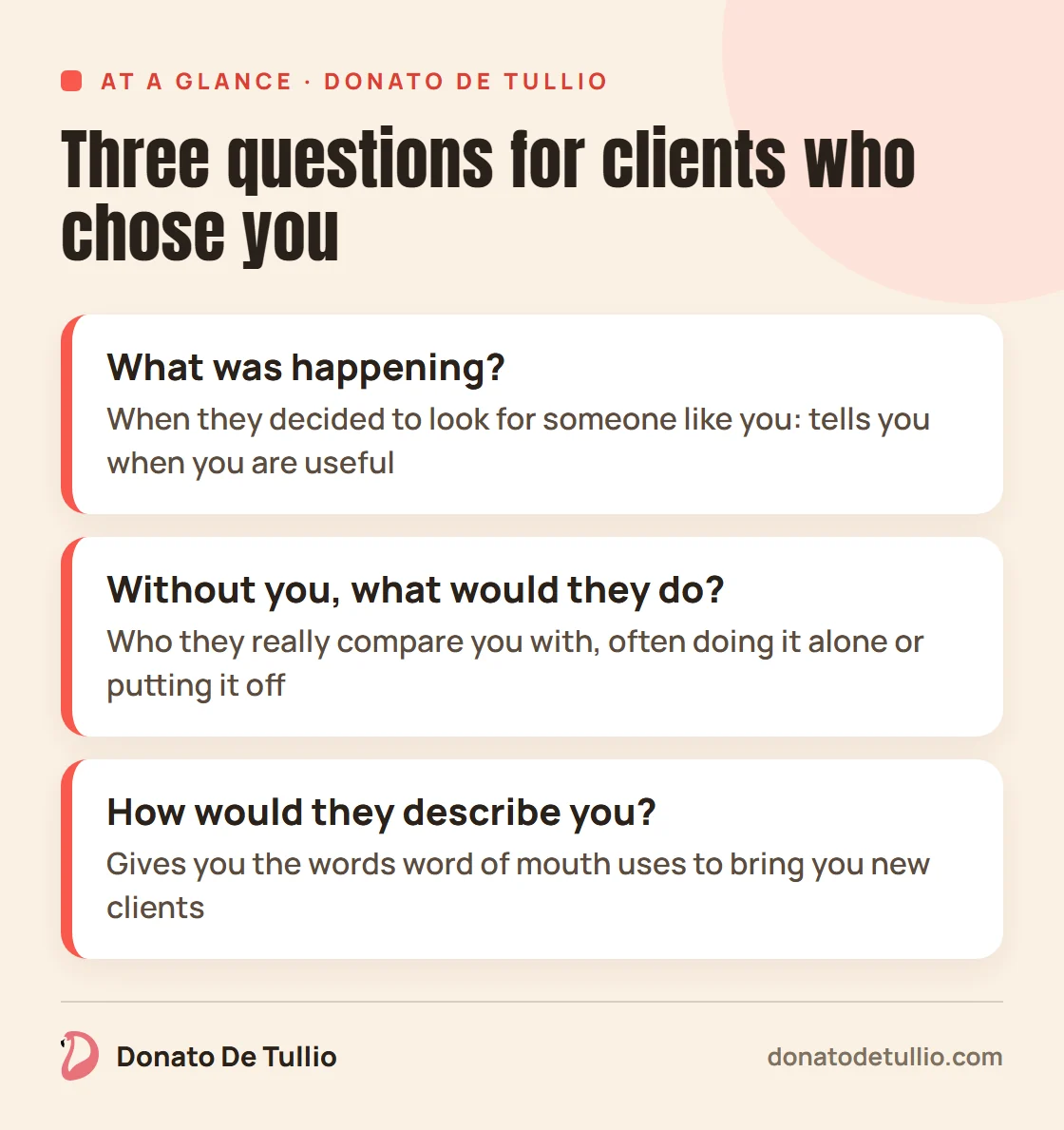
Pick three clients who bought gladly and stayed. Write to them, or better still call them, and ask these questions. Listen and write down the answers in their words, without correcting them.
- “What was happening when you decided to look for someone like me?” It tells you the moment, that is, when you are useful.
- “If I hadn’t been there, what would you have done?” It tells you who they really compare you with, which is often not a peer but doing it themselves, or putting it off.
- “How would you describe me to a friend who has the same problem?” It gives you the words that word of mouth uses to bring you new clients.
Often the reason they chose you is something you take for granted. That is exactly what to write down.
What does a finished buyer persona look like? An example
A made-up example, the names are invented. A workplace safety consultant writes “I support companies with safety”. She asks her best clients the three questions and sees that almost all of them were owners of small building firms, right after their first inspection report. Her buyer persona becomes this.
Marco, owner of a small building firm. He looked for me the week after his first inspection report, with the sheet still on the table. Without me he would have asked his accountant, or put it off until the next inspection. He describes me like this: “she’s the one who tells you what to do on Monday morning on site”.
The sentence on her website becomes “I support owners of small building firms who have just received their first inspection report”. To her peers it looks like very little. The owner with the report on the table thinks it is about him.
How do you build your buyer persona in five minutes, and how do you test it?
Take a sheet of paper and write down your last ten clients, one per line. Next to each one write the problem they came to you with, in the words they used. Then put a mark if you would do that job again tomorrow morning, and another mark if they understood the value without you having to defend it.
Circle the ones with two marks. Look at what those lines have in common, then complete this sentence: “I work with [who] when [what has just happened]”. It won’t come out pretty, and that’s fine. It is a hypothesis, to test with real clients and change if needed. If you don’t have a single line with two marks, that is an answer too, and maybe the most useful one on the sheet.
Use the sentence in your next five conversations and note what happens. Do they ask “and how does it work?”, or do they change the subject? If they ask to know more, refine it with the positioning statement and then with the value proposition.
Choosing a buyer persona usually doesn’t cost you clients, because you choose who you talk to, not who you accept. Ries and Trout wrote in 1981 that whoever tries to be everything to everyone takes no place in the mind of the person who has to choose. It is a strategic idea and not an experiment, so take it as a guide. The risk exists, the group can be too small, and that is why you test first. If your question is bigger, that is, which market to be in, start from how to choose a niche when you can do everything.
The buyer persona is one piece of brand positioning, the piece that says who you are for. You will find the rest in the guide to market positioning. With your clients you can see things they can’t see, and with yourself you can’t, because you are too close. That is the work we do in Position Lab, where I work as a sparring partner, and I promise you nothing about results.
Next time someone asks you what clients you have, try saying just one name.
The right clients have already told you who they are, and starting from them is the simplest way to get chosen by others like them and keep them. If you want to see how this applies to your business, let’s grab an espresso together: a free thirty-minute conversation. It is the first step of Position Lab.
Frequently asked questions
What is the difference between a buyer persona and an ideal customer?
Your ideal customer is the person for whom your work is worth the most and whom you are happy to work with. The buyer persona is their written portrait, with the moment they went looking for you and the words they use. You choose the first, and you write the second starting from the clients who have already chosen you.
How many buyer personas do you need when you work for yourself?
Two or three at most, each with a first name. If you have more, you are putting off the choice.
Should I turn down clients who are not ideal?
No. Your ideal customer decides who you talk to when you communicate. If a job outside the profile comes along and it suits you, you can take it. Over time you will see for yourself which ones to keep.
What if I can’t find a single ideal client among my clients?
It means the clients you want are not finding you yet, or that the work you do is no longer the work you want. In that case the first question is about you and your role.